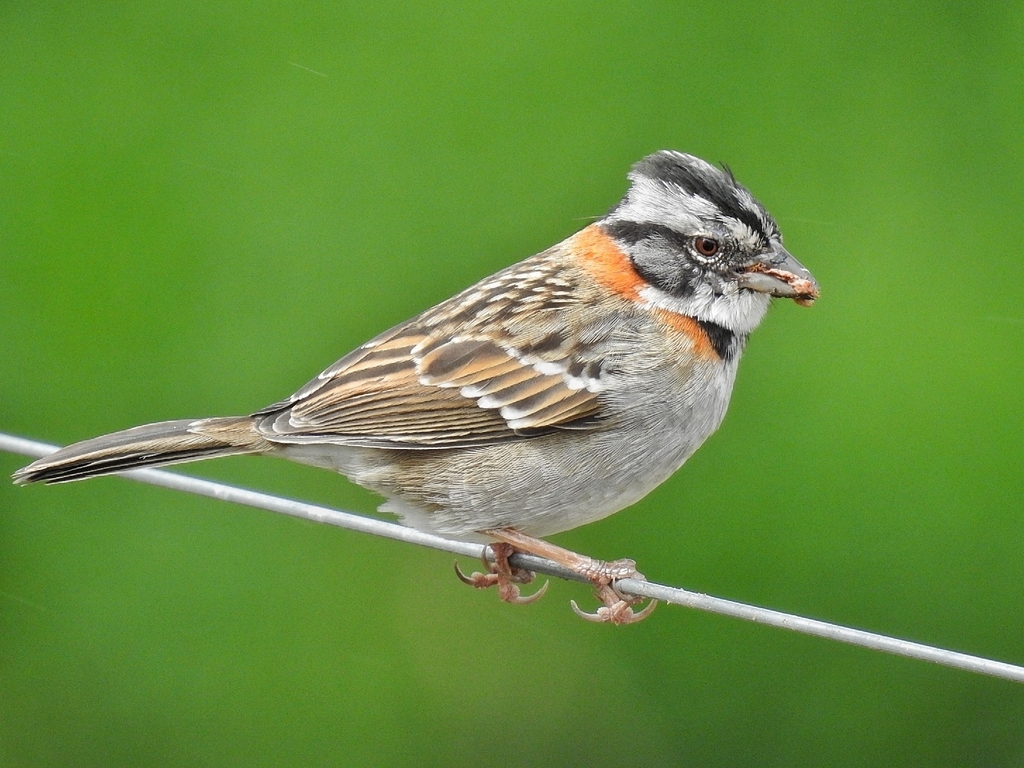
Rufous-collared Sparrow
Photo © Esteban Poveda
Photo © Esteban Poveda — CC BY 4.0 — Source: iNaturalist photo #112061150Identification
The rufous-collared sparrow is a compact bird, measuring 13.5–15 cm in length and weighing 20–25 g. Adults are distinctive with a grey head marked by bold black stripes along the crown sides and through the eye, contrasting with a white throat. The nape and breast sides are distinctly rufous, while the upperparts are black-streaked buff-brown with two white wing bars. The underparts are off-white with a black breast patch and brown flanking. Young birds are duller, lacking the rufous collar and showing streaked underparts with a buff ground colour. The species shows considerable geographic variation across its 27 subspecies, with size and coloration differing between coastal, Andean, and tepui populations.
Range & Habitat
This generally abundant species ranges from extreme south-east Mexico through Central and South America to Tierra del Fuego, with populations also present in the Caribbean, including Hispaniola and Aruba. In northern and western parts of its range, it typically occurs at 600–4,000 m elevation, while southern and eastern populations are found near sea level. The rufous-collared sparrow is remarkably adaptable, inhabiting open and semi-open environments including cultivations, gardens, parks, grasslands, scrubby second growth, and cerrado. It thrives in urban and suburban settings but avoids dense Amazonian forest. It is scarce on the Guiana Shield, occurring mainly on tepuis and in the Pakaraima Mountains.
Behaviour & Diet
This tame and approachable bird feeds on the ground, foraging for seeds, fallen grain, insects, and spiders, and has been observed picking termites from spider webs. It is usually encountered in pairs holding small territories or in small flocks, sometimes joining mixed-species feeding groups. The species has been intensely studied for its diverse vocalizations since the 1970s. Breeding is governed by food availability and rainfall patterns. Females construct open cup nests of plant material lined with fine grasses, placed low in vegetation, trees, or wall niches. Clutches consist of two or three pale greenish-blue eggs with reddish-brown blotches, incubated by the female for 12–14 days, with chicks fledging after approximately two weeks. Males assist in feeding young. Breeding failure from predation during incubation is frequent, though parasitism by shiny cowbirds may also occur.
Best Time & Places to See It
The rufous-collared sparrow is common throughout its vast range and not considered threatened. Being non-migratory and highly adaptable to human-modified landscapes, it can be encountered year-round in gardens, parks, agricultural areas, and open grasslands across suitable elevations. Look for it in the Andes, subtropical yungas of north-west Argentina, and highland regions of Mexico and Central America. The breeding season varies by location, tied to local rainfall patterns, making the wet season a particularly active time for observing nesting behaviour and vocalizations.
Photography Tips
The rufous-collared sparrow's approachable nature makes it excellent for photography. Look for the distinctive rufous nape and black breast patch in good lighting to capture field marks clearly. Early morning in open habitats—gardens, parks, and grasslands—offers the best opportunities. The bird's small size (5.25–6 inches) and ground-feeding behaviour mean a moderate telephoto lens is useful. During breeding season, patience near low vegetation may reward you with images of adults carrying nesting material or prey for chicks. The high-altitude and montane populations of the Andes offer dramatic landscape photography opportunities combined with sharp detail of the birds' striking head pattern.
Alerce Costero National Park
Antisana National Park
Araucárias National Park
Arenal Volcano National Park
Baritú National Park
Barra del Colorado National Wildlife Refuge
Brasília National Park
Braulio Carrillo National Park
Cabo de Hornos National Park
Nothing matches these filters.
No community photos yet. Log in to add the first one.
No community observations of this species yet.