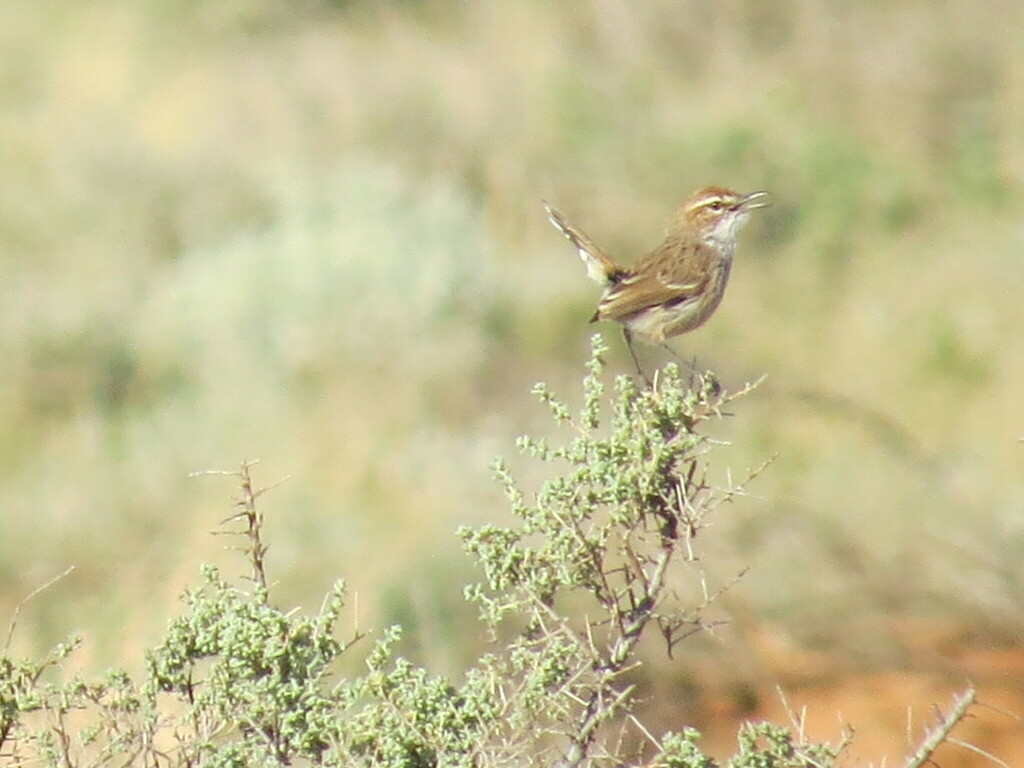
Rufous Fieldwren
Photo © ian_mcallan
Photo © ian_mcallan — CC BY 4.0 — Source: iNaturalist #205310810Identification
The Rufous Fieldwren is a small terrestrial songbird, measuring 11.5–13.5 cm in length with a wingspan of 15.5–19.5 cm. Eight subspecies occur across southern Australia, displaying considerable plumage variation. Most mainland populations show predominantly grey backs with a slight rufous wash and cream-toned underparts with dark striations. Island subspecies are paler, with grey upper parts and white underparts. The species is best distinguished from the similar Striated Fieldwren by its greyer upperparts, whiter underparts, and notably longer, finer decurved bill compared to the Striated's straighter, wedge-shaped bill.
Both sexes sing a cheerful, melodious whistled song—a characteristic whirr-whirr-chick-chick-whirr-ree-ree—typically delivered from atop low shrubs at dawn and for about 30 minutes after sunset during breeding season. The species is usually observed singly or in pairs, though small family groups of up to five are common. A distinctive behaviour is the strongly cocked tail, held erect even when hopping on the ground.
Range & Habitat
The Rufous Fieldwren is endemic to Australia, occurring in multiple disjunct sub-populations across the four southern mainland states. Western populations prefer dry open woodlands and coastal heaths within temperate and subtropical zones. On the north-west Nullarbor Plain, the species inhabits pearl bluebush shrubland and clumps of ray flower, alongside diverse shrub species including mallee paperbark and mallee honey myrtle. Habitat preferences differ from the Striated Fieldwren, with Rufous Fieldwrens favouring low shrub and heathland, whereas Striated Fieldwrens occupy rank herbage or cutting-grass swamps, though their ranges can overlap in coastal melaleuca heathland.
Behaviour & Diet
The Rufous Fieldwren is an insectivorous species, foraging within its preferred shrubland and heathland habitats. The bird is often observed in interspecies flocks alongside similarly sized inland thornbills, shy heathwrens, and slender-billed thornbills. Both males and females sing, with breeding seasons varying by sub-population—some populations breed year-round. Sharp alarm calls consist of chrr-r-r and han-han-han vocalisations.
Best Time & Places to See It
The best viewing opportunities occur during breeding season when the species is most vocal, particularly at dawn and for approximately 30 minutes after sunset. Look for the characteristic cocked-tail silhouette perched atop low shrubs in heathland and shrubland habitats across southern Australia. Western Australian coastal heaths, the Nullarbor Plain, and temperate shrubland areas of southeastern Australia are reliable locations, depending on which subspecies range you are visiting.
Photography Tips
Position yourself near low-lying shrubs during early morning or late evening hours to capture singing birds. The distinctive erect tail posture and preference for exposed perches make this species relatively approachable photographically. Use a telephoto lens to isolate individuals against heathland backgrounds, and take advantage of the clear dawn light to capture plumage detail and highlight the subtle colour differences between subspecies. Patient observers may document interspecies flock behaviour, as Rufous Fieldwrens regularly associate with other small thornbill and wren species.
Little Desert National Park
Australia
+200 birds+11 mammals
Across northwestern Victoria's semi-arid interior, sandstone ridges and heathland plateaus rise from red earth in a landscape sculpted by fire and drought rather than water. Little…
VIEW NATIONAL PARKLincoln National Park
Australia
+149 birds+5 mammals
Across the mid-north of South Australia, where the landscape transitions from coastal lowlands toward semi-arid interior plains, sprawls a wilderness of 2,671 square kilometres where red-earth…
VIEW NATIONAL PARKInnes National Park
Barcelona, Australia
+141 birds+10 mammals
Granite ridges and weathered stone outcrops rise across South Australia's Fleurieu Peninsula, defining a landscape where ancient rock formations meet open eucalypt woodland and heathland scrub.…
VIEW NATIONAL PARKFitzgerald River National Park
Fitzgerald River National Park, Australia
+209 birds+11 mammals
Where granite peaks rise above windswept heathlands and pristine river systems carve through untamed wilderness, one of Australia's most biodiverse landscapes unfolds across the southwestern corner…
VIEW NATIONAL PARKMurray-Sunset National Park
Australia
+205 birds+2 mammals
Across the semi-arid borderlands of northwestern Victoria, where the Murray River defines the state's edge, sprawls a landscape of remarkable resilience and subtle beauty. Murray-Sunset National…
VIEW NATIONAL PARKKalbarri National Park
Australia
+157 birds+6 mammals
Where ochre cliffs and weathered gorges slice through Western Australia's semi-arid interior, Kalbarri National Park reveals a landscape shaped by millions of years of erosion and…
VIEW NATIONAL PARKCape Range National Park
Australia
+159 birds+15 mammals
Where arid limestone ridges plunge toward turquoise waters, Cape Range National Park frames one of Australia's most dramatic desert-ocean interfaces. The park's spine—a stark, weathered range…
VIEW NATIONAL PARKStirling Range National Park
Australia
+149 birds+7 mammals
Where ancient quartzite ranges rise abruptly from the southwestern Australian plateau, Stirling Range National Park unfolds as a realm of dramatic escarpments, deep valleys, and surprising…
VIEW NATIONAL PARKNo community photos yet. Log in to add the first one.
No community observations of this species yet.