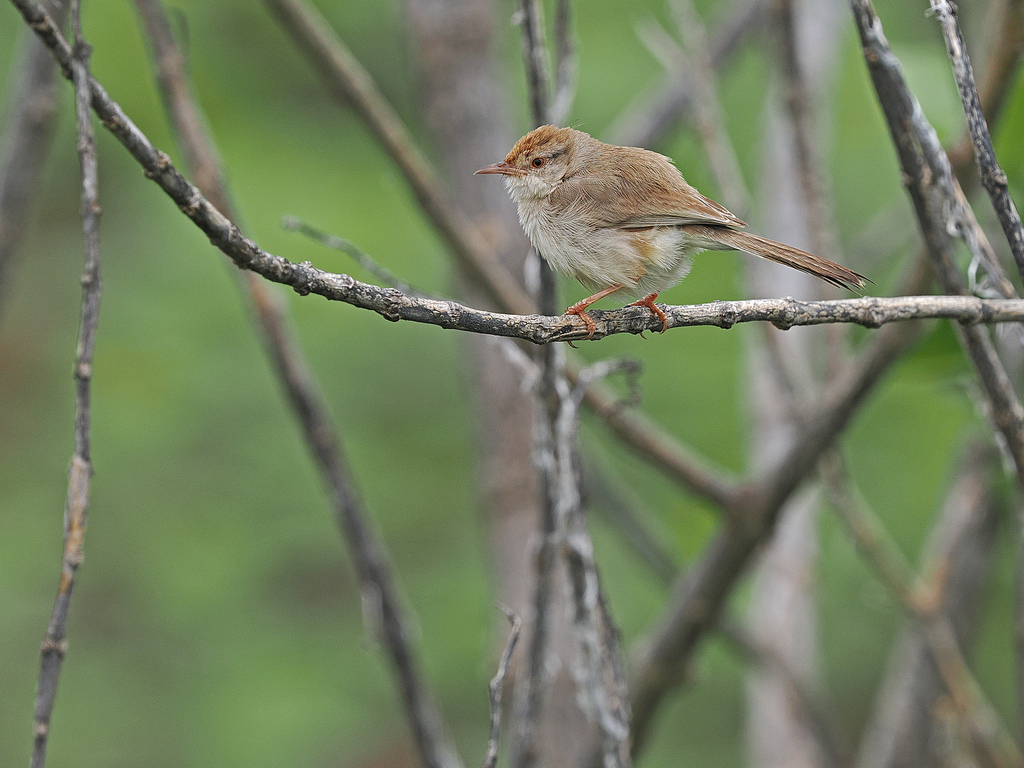
Rufous-fronted Prinia
Photo © James Eaton
Photo © James Eaton — CC0 1.0 — Source: iNaturalist #192422197The rufous-fronted prinia (Prinia buchanani) is a species of bird in the family Cisticolidae. It is found in India and Pakistan. Its natural habitat is subtropical or tropical dry forest. The species was described by Edward Blyth on the basis of an illustration of the bird from Bengal in the collections of Buchanan Hamilton. == Description == The rufous-fronted prinia is a small stocky bird, generally 12 cm long and weighing between 5 and 6 grams. The upper parts are sandy color. The lower parts are off-white. The legs and toes are pink. Remiges and tail feathers are also sandy color. The underside of the tail is creamy white. The head is olive brown, and the bird has a pale eyebrow and a thin red eye circle. The beak is a classic insectivore, thin and slightly curved, and the eyes are reddish-orange. == Reproduction == The nest is made of strips of grass woven together. It is built at one or two meters from the ground. The female generally lays between two and four eggs. == Habitat and behavior == The rufous-fronted prinia is located in India and Pakistan. The species inhabits subtropical or tropical dry forest. It is also…
Ranthambhore National Park
Sawai Madhopur, India
+294 birds+20 mammals
Granite ridges and ravines carved through the Aravalli Range frame this protected landscape in eastern Rajasthan, where deciduous forest mingles with open scrubland and seasonal water…
VIEW NATIONAL PARKKeoladeo National Park
Shreenagar Rural, India
+326 birds+14 mammals
Where shallow wetlands shimmer beneath vast Rajasthani skies, one of Asia's finest bird sanctuaries pulses with extraordinary life. This former maharaja's hunting reserve, now spanning 29…
VIEW NATIONAL PARKGir National Park
Asundrali, India
+258 birds+13 mammals
Dry deciduous forests cloak the rolling hills of western Gujarat where the Gir landscape rises as a final sanctuary for one of the world's rarest felids:…
VIEW NATIONAL PARKNo community photos yet. Log in to add the first one.
No community observations of this species yet.