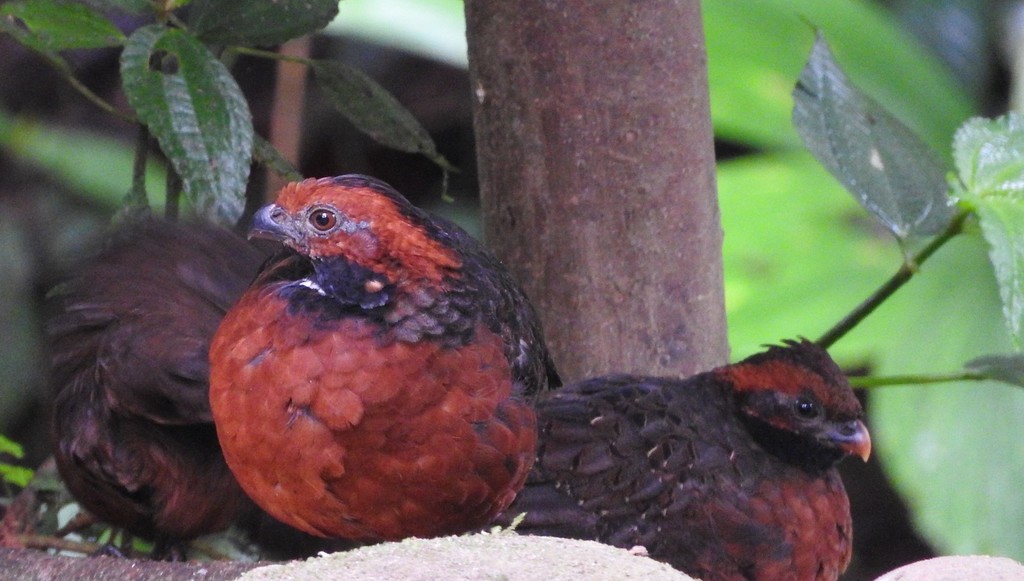
Rufous-fronted Wood Quail
CC BY 4.0
CC BY 4.0 — Source: iNaturalist photo #50362568Identification
The Rufous-fronted Wood Quail is a small, stocky ground-dwelling bird measuring 23 to 28 cm in length, weighing around 340 g in males and 329 g in females. Males are immediately recognizable by their distinctive rufous crown, crest, and face, framed by a striking ring of bare purple skin around the eye. The back and rump are predominantly black or olive with black spotting, while the breast and belly display rich dark rufous coloration. Females present a more subdued appearance, with a darker, duller chestnut face and a blue-black eye ring. Juveniles resemble females but are distinguished by black spots and barring on the belly. The two subspecies show subtle but notable differences: the nominate form from southwestern Ecuador differs from O. e. parambae, which has darker upperparts and a distinctive white throat.
Range & Habitat
This species is endemic to the northwestern part of South America, found exclusively in Colombia and Ecuador. The nominate subspecies inhabits southwestern Ecuador, while O. e. parambae occupies a broader range across the Pacific slope of western Ecuador and western Colombia, as well as Colombia's Magdalena Valley. These quails are creatures of humid tropical forest, favoring both primary and secondary growth. In Ecuador, they may be found at elevations up to 1,600 m, though they typically remain below 1,100 m in Colombia, suggesting a preference for the lower and middle forest strata.
Behaviour & Diet
The Rufous-fronted Wood Quail is a vocal species with a distinctive acoustic presence in its forest habitat. It produces at least two characteristic calls: a rapidly repeated, ringing duet described as "chowita, chowita, chowita," and a resonant "koo-klaw, koo-klaw, koo-klaw." These vocalizations make the species more often heard than seen. The bird's diet remains largely unstudied, though it has been observed visiting grain feeders at forest lodges, suggesting it may forage for seeds and similar vegetable matter on or near the forest floor. The breeding season is believed to span from January to May, though detailed breeding biology remains poorly documented.
Best Time & Places to See It
Travellers seeking this species should focus on protected areas in western Ecuador and Colombia where humid tropical forests remain intact. The breeding season from January to May may offer the best opportunities for detection, as birds are likely more vocal during this period. Early morning hours are typically most productive for locating quails, when they call most actively. Listen carefully for the distinctive "chowita" or "koo-klaw" calls echoing through the understory. While the species occurs in several protected areas, habitat loss outside reserves means that visiting established nature reserves with intact forest cover offers the highest probability of encounters.
Photography Tips
Photographing the Rufous-fronted Wood Quail presents considerable challenges due to its preference for dense forest cover and cryptic ground-dwelling habits. Use audio lures or recordings of its characteristic calls to attract birds closer, allowing better photographic opportunities. Early morning light is preferable, and a longer focal length lens (200-400 mm) is advisable given the bird's tendency to remain in cover. Ground-level or low-angle perspectives can be particularly effective for capturing this forest-floor species. Exercise patience, as quails are often elusive; remaining still and quiet after locating a calling bird may eventually yield a visual sighting. The male's striking rufous face and distinctive eye-ring make compelling compositional elements when capture is possible.
Natural Utría National Park
Alto Baudó (Pie de Pató), Colombia
+372 birds+11 mammals
Where the Chocó's coastal mountains plunge toward the Pacific, Utría National Park preserves one of Colombia's most biodiverse and least-visited wilderness expanses. Sprawling across 1,287 square…
VIEW NATIONAL PARKNatural Farallones de Cali National Park
Buenaventura, Colombia
+733 birds+27 mammals
Where the Pacific coastal plain meets the western slopes of the Andes, Farallones de Cali National Park sprawls across nearly 3,500 square kilometers of dramatic topography…
VIEW NATIONAL PARKNo community photos yet. Log in to add the first one.
No community observations of this species yet.