Identification
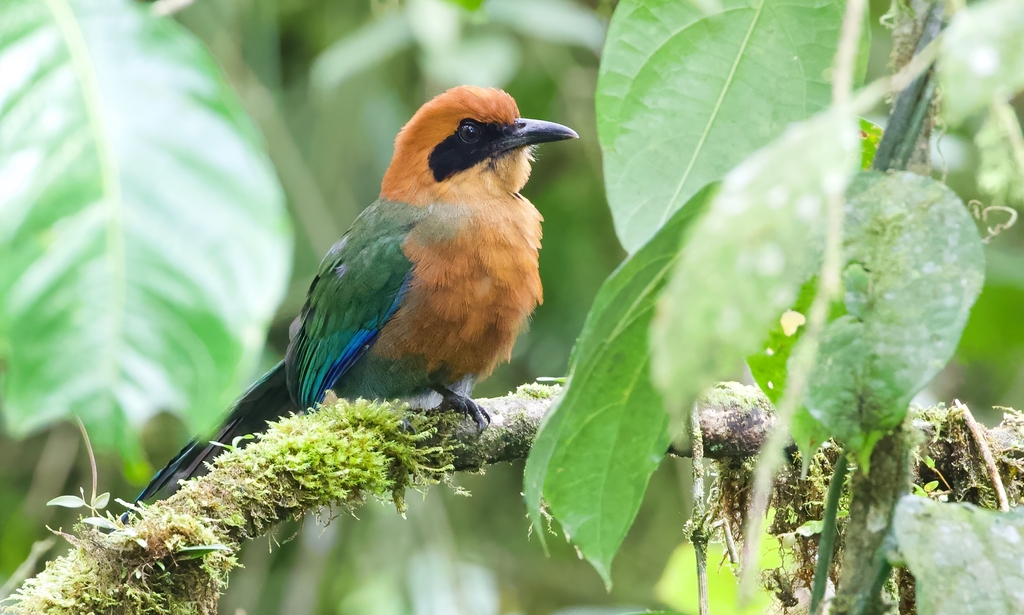
The rufous motmot is the second-largest member of the motmot family, measuring 42 to 47 cm in length. Adults are predominantly cinnamon-rufous in colour, with a distinctive black face mask and central breast spot. The wings and sides are green, contrasting with a greenish-blue lower belly, while the tail and flight feathers are dark blue. The tail is notably long; in the subspecies B. m. semirufus, the tail feathers end in bare-shafted racket tips, creating a striking silhouette in flight. The bill and legs are black. Younger birds are considerably paler and duller than adults, lacking both the elaborate tail rackets and the black breast spot that characterise mature birds.
Range & Habitat
Two geographically separated subspecies divide this species' range across Central and South America. The nominate subspecies occurs in the western Amazon Basin from southeastern Colombia through eastern Ecuador and Peru to northern Bolivia and into western Brazil. The subspecies B. m. semirufus inhabits the Caribbean slopes from eastern Honduras through Nicaragua, Costa Rica, and Panama, continuing along the Pacific slope into northwestern Colombia and western Ecuador. Elevational range varies by region, typically from near sea level to 1,250–1,400 m, though locally reaching 1,600 m in Peru. The rufous motmot favours humid lowland evergreen primary and secondary forests, preferring tall forest structures, particularly along rivers and streams, whilst avoiding areas of dense foliage.
Behaviour & Diet
This omnivorous species feeds on a varied diet including multiple fruit types, adult insects and larvae, arachnids including crustaceans, and small vertebrates such as fish, lizards, and frogs. The rufous motmot's breeding ecology remains poorly documented, though like other motmots it is presumed to nest in deep burrows excavated into earthen banks. Vocalizations include distinctive hoos, hoots, or hoops, sometimes answered by a low, owl-like hoop hoop huhuhuhuhuhu, with dry chatter serving as an agitation call.
Best Time & Places to See It
Observers seeking the rufous motmot should focus on humid primary and secondary forests in the lowlands and foothills of their respective ranges. In Central America, the Caribbean slope forests of Costa Rica, Panama, and Nicaragua offer good opportunities, particularly in protected reserves along river valleys. In South America, the western Amazon region—especially riparian corridors in Ecuador, Peru, and Bolivia—provides habitat. The species' preference for tall, open forest structure means scanning along river courses and forest edges can be productive, though specific information on seasonal activity patterns remains limited.
Photography Tips
The rufous motmot's striking plumage and long tail make it a rewarding photographic subject when encountered in suitable forest habitat. Early morning hours often provide the best light and activity levels. Position yourself along forest streams and rivers where the species frequents, using patient observation to locate feeding birds. The combination of warm rufous tones and contrasting green and blue plumage requires careful exposure metering to preserve detail in both highlights and shadows. A longer focal length lens will help capture the bird's full length, particularly showcasing the distinctive tail structure.