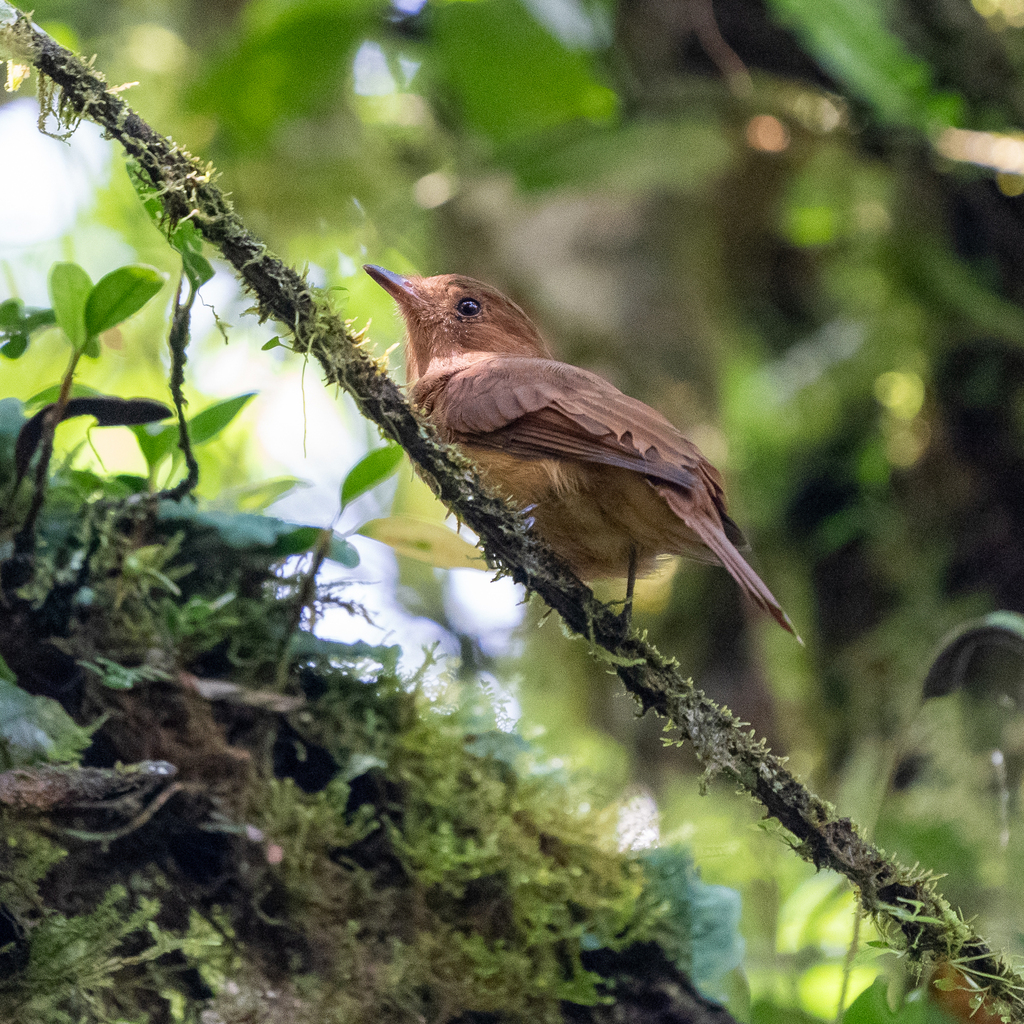
Rufous Mourner
Photo © Anthony Batista
Photo © Anthony Batista — CC BY 4.0 — Source: iNaturalist #242032539Identification
The Rufous Mourner is a medium-sized tyrant flycatcher measuring 19.5–21 cm in length. Both sexes share identical plumage, making them straightforward to identify. The bird's most distinctive feature is its predominantly cinnamon-brown to russet coloration throughout the head and upperparts, with a darker rufous crown. The wings are noticeably darker brown than the back, edged with cinnamon-rufous on the flight feathers, while the tail is mostly cinnamon-rufous with darker central feathers. The underparts are bright cinnamon to tawny-ochre, lighter on the throat and belly but darker across the breast. Juveniles appear brighter and more rufous overall with paler underparts than adults. The bird has a light brown to reddish-brown iris, a slightly hooked black bill with a dusky brown base on the upper mandible, and gray to black legs and feet.
Range & Habitat
The Rufous Mourner is found from southern Mexico through Central America to northwestern South America, with two recognized subspecies. The nominate race occurs from Oaxaca, Mexico (excluding the Yucatán Peninsula) southward through Belize, Guatemala, Honduras, Nicaragua, and Costa Rica, continuing on both slopes through Panama and into north-central Colombia. The subspecies R. h. rosenbergi inhabits the Pacific slope from southwestern Colombia south into Ecuador. This species favors humid evergreen forest and mature secondary forest in tropical and lower subtropical lowlands, ranging from sea level to 1,200 m in northern Central America and Costa Rica, up to 1,400 m in Colombia, and 700 m in Ecuador.
Behaviour & Diet
The Rufous Mourner is a year-round resident that feeds primarily on large insects and spiders, supplemented with fruit. Its insect prey includes katydids, cicadas, treehoppers, ants, stick insects, beetles, and butterflies. It also consumes fruits from trees including Alchornea, Casearia, Bursera, Cymbopetalum, and Guarea. This bird typically forages singly or in pairs, often joining mixed-species feeding flocks. It hunts by perching on branches—sometimes nearly horizontally in the forest's mid-story—and sallying out to glean prey from the undersides of vegetation while briefly hovering in place.
Best Time & Places to See It
The Rufous Mourner is a year-round resident throughout its range, so it can be found at any time of year. However, birds are most active and vocal during the breeding season, which varies by location: March–May in Belize, March–June in Costa Rica, and February–May in Colombia. It is considered uncommon to fairly common in northern Central America and Costa Rica, though uncommon and inconspicuous in Colombia. This species prefers the interior of humid lowland forests and is best located in mature evergreen forest tracts where it remains largely unobtrusive.
Photography Tips
The Rufous Mourner's cryptic habits and preference for the forest mid-story make photography challenging. The bird's rufous plumage blends well with shaded forest foliage, so look for movement rather than color. Listen for its distinctive vocalizations—a steady, rich wheeo-wheeo-wheeo phrase or its characteristic mournful wolf-whistle that rises and falls in pitch—to locate individuals. Early morning and late afternoon often bring increased activity. Position yourself quietly near mixed-species feeding flocks, as the Rufous Mourner often joins these aggregations. Patient observation will reveal the bird's characteristic foraging technique of hovering briefly beneath vegetation to pluck prey.
Arenal Volcano National Park
Barbilla National Park
Barra del Colorado National Wildlife Refuge
Baru Volcano National Park
Braulio Carrillo National Park
Cahuita National Park
Caño Negro National Wildlife Refuge
Carara National Park
Chagres National Park
Nothing matches these filters.
No community photos yet. Log in to add the first one.
No community observations of this species yet.