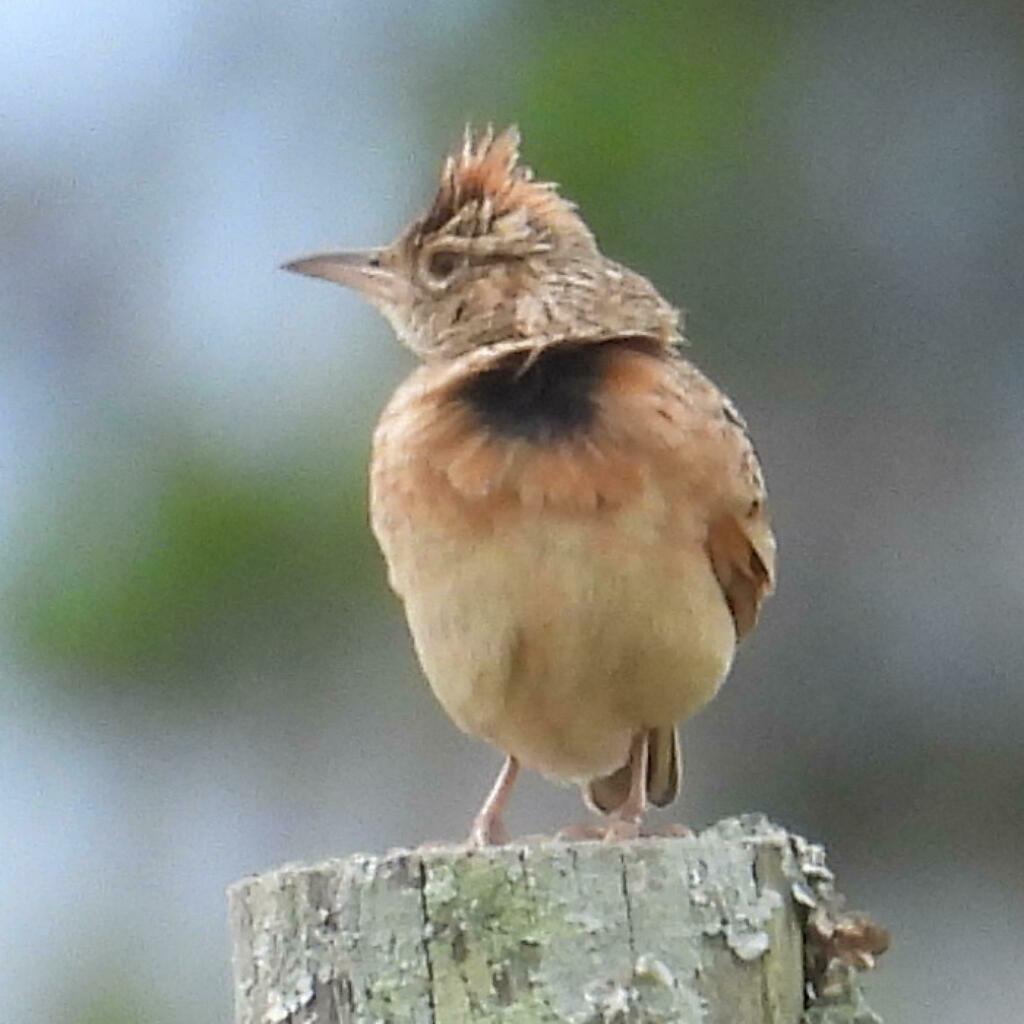
Rufous-naped Lark
Photo © Henry de Lange
Photo © Henry de Lange — CC BY 4.0 — Source: iNaturalist #259502298Identification
The rufous-naped lark is a fairly large and robust lark, measuring 15–18 cm in length and weighing 40–44 g. Its most distinctive feature is its conspicuously rufous wings, which show up as a striking panel on the closed wing and are particularly eye-catching in flight. The bird also sports a short, erectile crest and a creamy-buff eyebrow that merges with the lore. Adults display individual and geographic variation, but consistently show streaked upper parts, a dark brown tail, and a pale rufous-buff belly with darker flanks. The hindcrown and nape are streaked with variable coloring—chestnut, rufous, pinkish buff, or greyish brown depending on the subspecies. The longish, curved upper mandible and straight lower mandible are distinctive. Juveniles are bolder, with black spotting on the crown, mantle, and wing coverts edged in buff.
Range & Habitat
The rufous-naped lark is widespread and conspicuous throughout the lightly wooded grasslands, open savannas, and farmlands of the Afrotropics. Its range spans from East Africa—including east Uganda and west Kenya—southward through the Democratic Republic of Congo, Zambia, Angola, Botswana, Zimbabwe, Malawi, Tanzania, and into South Africa. The species is geographically highly variable, with eleven recognized subspecies distributed across this vast range, each adapted to local conditions. This variation is so pronounced that the species was recently split into six separate species in 2024, though they remain closely related.
Behaviour & Diet
Males of this species are notably bold and attention-seeking, performing a distinctive wing-fluttering display from prominent perches. This display is accompanied by a melodious and far-carrying whistled phrase that carries across the grasslands. Ornithologists have proposed that this rudimentary display represents a precursor to the more elaborate wing-clapping displays seen in other bush lark species, making the rufous-naped lark particularly interesting from an evolutionary perspective. The sexes are similar in appearance, though males average slightly larger and heavier than females.
Best Time & Places to See It
The rufous-naped lark's widespread distribution and conspicuous nature make it a reliable species to observe across much of sub-Saharan Africa. Look for it in open savannas and lightly wooded grasslands, where males perch prominently while delivering their distinctive displays. The bird's bold behavior and far-carrying calls make it relatively easy to locate once you know its habitat preferences. Its presence in farmlands means it can sometimes be encountered in more disturbed landscapes, adding to its accessibility for travellers.
Photography Tips
Photograph the rufous-naped lark during its wing-fluttering display from a prominent perch—this is when the bird is most conspicuous and most willing to remain stationary. The rufous coloring of the wings is best captured when the bird is in flight or with wings partially spread, so anticipate these moments. The erectile crest and facial markings are clearly visible when the bird is alert and perched. Early morning light will best illuminate the bird's variable plumage tones and bring out the characteristic rufous panels on the wings. Males performing their displays offer excellent photographic opportunities, as they repeat this behavior regularly from accessible vantage points.
Serengeti National Park
Tanzania
+558 birds+57 mammals
Across Tanzania's northern plateau, where volcanic soils meet acacia woodland and open grassland, unfolds one of Earth's most dynamic ecosystems. The Serengeti National Park sprawls across…
VIEW NATIONAL PARKChobe National Park
Botswana
+446 birds+45 mammals
Where the Chobe River cuts a sinuous path through northern Botswana, the landscape transforms into one of Africa's most dynamic wetland-savanna mosaics. This national park encompasses…
VIEW NATIONAL PARKMurchison Falls National Park
Uganda
+608 birds+33 mammals
Where the Victoria Nile compresses through a narrow gorge and explodes across a 45-meter precipice, the landscape speaks in thunder. Murchison Falls National Park sprawls across…
VIEW NATIONAL PARKNgorongoro Conservation Area
Tanzania
+626 birds+55 mammals
Volcanic calderas and open grassland dominate this high plateau in northern Tanzania, where the landscape rises above 2,000 metres and ancient geological forces have shaped both…
VIEW WILDLIFE MANAGEMENT AREAQueen Elizabeth National Park
Uganda
+672 birds+30 mammals
Across the southwestern escarpment of Uganda, where the Western Rift Valley descends through ancient volcanic terrain, Queen Elizabeth National Park sprawls across more than 8,300 square…
VIEW NATIONAL PARKPilanesberg National Park
Moses Kotane Local Municipality, South Africa
+364 birds+49 mammals
Granite peaks and volcanic ridges rise unexpectedly from the savanna floor across this 734-square-kilometre expanse in the North West province, creating a landscape of profound ecological…
VIEW NATIONAL PARKKruger National Park
Ba-Phalaborwa Local Municipality, South Africa
+540 birds+91 mammals
Across the low-lying savanna of northeastern South Africa unfolds one of Africa's largest and most ecologically intact protected areas, where acacia woodlands merge into mopane scrub…
VIEW NATIONAL PARKMountain Zebra National Park
Inxuba Yethemba Local Municipality, South Africa
+265 birds+35 mammals
Across the windswept plateaus and deeply incised valleys of the Eastern Cape's interior, Mountain Zebra National Park unfolds as a landscape of geological drama and ecological…
VIEW NATIONAL PARKAddo Elephant National Park
Sundays River Valley Local Municipality, South Africa
+388 birds+55 mammals
Where the Eastern Cape's semi-arid scrublands meet transitional woodland, Addo sprawls across 13,478 square kilometres of one of southern Africa's most biodiverse landscapes. The terrain rises…
VIEW NATIONAL PARKNkasa Rupara National Park
Namibia
+283 birds+17 mammals
Where the Zambezi's floodplains spill across the border between Namibia and Botswana, Nkasa Rupara National Park unfolds across 518 square kilometers of wetland and woodland mosaic.…
VIEW NATIONAL PARKEtosha National Park
Namibia
+356 birds+58 mammals
Across northern Namibia's stark semi-arid plateau, a vast shallow depression transforms seasonally into one of Africa's most dramatic wildlife theaters. Etosha National Park, encompassing more than…
VIEW NATIONAL PARKNo community photos yet. Log in to add the first one.
No community observations of this species yet.