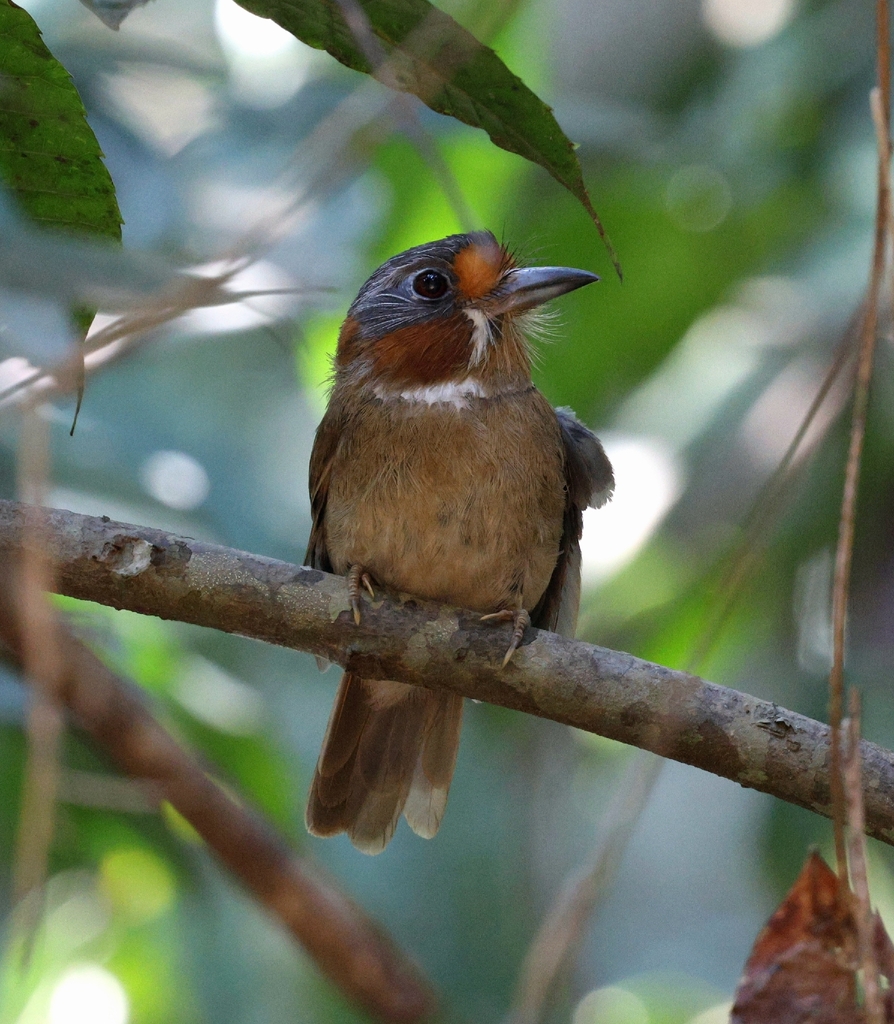
Rufous-necked Puffbird
Photo © Miguel
Photo © Miguel — CC BY-SA 4.0 — Source: iNaturalist photo #584298519Identification
The rufous-necked puffbird is a compact bird, measuring about 18 cm in length and weighing 39 to 46 grams. Among puffbirds, it is somewhat unusual in being unstreaked. Its most distinctive feature is the wide rufous collar on the nape that extends onto the sides of the neck, paired with a large rufous loral spot near the eye. The crown and cheeks are dark gray with narrow pale streaks, while the back is dark brown and the wings and tail a warmer shade. The underparts grade from darker brown on the breast to paler tones on the belly, with a striking white crescent on the upper breast bordered by a thin black line below.
The bill is blue-gray to black, and the eye is dark brown or dark red. The feet are pale gray-brown to pale olive-gray. Two subspecies exist: the nominate M. r. rufa and M. r. brunnescens, which are very similar, differing mainly in color intensity.
Range & Habitat
The rufous-necked puffbird is found in southern Amazonia across three countries: northeastern Peru, northeastern Bolivia, and western Brazil. The nominate subspecies occurs in Peru, Bolivia, and western Brazil south of the Amazon River and west of the Madeira River, while M. r. brunnescens is found in Brazil south of the Amazon and east of the Tapajós River extending to the Atlantic Ocean. Intergrades between the two subspecies occur in the region between the Madeira and Tapajós rivers.
The species predominantly inhabits the understory of terra firme evergreen forest throughout most of its range. In northeastern Peru, however, it appears to be restricted to várzea forest, showing some flexibility in habitat preference depending on local availability.
Behaviour & Diet
The rufous-necked puffbird hunts from perches several meters above the ground, sallying out to capture prey from vegetation or the ground. Its diet consists mostly of insects and other invertebrates, with perhaps small vertebrates also taken, though feeding ecology has not been extensively studied. The species occasionally joins mixed-species foraging flocks and has been observed attending army ant swarms, likely taking advantage of prey flushed by the ants.
Almost nothing is known about its breeding phenology, though one documented nest was found in a tunnel in the ground. The species produces a long, descending musical trill that is indistinguishable from songs of other puffbird species. Its calls include a thin whistled "seeeee" and an agitated harsh rasping series: "trr'r'r'r'r-SHEEAH" repeated multiple times.
Best Time & Places to See It
The rufous-necked puffbird's best time for observation and its specific seasonal availability are not detailed in available sources. The species occurs across a very large range in southern Amazonia, making it potentially accessible to travellers visiting the Amazon basin of Peru, Bolivia, or Brazil. Its preference for forest understory habitat means that spotting it will require careful observation and patience, as birds perching several meters above ground can be easily overlooked among dense vegetation.
Photography Tips
Photographing the rufous-necked puffbird requires patience and attention to its perching habits, as it hunts from elevated positions within the forest understory. The rufous collar and loral spot are distinctive features worth capturing. Early morning light filtering through the canopy will best reveal the bird's subtle brown plumage and highlights. Since the species occasionally joins mixed-species feeding flocks, monitoring such groups may increase the chances of encounters. The bird's small size and preference for mid-story perches mean that a telephoto lens will be valuable for approaching close enough for detailed shots without disturbing the bird.
Amazônia National Park
Brazil
+439 birds+6 mammals
Where the Rio Amazonas and its tributaries weave through the heart of Pará state, a vast tapestry of rainforest stretches across 23,611 square kilometers of unbroken…
VIEW NATIONAL PARKMapinguari National Park
Brazil
+354 birds
Vast tracts of western Amazonian rainforest blanket the remote terrain of this 56,827 square kilometre national park in Amazonas state, where seasonal rivers wind through dense…
VIEW NATIONAL PARKPacaás Novos National Park
Brazil
+279 birds+1 mammals
Across the border between Rondônia and Amazonas, vast tracts of humid tropical forest rise and fall in gentle undulations, carved by clear-flowing rivers that feed into…
VIEW NATIONAL PARKCampos Amazónicos National Park
Amazonas, Brazil
+434 birds+7 mammals
Sprawling across the southwestern Amazon basin in Amazonas state, this 27,263-square-kilometre national park encompasses some of the region's most pristine lowland rainforest, where terra firme forest…
VIEW NATIONAL PARKNo community photos yet. Log in to add the first one.
No community observations of this species yet.