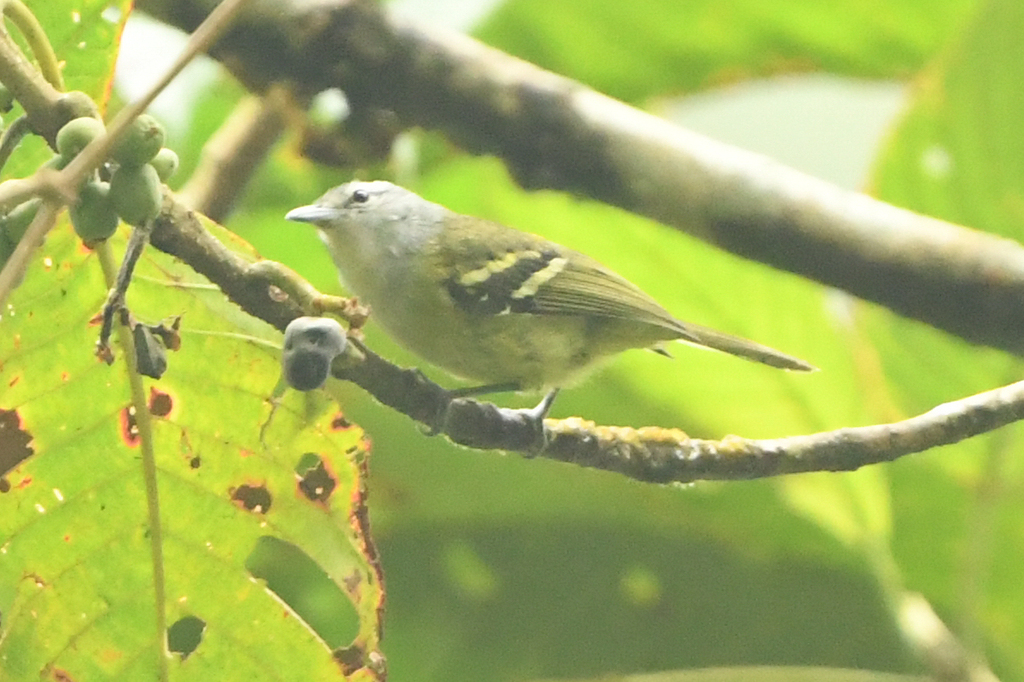
Rufous-rumped Antwren
Photo © Julien Renoult
Photo © Julien Renoult — CC BY 4.0 — Source: iNaturalist photo #488799931Identification
The Rufous-rumped Antwren is a small, slender bird measuring 10–12 cm in length, weighing only 7–9.5 g. It resembles a greenlet or New World warbler with a notably long tail. The most distinctive feature is the bright rufous or orange-brown lower back and rump, which contrasts sharply with the olive upper back. Males of the widespread nominate subspecies display blackish lores and an eye-line on a pale gray face, with a black crown and nape. Females have a brownish-olive crown and grayish-olive head sides. Both sexes show pale gray throats and breasts with pale yellow-green bellies, slate-gray wing coverts with pale yellow tips forming two bars, and dusky tails with olive edges. The iris is brown or dark brown, the upper mandible black, and the legs bluish-gray. Subspecies vary subtly in coloration intensity and tone.
Range & Habitat
The Rufous-rumped Antwren has a highly disjunct distribution across nine countries: Costa Rica, Panama, Colombia, Ecuador, Peru, Venezuela, Guyana, Suriname, and French Guiana. The nominate subspecies is most widespread with several separate populations ranging from the Cordillera de Talamanca in Costa Rica and Panama south through the Andes into northern Peru. Other subspecies occupy the Serranía del Perijá and Venezuelan Andes, as well as the Guiana Shield region. The species inhabits the interior and edges of humid foothill and montane forests, typically between 700–2,500 m elevation depending on location, though it can range from 750–2,000 m in different regions.
Behaviour & Diet
This species is a year-round resident throughout its range. The Rufous-rumped Antwren feeds exclusively on arthropods, foraging almost entirely in the forest canopy where it acrobatically gleans prey from leaves and sticks. It typically forages in pairs and regularly joins mixed-species feeding flocks, a behavior typical of many antbirds. In Costa Rica, the breeding season occurs from February through May, though other details of its breeding biology remain poorly documented. The species has a distinctive voice: its song is a rapidly uttered, high-pitched series that accelerates into a fast chipper or trill, described as "tsii-tsii-tsi-tsi-titititititititi." Calls consist of high "tsi" and "ti" notes.
Best Time & Places to See It
The Rufous-rumped Antwren is considered rare in Costa Rica and uncommon in Colombia, Ecuador, and Peru, though more regular in parts of its range. Year-round residency means the species can be found throughout the year, but the February–May breeding season in Central America may offer increased activity and vocalization. Target humid montane forests between 700–2,500 m elevation in the species' respective countries. Look for mixed-species feeding flocks moving through the canopy, particularly in foothill and montane forest edges where this species regularly forages.
Photography Tips
The Rufous-rumped Antwren's small size, canopy-dwelling habits, and tendency to forage acrobatically among foliage make photography challenging. The bright rufous rump is the most distinctive and photogenic feature—position yourself to capture this field mark, which immediately separates this species from other small antbirds. Early morning often provides better light and increased activity. The bird's habit of joining mixed-species feeding flocks offers opportunities to anticipate its arrival in productive feeding areas. Use fast shutter speeds to freeze rapid, acrobatic movements as it gleans from branches. The high-pitched, accelerating song can aid in locating birds, allowing you to position yourself for photography before the bird moves on.
Braulio Carrillo National Park
Las Horquetas, Costa Rica
+547 birds+18 mammals
Where the Caribbean slope descends from the central volcanic cordillera toward the humid lowlands of Heredia, Braulio Carrillo National Park preserves one of Costa Rica's most…
VIEW NATIONAL PARKPodocarpus National Park
Zamora, Ecuador
+496 birds+6 mammals
Where the Andes descend toward the Amazon basin, Podocarpus National Park sprawls across nearly 2,800 square kilometres of the most biodiverse terrain in Ecuador's southern highlands.…
VIEW NATIONAL PARKSumaco Napo-Galeras National Park
Loreto, Ecuador
+563 birds+4 mammals
Where Ecuador's Amazon transitions into cloud forest, a massive shield volcano rises from the emerald lowlands of Orellana Province, anchoring one of the continent's most biodiverse…
VIEW NATIONAL PARKNatural Serranía de los Yariguíes National Park
El Carmen de Chucurí, Colombia
+320 birds+3 mammals
Where the northern cordilleras of Colombia rise toward cloud forest, the Serranía de los Yariguíes unfolds across nearly 1,820 square kilometers of some of the most…
VIEW NATIONAL PARKNatural Farallones de Cali National Park
Buenaventura, Colombia
+733 birds+27 mammals
Where the Pacific coastal plain meets the western slopes of the Andes, Farallones de Cali National Park sprawls across nearly 3,500 square kilometers of dramatic topography…
VIEW NATIONAL PARKGuácharos Cave National Natural Park
Acevedo, Colombia
+359 birds
High in the Andean foothills of southern Huila, where mist-laden slopes rise above 1,600 metres, lies a landscape carved by underground rivers and crowned by karst…
VIEW NATIONAL PARKYanachaga–chemillén National Park
Palcazu, Peru
+639 birds+6 mammals
Where the eastern slopes of Peru's central cordillera plunge into cloud forest, Yanachaga–Chemillén National Park protects nearly three thousand square kilometres of montane wilderness that few…
VIEW NATIONAL PARKCordillera Azul National Park
Pampa Hermosa, Peru
+322 birds+1 mammals
Where the eastern Andes descend into the western Amazon basin, Cordillera Azul National Park sprawls across nearly 38,000 square kilometres of some of Peru's most pristine…
VIEW NATIONAL PARKDarién National Park
Tucutí, Panama
+534 birds+13 mammals
Where the spine of Central America crumbles into wetland and rainforest, Darién National Park sprawls across more than 20,000 square kilometres of some of the tropics'…
VIEW NATIONAL PARKTapantí Macizo de la Muerte National Park
Orosi, Costa Rica
+503 birds+18 mammals
Where montane cloud forest rises steeply from the Orosi Valley, Tapantí Macizo de la Muerte National Park enfolds a landscape of perpetual moisture and emerald complexity.…
VIEW NATIONAL PARKNo community photos yet. Log in to add the first one.
No community observations of this species yet.