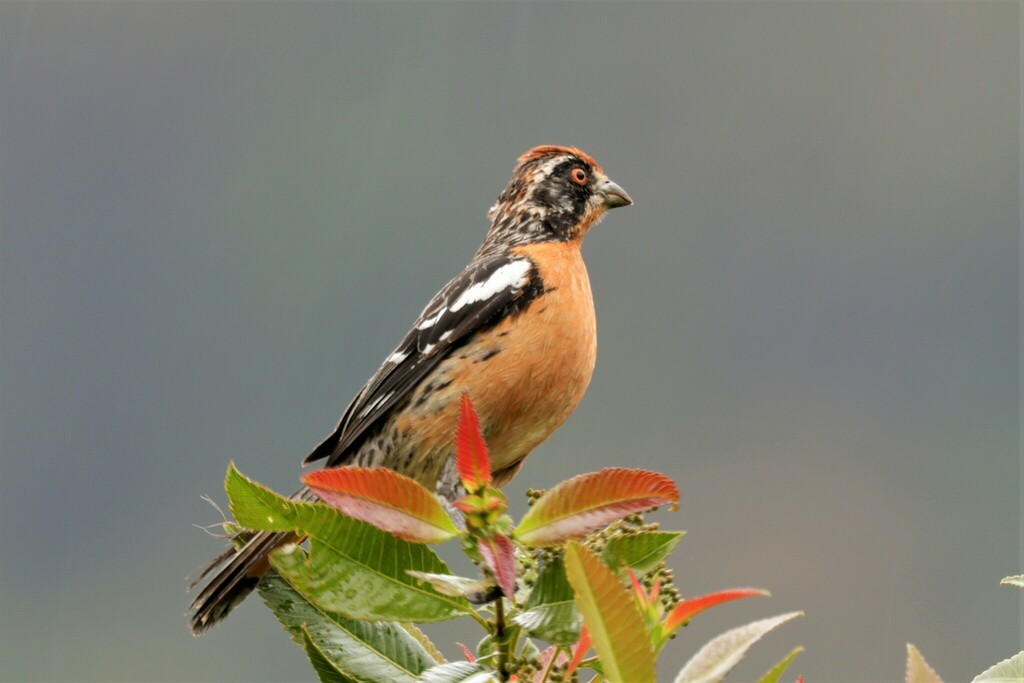
Rufous-tailed Plantcutter
Photo © russnamitz
Photo © russnamitz — CC0 1.0 — Source: iNaturalist photo #457927588Identification
The rufous-tailed plantcutter is a stocky, medium-sized bird measuring 18–20 centimetres in length, with a distinctive long black tail highlighted by a reddish base. Males are particularly striking, displaying greyish-brown upperparts with dark streaks, a chestnut crown and breast, and a bold pattern of dark and pale facial markings. A white wing bar further distinguishes males. Females are more subdued in colouration, with buff underparts streaked in brown and buff (rather than white) wing markings; they lack the males' chestnut crown but may show a cinnamon wash to the forehead and throat. Both sexes have a prominent red eye and a short, thick finch-like bill with distinctive serrated edges—an adaptation for their specialised feeding ecology.
The plantcutter's vocalisation is memorable: a series of stuttering notes followed by a rasping trill that closely resembles the sound of a fishing reel being wound, making it identifiable by ear as well as sight.
Range & Habitat
This species holds the distinction of being the southernmost-breeding cotinga in the world. It inhabits scrub, forest edges, and river valleys across a wide range in southern South America, from the Atacama region of Chile northwards to the Magallanes region, and from Santa Cruz Province in Argentina north to Mendoza. Birds breeding in southern or high-altitude regions undertake seasonal movements, shifting northwards or towards lower elevations during winter months. The species has been recorded as a vagrant to the Falkland Islands.
Rufous-tailed plantcutters are commonly encountered in cultivated landscapes including gardens, farmland, and orchards, where they sometimes achieve pest status due to their feeding habits. The species constructs a cup-shaped nest from root fibres and twigs, placed in the fork of a shrub or tree, in which females lay two to four blue-green eggs with dark spotting concentrated at the larger end.
Behaviour & Diet
True to its name, the rufous-tailed plantcutter specialises in stripping buds, leaves, and fruits from vegetation using its uniquely adapted serrated bill. This highly specialised feeding behaviour makes the bird a conspicuous forager in its habitat. Whilst plant matter dominates the diet, insects are taken opportunistically and are also provisioned to chicks during the breeding season, providing essential protein for developing young.
Best Time & Places to See It
The rufous-tailed plantcutter is a fairly common species across its range, though not uniformly distributed, making it a reliable subject for travellers visiting suitable habitat in Chile and western Argentina. Orchards, gardens, scrubby woodland edges, and cultivated areas offer the best opportunities for observation. Seasonal movements mean that birds present in high-altitude or southern breeding areas during summer will shift to lower elevations or more northerly locations as winter approaches, so timing visits according to these patterns may improve sighting chances in specific localities.
Photography Tips
The plantcutter's preference for open scrub, orchards, and gardens makes it relatively approachable for photography compared to many forest cotingas. Males, with their distinctive chestnut crowns and contrasting facial markings, are more visually striking subjects than females. The bird's active foraging behaviour on vegetation can provide dynamic shooting opportunities, and its distinctive posture—stocky and upright—creates recognisable silhouettes. The red eye is a key focal point for close portraits. Early morning light will best reveal the subtle plumage differences between males and females, particularly the white versus buff wing bars.
Cerro Castillo National Park
Chiloé National Park
Corcovado National Park
Lago Puelo National Park
Laja National Park Lagoon
Lanín National Park
Los Alerces National Park
Los Glaciares National Park
Nahuel Huapi National Park
Nothing matches these filters.
No community photos yet. Log in to add the first one.
No community observations of this species yet.