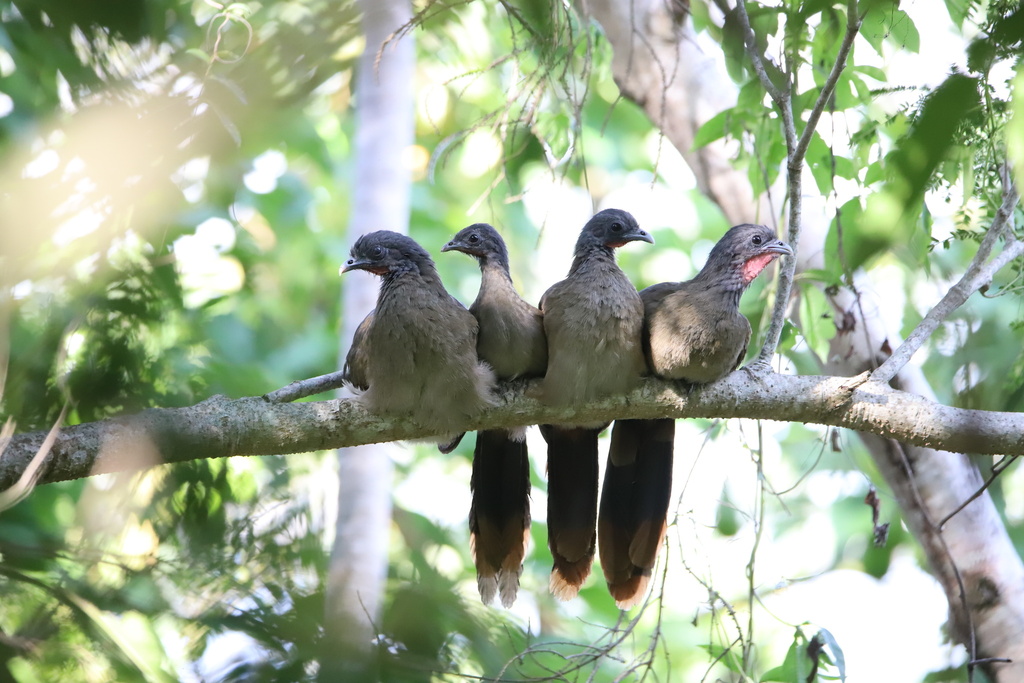
Rufous-vented Chachalaca
Photo © Aitor
Photo © Aitor — CC BY 4.0 — Source: iNaturalist photo #317319759Identification
The Rufous-vented Chachalaca is a medium-sized bird measuring 53–58 cm in length, with females weighing around 540g and males approximately 640g. These birds bear a superficial resemblance to turkeys, characterized by small heads, long sturdy legs, and a long broad tail. Their plumage is fairly dull, appearing dark brown above and paler below, with a grey head. The brown tail is distinctively tipped with rufous or white depending on the subspecies, giving the bird its common name.
Range & Habitat
The Rufous-vented Chachalaca is found in northeast Colombia and northern Venezuela, where local people call it the guacharaca. The species also inhabits the island of Tobago in Trinidad and Tobago, where it is known as the cocrico and holds special cultural significance as one of the country's two national birds, featured on the nation's coat of arms. The bird has also been recorded on Bequia and Union Island in the Grenadines, possibly as a result of human introduction.
This is largely an arboreal species, preferring forest and woodland habitats but adapting well to more open dry scrubby areas. This habitat flexibility, combined with relatively low hunting pressure, makes the Rufous-vented Chachalaca considerably less vulnerable than larger members of its family, particularly the curassows.
Behaviour & Diet
The Rufous-vented Chachalaca is renowned as a very vocal species, with particularly noisy choruses occurring at dawn. Males produce a loud, low-pitched call described as ka-ka-rooki-rooki-ka, which is answered by the female's higher-pitched watch-a-lak. These duets are often repeated several times in precise synchronization, making the birds conspicuous even when hidden in vegetation.
These are highly social birds, frequently observed in family groups. They walk deliberately along branches in search of food, feeding on fruit such as mangoes and berries, as well as seeds and leaves, including those from the Euterpe palm. Although capable fliers that can take off and fly vertically, they do not typically undertake long-distance flights. During breeding season, they construct a twig nest placed low in a tree, where the female lays three or four large white eggs and incubates them alone.
Best Time & Places to See It
Dawn is the ideal time to locate this species, when their loud and distinctive vocal displays make them most conspicuous. In Trinidad and Tobago, particularly on Tobago where the cocrico holds national bird status, guided birdwatching tours through suitable forest and woodland habitats offer excellent opportunities. The species is also accessible in suitable habitats throughout northeast Colombia and northern Venezuela, as well as on the Caribbean islands of Bequia and Union Island in the Grenadines.
Photography Tips
Rise early to locate these birds during their dawn chorus—the combination of activity and vocalization makes early morning the most productive time for observation and photography. Since the Rufous-vented Chachalaca is an arboreal species that walks along branches rather than remaining stationary, patience and a good vantage point overlooking fruiting trees will increase your chances of capturing clear images. The relatively dull plumage means strong, even lighting is beneficial to reveal the subtle tones and the characteristic rufous-tipped tail feathers that define the species.
Natural el Cocuy National Park
Güicán, Colombia
+313 birds+3 mammals
Where the Andes rise to their highest peaks in Colombia's eastern cordillera, El Cocuy National Park sprawls across more than 6,600 square kilometers of some of…
VIEW NATIONAL PARKMorrocoy National Park
Municipio Silva
+290 birds
Where the Caribbean coast of northwestern Venezuela meets protected coastal waters, a mosaic of mangrove forests, sandy beaches, and coral reef systems defines Morrocoy National Park.…
VIEW NATIONAL PARKEl Tamá National Park
Toledo, Colombia
+435 birds
Where the Andes descend toward the Caribbean coastal lowlands of northern Colombia, El Tamá National Park sprawls across nearly 3,800 square kilometres of montane forest, cloud…
VIEW NATIONAL PARKNatural Sierra de la Macarena National Park
Vista Hermosa, Colombia
+566 birds+15 mammals
Across nearly 20,000 square kilometres of Colombia's Meta Department, the terrain rises from lowland savanna into Andean foothills through a mosaic of gallery forests, palm-fringed wetlands,…
VIEW NATIONAL PARKNo community photos yet. Log in to add the first one.
No community observations of this species yet.