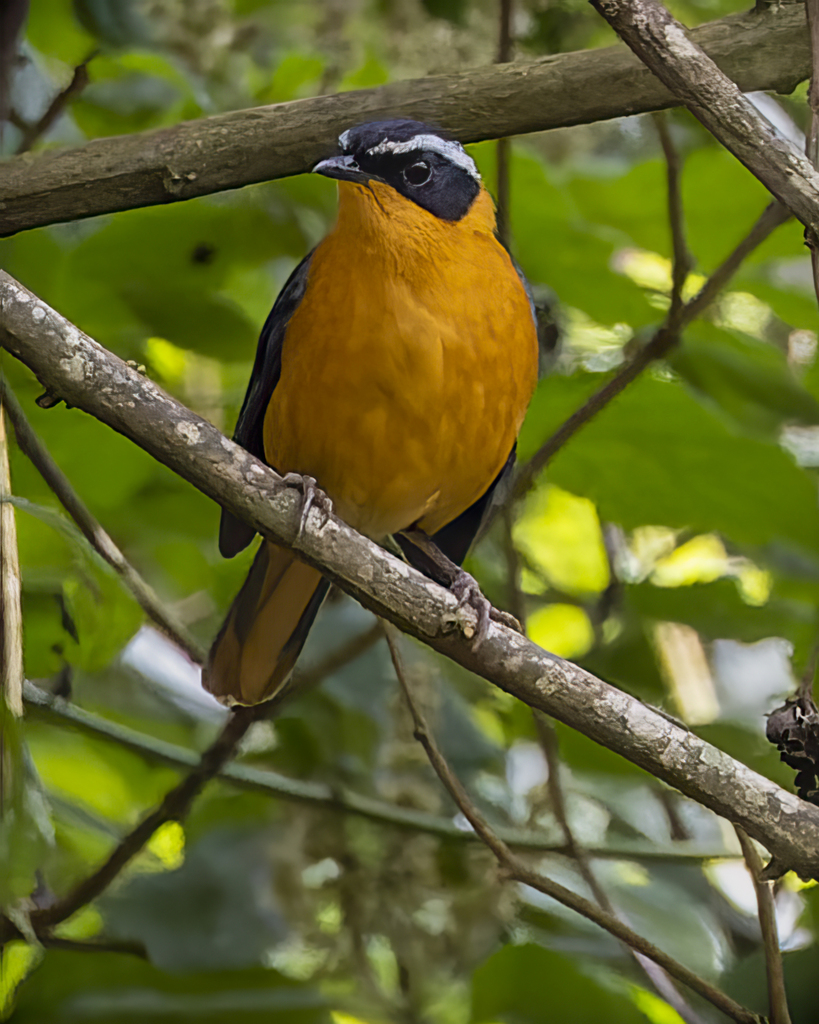
Rüppell’s Robin-Chat
Photo © Gary T. Leavens
Photo © Gary T. Leavens — CC BY-SA 4.0 — Source: iNaturalist #207861394Rüppell's robin-chat (Cossypha semirufa) is a species of bird in the family Muscicapidae, that is native to the Afrotropics. It is named for the German naturalist Eduard Rüppell. == Description == It is a smaller version of the White-browed robin-chat, measuring 18 cm rather than 20 cm, with darker, blackish central tail feathers, and in some races a more constricted supercilium behind the eye. == Range == It is native to Eritrea, Ethiopia, Kenya, South Sudan and Tanzania. == Habitat == It is found in subtropical or tropical moist montane forests, including Juniper and Podocarpus forest, and in subtropical or tropical moist shrubland and gardens. == Races == There are three races: Cossypha semirufa semirufa Range: Eritrea, Ethiopia, south-eastern South Sudan and northern Kenya Cossypha semirufa donaldsoni Sharpe, 1895 Description: Rufous collar almost complete, upperparts darker than nominate Range: south-eastern Ethiopia and adjacent Somalia Cossypha semirufa intercedens (Cabanis, 1878) Range: central to south-eastern Kenya and northern Tanzania
Serengeti National Park
Tanzania
+558 birds+57 mammals
Across Tanzania's northern plateau, where volcanic soils meet acacia woodland and open grassland, unfolds one of Earth's most dynamic ecosystems. The Serengeti National Park sprawls across…
VIEW NATIONAL PARKArusha National Park
Tanzania
+555 birds+16 mammals
Where the slopes of Mount Mawenzi rise above the Arusha region, a compact yet ecologically rich national park unfolds across montane forest, moorland, and alpine zones.…
VIEW NATIONAL PARKKilimanjaro National Park
Kenya
+207 birds+16 mammals
Africa's highest mountain rises not in isolation but as the centerpiece of a vast national park that sweeps across the borderlands of northern Tanzania, where savanna…
VIEW NATIONAL PARKMount-Kenya National Park
Abothuguchi west ward, Kenya
+334 birds+11 mammals
Where the slopes of Kenya's second-highest mountain rise steeply from the Meru County foothills, a landscape of profound ecological richness unfolds across Mount Kenya National Park.…
VIEW NATIONAL PARKNgorongoro Conservation Area
Tanzania
+626 birds+55 mammals
Volcanic calderas and open grassland dominate this high plateau in northern Tanzania, where the landscape rises above 2,000 metres and ancient geological forces have shaped both…
VIEW WILDLIFE MANAGEMENT AREAAbijata-Shalla Lakes National Park
Ethiopia
+438 birds+7 mammals
Two crater lakes of contrasting chemistry define this remote corner of Ethiopia's Rift Valley, where soda lakes and freshwater basins create a mosaic of distinct aquatic…
VIEW NATIONAL PARKBale Mountains National Park
Ethiopia
+397 birds+20 mammals
Where the Ethiopian highlands rise above 4,000 metres, the Bale Mountains create a landscape of stunning ecological extremes—from afroalpine grasslands swept by wind and mist to…
VIEW NATIONAL PARKAwash National Park
Didiga, Ethiopia
+473 birds+23 mammals
Where the Ethiopian Rift Valley carves through volcanic plateaus, a ribbon of riverine forest winds through acacia scrubland and grassland, creating a mosaic of habitats that…
VIEW NATURAL PARKSimien Mountains National Park
Debark, Ethiopia
+120 birds+9 mammals
Where granite escarpments plunge thousands of metres into misty valleys, the Ethiopian highlands reveal a landscape of almost mythical drama. These volcanic plateaus, carved by ancient…
VIEW NATIONAL PARKNech Sar National Park
Arba Minch, Ethiopia
+191 birds+10 mammals
Where the East African Rift Valley plateaus drop dramatically toward the shore of Lake Abaya, a mosaic of habitats unfolds across sun-scorched savanna and acacia woodland.…
VIEW NATIONAL PARKYabelo Wildlife Sanctuary
Bedewera, Ethiopia
+359 birds+5 mammals
Where acacia woodlands meet volcanic plateaus in southern Ethiopia, a landscape of austere beauty unfolds across nearly 2,500 square kilometers. Yabelo Wildlife Sanctuary sprawls across semi-arid…
VIEW WILDLIFE SANCTUARYNairobi National Park
Nairobi, Kenya
+515 birds+35 mammals
Just minutes from Kenya's capital, where the Nairobi River winds through acacia woodland and open grassland, lies one of Africa's most paradoxical wildlife sanctuaries. The park's…
VIEW NATIONAL PARKLake Nakuru National Park
Nakuru West, Kenya
+494 birds+32 mammals
Alkaline waters ringed by acacia woodland and grassland create one of East Africa's most distinctive wetland ecosystems, where the interplay of geology and climate sustains a…
VIEW NATIONAL PARKAberdare National Park
Mweiga ward, Kenya
+394 birds+30 mammals
Where the central highlands of Kenya rise to their elemental grandeur, the Aberdare range unfolds across Nyeri County as a montane stronghold of cool, misty forest…
VIEW NATIONAL PARKMeru National Park
Igembe Central, Kenya
+408 birds+38 mammals
Granite outcrops and acacia woodland rise across the northern reaches of Meru, where semi-arid savanna transitions into drier scrubland under the fierce equatorial sun. The park's…
VIEW NATIONAL PARKHell’s Gate National Park
Olkaria ward, Kenya
+388 birds+18 mammals
Volcanic scarps and geothermal vents dominate the floor of Hell's Gate, where the East African Rift has carved a dramatic gorge through crystalline rock formations. The…
VIEW NATIONAL PARKChyulu Hills National Park
Kibwezi East, Kenya
+232 birds+30 mammals
Volcanic cones rise abruptly from the Kenyan savanna floor, their flanks clothed in dense acacia woodland and grassland that transforms the Chyulu Hills into an ecological…
VIEW NATIONAL PARKOl Donyo Sabuk National Park
Matungulu North ward, Kenya
+200 birds
Granite peaks rise abruptly from the highland plateau of Matungulu North, their weathered slopes clothed in scattered woodland and montane grassland that shifts between verdant and…
VIEW NATIONAL PARKNo community photos yet. Log in to add the first one.
No community observations of this species yet.