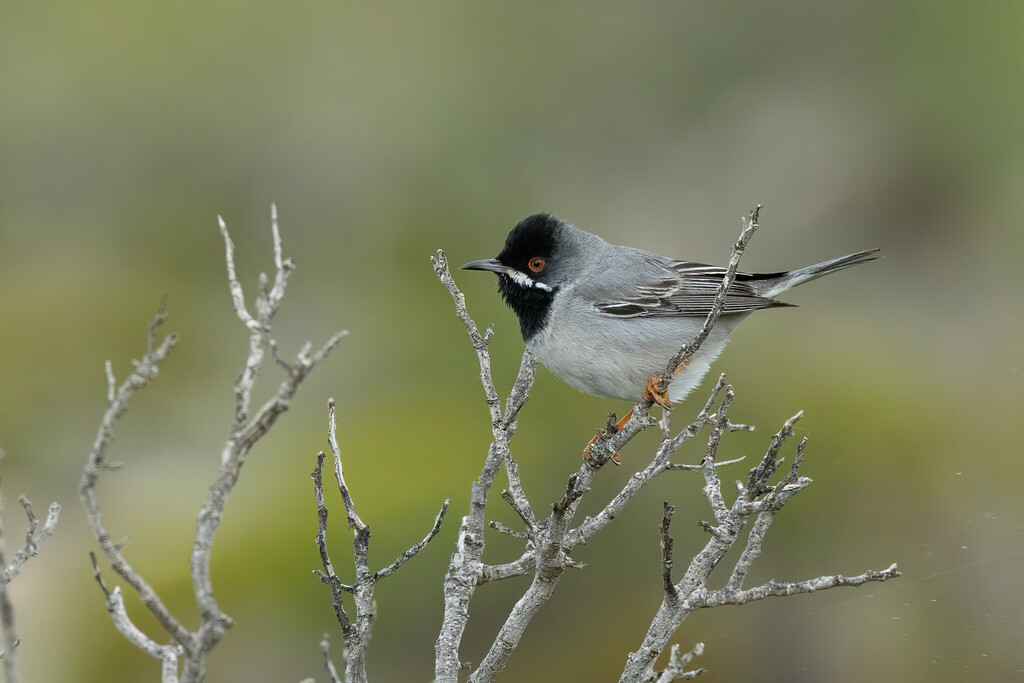
Rüppell’s Warbler
Photo © Thibaud Aronson
Photo © Thibaud Aronson — CC BY-SA 4.0 — Source: iNaturalist photo #381973895Identification
Rüppell's warbler is a small, elegant member of the Curruca genus with a distinctly austere plumage that rewards careful observation. Males are unmistakable: a jet-black head and usually black throat are separated by a striking white malar streak that resembles a bold moustache. Females and non-breeding birds are more subdued, with grey heads showing a brownish tinge on the back and pale throats. All birds share a fine, pointed bill, plain grey upperparts, paler grey underparts, brown legs, and distinctive red eyes. The species is slimmer than the similar Sardinian warbler and produces a slower, deeper rattle in song.
Range & Habitat
This migratory warbler breeds in Greece, Turkey, and neighbouring islands, wintering in northeast Africa. It favours dry, warm Mediterranean environments from sea level to approximately 800–1000 metres, though it reaches 1500 metres in southeastern Turkey and 1600 metres on Crete. Rüppell's warbler occupies rocky hillsides, maquis scrub, and open bushy woods dominated by oak and cypress, preferring more open habitats than its close relative, the Sardinian warbler. During winter and on migration, it frequents scrubby arid areas, gardens, canebrakes, desert wadis with Acacia trees, and bushy mountain slopes. It remains a rare vagrant to western Europe.
Behaviour & Diet
This insectivorous passerine primarily forages for adult and larval insects, supplementing its diet with berries during the non-breeding season. It breeds in dry, scrubby terrain where it constructs a robust, cup-shaped nest from grass leaves and stems, lined with fine materials and typically positioned 45–75 centimetres above ground in dense, often thorny vegetation. In Greece, egg-laying occurs from mid-April to mid-May, with clutches of four or five eggs.
Best Time & Places to See It
The breeding season (April to May) offers the best opportunity to encounter this species in its Greek and Turkish strongholds, particularly in rocky, scrub-covered hillsides and maquis habitats. The striking males are most vocal and conspicuous during this period. Winter observers should focus on northeast African wintering grounds, while migration periods may bring occasional sightings across southern Mediterranean regions and, exceptionally, to western Europe.
Photography Tips
The male's jet-black head and white malar streak provide dramatic contrast and are highly photogenic in clear Mediterranean light. Position yourself with backlighting to enhance the red eye and separate the black plumage from darker backgrounds. The species favours open, bushy terrain, offering good sight lines; early morning provides optimal light and activity levels. Be prepared for rapid, jerky movements through low scrub—use a faster shutter speed and continuous autofocus. Patience and a telephoto lens (400mm or longer) are essential, as these warblers remain small and often skulk in vegetation.
Nothing matches these filters.
Camargue Regional Nature Park
Mount Parnitha National Park
Samaria National Park
Nothing matches these filters.
No community photos yet. Log in to add the first one.
No community observations of this species yet.