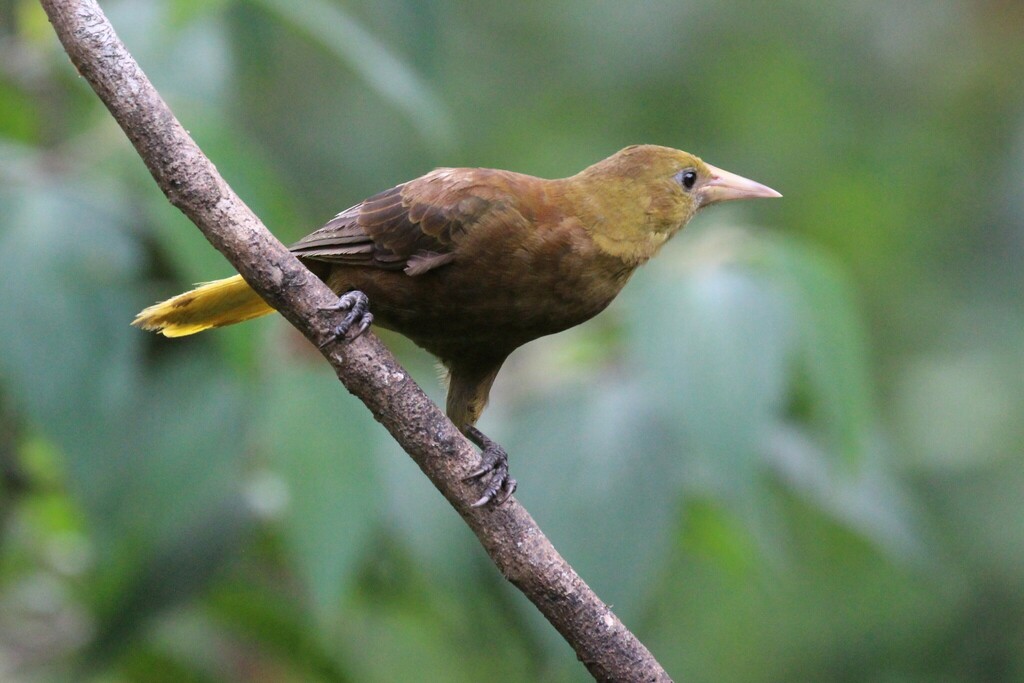
Russet-backed Oropendola
Photo © Rob Foster
Photo © Rob Foster — CC BY 4.0 — Source: iNaturalist photo #352445141Identification
The russet-backed oropendola is a large passerine with striking sexual dimorphism. Males measure 44–48 cm and weigh 250–470 g, while females are noticeably smaller at 34–38 cm and 170–230 g. Males sport an impressive crest of elongated nape feathers absent in females. The nominate subspecies displays an olivaceous-brown head, mostly brown body and wings with russet tones, and a paler russet-brown rump. The tail is predominantly yellow with dusky brown edges, while the bill is blackish, the iris dark brown, and legs and feet blackish. Juveniles appear somewhat yellower on the head with duller tail plumage.
Seven recognized subspecies exhibit considerable variation across the species' range. Notable differences include subspecies with yellow foreheads and chestnut backs (P. a. salmoni), rufescent plumage with orange-yellow bills (P. a. atrocastaneus), and greenish-ivory bills with yellowish-olive tones (P. a. oleagineus). Some populations, particularly P. a. alfredi in Ecuador and Peru, display striking blue eyes. This phenotypic complexity has led taxonomists to suggest that multiple cryptic species may exist within what is currently classified as a single species.
Range & Habitat
The russet-backed oropendola is found across six South American countries: Bolivia, Brazil, Colombia, Ecuador, Peru, and Venezuela. Its distribution is disjunct, with different subspecies occupying distinct geographic regions from the Western Andes of Colombia south to central Bolivia, and from the Venezuelan Coastal Range through the Amazon Basin. Elevation varies significantly by location: in Venezuela it ranges between 400–2,500 m depending on region; in Colombia below 2,500 m; in Ecuador between 1,000–2,000 m; in Peru below 2,000 m; and in Brazil and Bolivia at lower elevations.
Habitat preferences vary by subspecies and landscape. The nominate subspecies of the Amazon Basin favors várzea forest along whitewater rivers, oxbow lakes, and forest clearings. The Andean subspecies inhabit wet subtropical montane forests, humid primary and secondary forest, and increasingly plantations including shade coffee farms. P. a. oleagineus specifically prefers humid to wet montane forests and nearby woodlands. The species demonstrates considerable ecological flexibility, thriving from lowland riparian zones to montane cloud forests.
Behaviour & Diet
The russet-backed oropendola is notably a "noisy and social bird that forages, nests, and roosts in groups." This gregarious nature shapes all aspects of its ecology, from feeding to breeding and roosting behavior. The species maintains strong social bonds and operates within structured flock hierarchies, making it a conspicuous presence throughout its range.
Beyond its highly social and vocal nature, detailed information about specific dietary preferences and foraging techniques remains limited in current scientific literature. However, as an icterid, it likely feeds opportunistically on fruits and insects, with feeding behavior organized around the group dynamics for which the species is known.
Best Time & Places to See It
The russet-backed oropendola is widely distributed across multiple countries and elevation zones, offering varied opportunities for observation. In Brazil's Amazon region, várzea forests along whitewater rivers and near oxbow lakes provide prime habitat for the nominate subspecies. In Ecuador, Peru, and Colombia, humid montane forests between 1,000–2,500 m elevation host multiple subspecies. Venezuelan populations occur both in coastal mountain ranges and Andean slopes.
The species' highly social and vocal habits make it relatively conspicuous despite inhabiting forested areas. Its preference for group roosting and communal nesting sites concentrates birds in accessible locations. Visiting shade coffee plantations in appropriate regions can yield sightings, particularly during periods of group activity. The bird's noisy nature aids location—patient observers listening for distinctive vocalizations can pinpoint flocks within suitable forest habitat.
Photography Tips
Photographing russet-backed oropendolas requires positioning near communal roosting or nesting sites where groups congregate. Males' elaborate crest displays and sexual dimorphism offer compelling compositional opportunities. The contrast between russet and yellow plumage varies dramatically among subspecies, so understanding local subspecies helps anticipate color tones and plan exposure settings accordingly.
The species' social behavior means photographing multiple individuals interacting provides richer documentation than single-bird portraits. Early morning activity near roosts maximizes lighting and behavioral opportunities. Dense montane forest or várzea canopy habitats present typical challenges; consider positioning below or at eye level with birds to use gaps in vegetation effectively. The birds' size and bold coloration reward moderate telephoto lenses, and their group behavior often rewards patience as individuals cycle through predictable patterns throughout the day.
Yasuní National Park
Aguarico, Ecuador
+601 birds+43 mammals
Where the western Amazon basin converges with Ecuador's Orellana Province, lowland rainforest reaches toward the horizon in an unbroken canopy of staggering botanical density. Yasuní National…
VIEW NATIONAL PARKSangay National Park
Cebadas, Ecuador
+320 birds+10 mammals
High in Ecuador's Andean spine, where the Western Cordillera rises to touch perpetual snow, a landscape of volcanic drama and ecological intensity unfolds across Sangay National…
VIEW NATIONAL PARKPodocarpus National Park
Zamora, Ecuador
+496 birds+6 mammals
Where the Andes descend toward the Amazon basin, Podocarpus National Park sprawls across nearly 2,800 square kilometres of the most biodiverse terrain in Ecuador's southern highlands.…
VIEW NATIONAL PARKSumaco Napo-Galeras National Park
Loreto, Ecuador
+563 birds+4 mammals
Where Ecuador's Amazon transitions into cloud forest, a massive shield volcano rises from the emerald lowlands of Orellana Province, anchoring one of the continent's most biodiverse…
VIEW NATIONAL PARKAntisana National Park
Quijos, Ecuador
+432 birds+21 mammals
Where the eastern Andean slopes descend into the Amazon basin, Antisana National Park sprawls across roughly 2,500 square kilometers of some of South America's most dramatic…
VIEW NATIONAL PARKLlanganates National Park
Tena, Ecuador
+239 birds+8 mammals
Where the eastern slopes of the Andes plunge toward the Amazon basin, Llanganates National Park sprawls across nearly 3,500 square kilometers of montane wilderness, its terrain…
VIEW NATIONAL PARKNatural Utría National Park
Alto Baudó (Pie de Pató), Colombia
+372 birds+11 mammals
Where the Chocó's coastal mountains plunge toward the Pacific, Utría National Park preserves one of Colombia's most biodiverse and least-visited wilderness expanses. Sprawling across 1,287 square…
VIEW NATIONAL PARKNatural Munchique National Park
El Tambo, Colombia
+194 birds
Where the Western Cordillera rises steeply from the Pacific plains of southwestern Colombia, Natural Munchique National Park sprawls across 1,078 square kilometers of montane forest that…
VIEW NATIONAL PARKNatural Serranía de los Churumbelos National Park
Santa Rosa, Colombia
+70 birds+2 mammals
Where the western cordillera of Colombia rises toward the Pacific watershed, the Serranía de los Churumbelos unfolds across more than 3,200 square kilometers of some of…
VIEW NATIONAL PARKNatural la Paya National Park
Puerto Leguízamo, Colombia
+262 birds+4 mammals
Where the Amazon's western reaches fold into the Andes foothills, La Paya National Park sprawls across more than 8,500 square kilometers of pristine Amazonian rainforest in…
VIEW NATIONAL PARKNatural Serranía de los Yariguíes National Park
El Carmen de Chucurí, Colombia
+320 birds+3 mammals
Where the northern cordilleras of Colombia rise toward cloud forest, the Serranía de los Yariguíes unfolds across nearly 1,820 square kilometers of some of the most…
VIEW NATIONAL PARKNatural Farallones de Cali National Park
Buenaventura, Colombia
+733 birds+27 mammals
Where the Pacific coastal plain meets the western slopes of the Andes, Farallones de Cali National Park sprawls across nearly 3,500 square kilometers of dramatic topography…
VIEW NATIONAL PARKNatural el Cocuy National Park
Güicán, Colombia
+313 birds+3 mammals
Where the Andes rise to their highest peaks in Colombia's eastern cordillera, El Cocuy National Park sprawls across more than 6,600 square kilometers of some of…
VIEW NATIONAL PARKGuácharos Cave National Natural Park
Acevedo, Colombia
+359 birds
High in the Andean foothills of southern Huila, where mist-laden slopes rise above 1,600 metres, lies a landscape carved by underground rivers and crowned by karst…
VIEW NATIONAL PARKNatural Sumapaz National Park
Cubarral, Colombia
+368 birds+1 mammals
Where the Andes descend toward the Amazon basin, the high páramo grasslands of Sumapaz National Park sprawl across more than five thousand square kilometers of Meta…
VIEW NATIONAL PARKEl Tamá National Park
Toledo, Colombia
+435 birds
Where the Andes descend toward the Caribbean coastal lowlands of northern Colombia, El Tamá National Park sprawls across nearly 3,800 square kilometres of montane forest, cloud…
VIEW NATIONAL PARKNatural Sierra de la Macarena National Park
Vista Hermosa, Colombia
+566 birds+15 mammals
Across nearly 20,000 square kilometres of Colombia's Meta Department, the terrain rises from lowland savanna into Andean foothills through a mosaic of gallery forests, palm-fringed wetlands,…
VIEW NATIONAL PARKAmacayacu National Park
Leticia, Colombia
+567 birds+25 mammals
Where the Rio Amazonas curves through the tri-border region where Colombia, Peru, and Brazil converge, Amacayacu National Park sprawls across more than 5,250 square kilometres of…
VIEW NATIONAL PARKNatural Nevado del Huila National Park
Planadas, Colombia
+117 birds
Where the Colombian Andes rise above 5,000 metres, tropical cloud forest yields to páramo and glaciated peaks, and the Planadas region of Tolima contains one of…
VIEW NATIONAL PARKAnavilhanas National Park
Brazil
+468 birds+8 mammals
Across the Rio Negro in central Amazonas, an archipelago of over a thousand islands rises from the world's largest rainforest river system, creating a labyrinth of…
VIEW NATIONAL PARKSerra do Divisor National Park
Brazil
+448 birds+10 mammals
Where the western Amazon meets the Andes foothills, Serra do Divisor National Park sprawls across one of South America's most biodiverse and least accessible frontiers. Spanning…
VIEW NATIONAL PARKYanachaga–chemillén National Park
Palcazu, Peru
+639 birds+6 mammals
Where the eastern slopes of Peru's central cordillera plunge into cloud forest, Yanachaga–Chemillén National Park protects nearly three thousand square kilometres of montane wilderness that few…
VIEW NATIONAL PARKManu National Park
Manu, Peru
+892 birds+26 mammals
Across the eastern slopes of the Peruvian Andes, tropical rainforest descends into the Amazon basin with a complexity that few terrestrial ecosystems match. Manu National Park…
VIEW NATIONAL PARKSierra del Divisor National Park
Alto Tapiche, Peru
+298 birds+2 mammals
Where the western Amazon meets the Andes foothills, nearly 41,000 square kilometres of pristine rainforest rise across Peru's Alto Tapiche region in a landscape of extraordinary…
VIEW NATIONAL PARKBahuaja Sonene National Park
San Pedro de Putina Punco, Peru
+602 birds+8 mammals
Where the Madre de Dios and Heath rivers converge in southeastern Peru rises one of South America's most biodiverse wilderness regions: a vast protected realm of…
VIEW NATIONAL PARKTingo Maria National Park
Mariano Dámaso Beraún, Peru
+423 birds
Where the eastern slopes of the Peruvian Andes descend toward the Amazon basin, the landscape fractures into a maze of limestone ridges, humid gorges, and cloud-wrapped…
VIEW NATIONAL PARKCordillera Azul National Park
Pampa Hermosa, Peru
+322 birds+1 mammals
Where the eastern Andes descend into the western Amazon basin, Cordillera Azul National Park sprawls across nearly 38,000 square kilometres of some of Peru's most pristine…
VIEW NATIONAL PARKNo community photos yet. Log in to add the first one.
No community observations of this species yet.