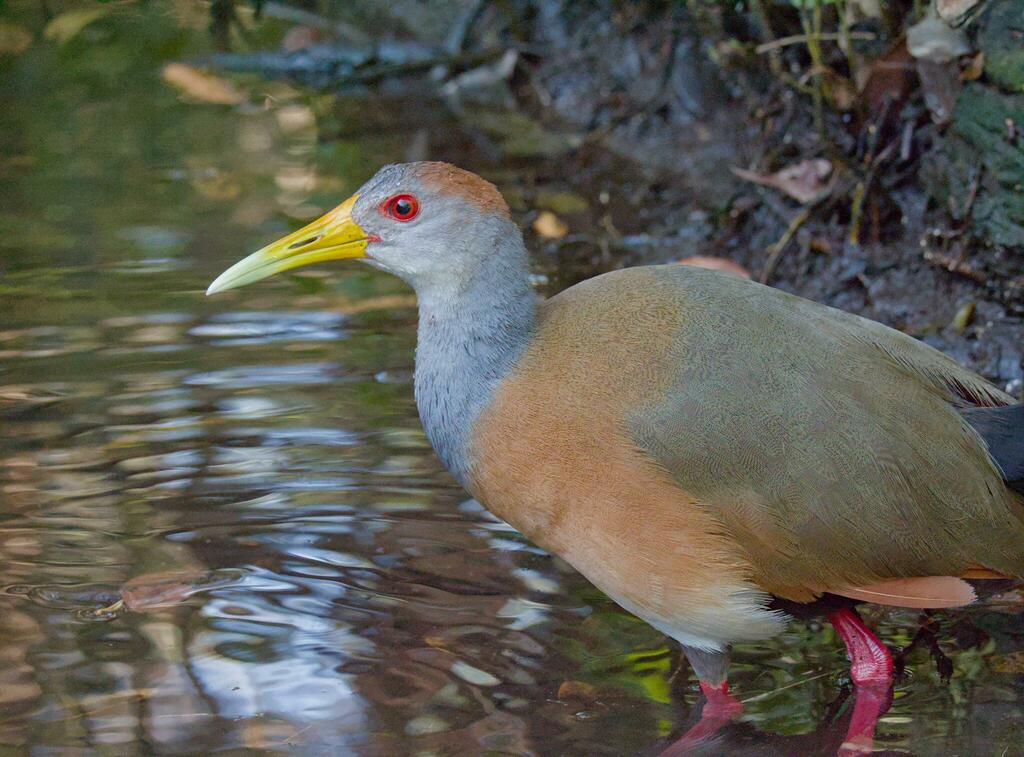
Russet-naped Wood Rail
Photo © Blake Ross
Photo © Blake Ross — CC BY 4.0 — Source: iNaturalist photo #451568796Identification
The russet-naped wood rail is a medium-sized rail measuring 33 to 40 cm in length and weighing 450 to 600 grams. Both sexes appear identical. Adults are distinguished by a thick dark yellow bill with a light green tip, a striking deep red eye, and red to pink legs and feet. The head is slate gray on the forehead, crown, and hindneck, with a distinctive chestnut patch on the back of the head. The back is grayish olive and the tail is black. The throat and chin are white, while the sides of the neck, lower throat, and upper breast are gray. The breast, upper belly, and flanks are pale tawny cinnamon, separated by a pale band from the black lower belly, vent, and undertail coverts. Juveniles lack white on the belly and have dark gray underparts with tawny flecks instead of the adult's black markings.
Range & Habitat
The russet-naped wood rail is found from Mexico through Central America to Costa Rica. Five subspecies occupy different regions: mexicanus inhabits eastern Mexico from southern Tamaulipas to the Yucatán Peninsula; vanrossemi occupies the Pacific slope from southern Mexico through Guatemala and El Salvador; albiventris ranges from the Yucatán Peninsula through Belize into northern Guatemala; pacificus inhabits the Caribbean slope of Honduras and Nicaragua; and plumbeicollis is found in northeastern Costa Rica. This species is a year-round resident throughout its range.
The russet-naped wood rail inhabits a remarkably diverse array of wetland and woodland habitats, including fresh and salt marshes, swamp forest, river and stream corridors, thorn forest, semi-evergreen forest, and mangrove forest. The key requirement is dense vegetation cover regardless of whether the habitat is wet or dry.
Behaviour & Diet
This species is predominantly secretive, spending much of its time foraging within dense vegetation. However, it occasionally feeds in open areas, particularly along stream banks and in grassy zones adjacent to forest. Its diet includes vegetable matter, snails, crabs, and has been documented to include a snake, though its feeding ecology remains incompletely known.
The russet-naped wood rail's nesting season spans multiple months, with breeding adults recorded in January, April through June, and August. The nest is a shallow bowl loosely constructed of sticks and plant fibers, typically placed a few meters above ground in bushes, vines, or trees, often positioned above water. Clutches contain three to seven eggs. The species is most vocal at twilight and night, producing a remarkable variety of vocalizations described as a rapid, crazed-sounding series of pops, coos, clucks, and rollicking sounds, including harsh cackling or growling when disturbed.
Best Time & Places to See It
The russet-naped wood rail is a permanent resident, making it potentially observable year-round throughout its range from Mexico to Costa Rica. The species is most vocal and active during twilight hours and at night, when your chances of hearing this distinctive bird are greatest. Look for it in marshy areas, mangrove forests, swamp edges, and stream corridors with dense vegetation cover. The bird's secretive nature means patience and careful listening are essential; use the bird's distinctive vocal series to locate individuals.
Photography Tips
Photographing the russet-naped wood rail requires persistence given its preference for dense cover and secretive habits. Early morning and late afternoon visits to suitable habitat offer the best opportunities for observation and photography. Position yourself near stream edges, marsh margins, or open feeding areas where the bird occasionally ventures into the open. The species' striking features—the chestnut nape, deep red eye, and colorful bill and legs—are most visible when birds emerge from cover. Use a telephoto lens to minimize disturbance, and consider that audio recording may be equally rewarding, as the bird's complex vocalizations are often easier to document than visual sightings.
Arenal Volcano National Park
Peñas Blancas, Costa Rica
+551 birds+21 mammals
Straddling the border between Alajuela and Guanacaste in northwestern Costa Rica, this national park rises dramatically around one of Central America's most active volcanic systems. The…
VIEW NATIONAL PARKTortuguero National Park
Roxana, Costa Rica
+420 birds+23 mammals
Canals and lagoons thread through a labyrinth of lowland rainforest where the Caribbean coast of Costa Rica meets the wetland frontier. This is terrain shaped by…
VIEW NATIONAL PARKBraulio Carrillo National Park
Las Horquetas, Costa Rica
+547 birds+18 mammals
Where the Caribbean slope descends from the central volcanic cordillera toward the humid lowlands of Heredia, Braulio Carrillo National Park preserves one of Costa Rica's most…
VIEW NATIONAL PARKSanta Rosa National Park
Santa Elena, Costa Rica
+359 birds+30 mammals
Where Pacific-facing slopes descend from volcanic uplands toward the Guanacaste lowlands, Santa Rosa National Park unfolds across a mosaic of tropical dry forest, gallery woodland, and…
VIEW NATIONAL PARKGuanacaste National Park
Santa Elena, Costa Rica
+461 birds+17 mammals
Where the Pacific slopes of northwestern Costa Rica rise toward the Continental Divide, dry tropical forest gives way to cloud-laden peaks and misty ridges—a landscape that…
VIEW NATIONAL PARKLagunas de Montebello National Park
Laguna de Montebello, Mexico
+360 birds+2 mammals
Where turquoise lagoons pierce the limestone plateau of southeastern Chiapas, the Lagunas de Montebello National Park unfolds across roughly 174 square kilometers of spectral water and…
VIEW NATIONAL PARKSian Ka’an
Chunyaxché, Mexico
+350 birds+16 mammals
Where the Yucatán Peninsula dissolves into wetland and mangrove, a vast mosaic of forest, lagoon, and coastal margin creates one of Mexico's most biodiverse strongholds. Across…
VIEW BIOSPHERE RESERVEMontes Azules
Candelaria, Mexico
+395 birds+47 mammals
Where jungle-clad limestone plateaus plunge into canyon systems carved by the Usumacinta River, Mexico's most pristine rainforest reserve unfolds across the Lacandón region of Chiapas. Montes…
VIEW BIOSPHERE RESERVETikal National Park
Tikal, Guatemala
+399 birds+16 mammals
Dense rainforest canopy rises above the limestone plateau of Petén, where archaeological wonder and ecological richness merge seamlessly across one of Central America's most biodiverse landscapes.…
VIEW NATIONAL PARKLaguna del Tigre National Park
Petén, Guatemala
+399 birds+29 mammals
Where the Petén lowlands dissolve into wetland and forest, Laguna del Tigre National Park protects one of Guatemala's most ecologically vital landscapes. This sprawling reserve encompasses…
VIEW NATIONAL PARKSierra del Lacandón National Park
Petén, Guatemala
+348 birds+7 mammals
Where the Petén rainforest rises into limestone ridges and deep ravines, Sierra del Lacandón National Park protects one of Central America's most intact tropical wilderness zones.…
VIEW NATIONAL PARKPalo Verde National Park
Bagaces, Costa Rica
+318 birds+24 mammals
Dry forest spreads across Palo Verde's low-lying terrain in northwestern Guanacaste, where seasonal rivers and lagoons etch through deciduous woodland that sheds its canopy each winter.…
VIEW NATIONAL PARKCahuita National Park
Talamanca, Costa Rica
+359 birds+15 mammals
Where the Caribbean shoreline dissolves into mangrove creeks and coral gardens, Cahuita's mosaic of habitats unfolds across the Limón coast. The park's signature feature—a living coral…
VIEW NATIONAL PARKRincón de la Vieja National Park
Liberia, Costa Rica
+451 birds+30 mammals
Where volcanic slopes rise abruptly from the Guanacaste lowlands, Rincón de la Vieja National Park sprawls across a landscape shaped by geothermal drama and seasonal extremes.…
VIEW NATIONAL PARKVolcán Tenorio National Park
Guatuso, Costa Rica
+480 birds+12 mammals
Where volcanic slopes rise through Costa Rica's northwestern borderlands, Volcán Tenorio National Park sprawls across terrain shaped by ancient lava flows and mineral-rich springs. The park's…
VIEW NATIONAL PARKMarino Las Baulas National Park
Santa Cruz, Costa Rica
+246 birds+9 mammals
Where the Pacific meets a mosaic of dry forest and mangrove estuary, this coastal national park protects one of Central America's most dynamic wildlife theatres. The…
VIEW NATIONAL PARKCaño Negro National Wildlife Refuge
Caño Negro District, Costa Rica
+486 birds+16 mammals
Where the San Juan River's seasonal floodplain opens into expansive wetlands, Caño Negro Wildlife Sanctuary sprawls across one of Central America's most productive freshwater ecosystems. This…
VIEW WILDLIFE SANCTUARYGandoca-Manzanillo National Wildlife Refuge
Manzanillo, Costa Rica
+394 birds+18 mammals
Where the Caribbean coastal plain surrenders to water-logged forest and mangrove tangles, Gandoca-Manzanillo Wildlife Sanctuary shelters one of Costa Rica's most biodiverse lowland wetland ecosystems. The…
VIEW WILDLIFE SANCTUARYBarra del Colorado National Wildlife Refuge
Tortuguero, Costa Rica
+462 birds+36 mammals
Where the Caribbean's restless waters meet the Limón Province coastline, Barra del Colorado National Wildlife Sanctuary unfolds across a landscape of extraordinary ecological complexity. This equatorial…
VIEW WILDLIFE SANCTUARYNo community photos yet. Log in to add the first one.
No community observations of this species yet.