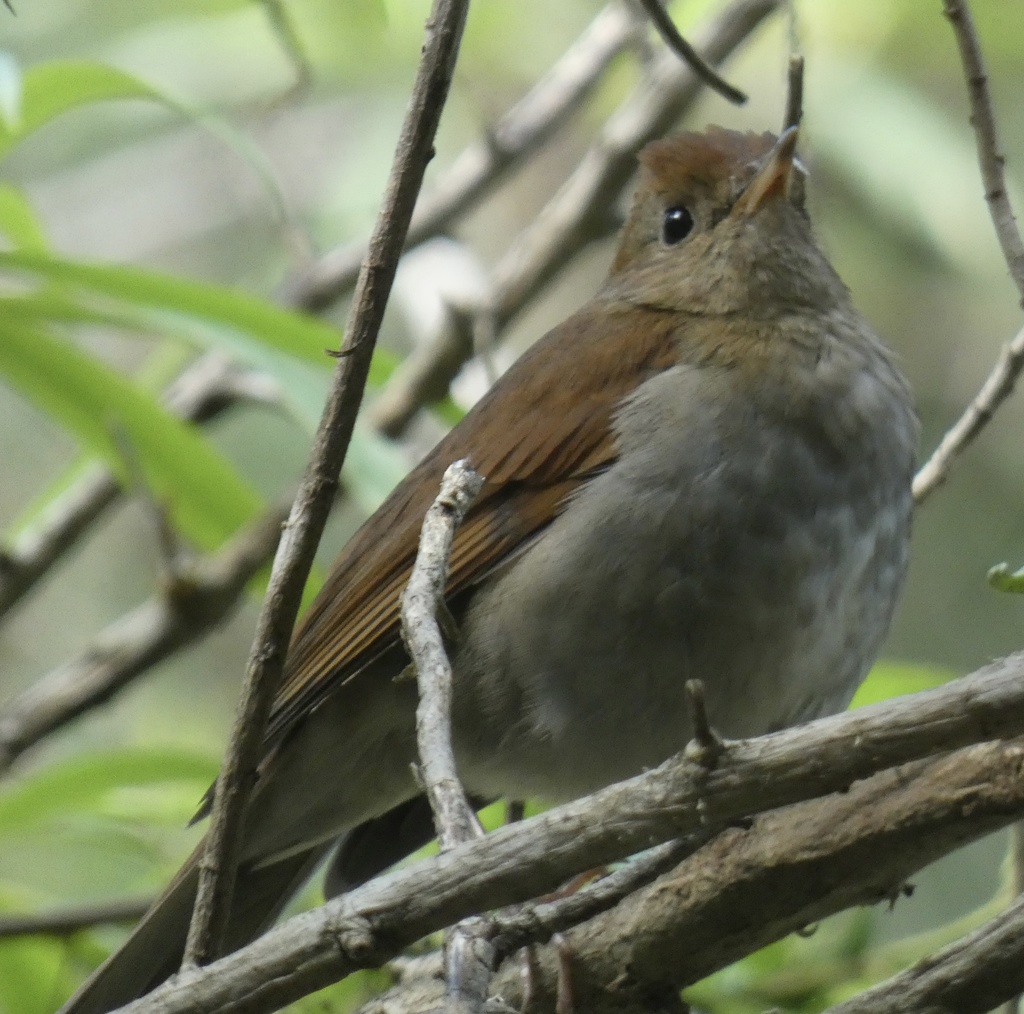
Russet Nightingale-Thrush
Photo © Jean-Paul Boerekamps
Photo © Jean-Paul Boerekamps — CC0 1.0 — Source: iNaturalist #66131644Identification
The russet nightingale-thrush is a small thrush, measuring 15.5 to 18 cm in length and weighing 22 to 37 grams. The nominate subspecies displays a distinctive deep russet-brown crown and nape contrasting with a light olive-brown or buffy-olive face. The upperparts are olivaceous russet-brown, while the tail and uppertail coverts show more rufescent tones. The underparts are subtly marked: a buffy-whitish throat with faint streaking, a pale buffy-olive breast with indistinct spots, and pale grayish-olive flanks. All subspecies share a brown iris, dark brown maxilla, and dusky-tipped yellowish mandible. Immature birds are distinctly streaked and spotted, appearing more rufescent with pale buffy underparts.
The four subspecies show notable variation across Mexico. C. o. olivascens lacks russet tones, displaying olive-brown upperparts and deeper buff underparts with prominent streaking. C. o. lambi is similar but darker with a redder crown. C. o. fulvescens is lighter and more fulvous throughout. Females and males are identical in plumage, making field identification based on appearance alone impossible.
Range & Habitat
Endemic to Mexico, the russet nightingale-thrush has a disjunct distribution across the country's mountain ranges. C. o. olivascens occupies northwestern Mexico from southeastern Sonora and western Chihuahua south through Sinaloa and northwestern Durango. C. o. lambi ranges across central Mexico from Durango to northwestern Jalisco and from southeastern Coahuila to northwestern Puebla. C. o. fulvescens inhabits southwestern Mexico from southern Jalisco through Puebla to Guerrero. The nominate C. o. occidentalis is restricted to southern Mexico in western Guerrero and Oaxaca.
This species favors montane evergreen, pine-oak, and oak forests in subtropical and lower temperate zones, typically between 1,500 and 3,700 meters elevation. These forest habitats provide the cool, moist conditions the species requires throughout the year, as the russet nightingale-thrush is primarily a permanent resident with only minor elevational movements recorded.
Behaviour & Diet
The russet nightingale-thrush is a cryptic, ground-dwelling forager that typically hunts singly in the understory, gleaning insects from the leaf litter and low vegetation. Its diet consists primarily of insects, supplemented occasionally with fruit, though detailed dietary information remains scarce. This secretive behavior makes the species challenging to observe despite its fairly common to common status across suitable habitat.
The breeding season spans at least April to July in the southern portion of its range, though the full extent of breeding activity across all populations remains incompletely documented. Pairs construct simple cup nests positioned near or on the ground, where females lay clutches of two or three plain blue eggs. The incubation period, fledging duration, and parental care behaviors have not been formally documented. The species produces a varied, thin song described as having a tinny quality—phrases like "she-vee-ee-i-lu" or "chee ti-vee" repeated in fairly rapid succession. Its calls include a quiet, low, gruff "chuk" or "chruh" and a nasal, mewing "reear."
Best Time & Places to See It
The russet nightingale-thrush is a year-round resident across its range, making it potentially observable in any season, though breeding activity peaks from April through July in southern populations. The species' fairly common to common status suggests reasonable encounter rates in appropriate habitat, though its ground-dwelling, secretive nature means patience and careful listening will reward birders.
Seek this thrush in montane pine-oak and oak forests throughout its disjunct range, visiting higher elevations between 1,500 and 3,700 meters. The subspecies distribution across Mexico's mountain chains—from northwestern ranges to the southern highlands of Guerrero and Oaxaca—offers multiple regions for exploration. Early morning visits to quiet forest understory sections, where the species forages, offer the best opportunity for encounters.
Photography Tips
Photographing the russet nightingale-thrush demands patience and a methodical approach. The species' preference for ground-level foraging in dense understory vegetation makes it inherently challenging to capture. Move slowly through suitable habitat during early morning hours when the bird is most active, and listen carefully for its distinctive thin, tinny phrases to locate individuals before attempting photography.
The subtle plumage differences between subspecies make this species particularly rewarding for photographers interested in documenting regional variation. Use a relatively fast shutter speed to freeze movement among leaf litter, and employ a telephoto lens to maintain distance and avoid flushing the bird. The species' low position and habit of foraging in shadows require careful exposure metering; compensate for underexposure to render the warm russet and olive tones accurately. Capturing the characteristic pale eye-line and facial markings will aid in subspecific identification, making your images scientifically valuable.
Parque Nacional Benito Juárez
San Andrés Huayápam, Mexico
+128 birds+4 mammals
High in the Sierra Madre del Sur of Oaxaca, where cloud forest mingles with pine woodland and the terrain climbs steeply through ravines carved by mountain…
VIEW NATIONAL PARKTutuaca
Tosanachi, Mexico
+147 birds+13 mammals
Where copper canyons plunge deeper than the Grand Canyon itself, Mexico's remote Sierra Madre Occidental unfolds in dramatic vertical relief. Tutuaca anchors this wilderness realm, a…
VIEW PROTECTED LANDSCAPENo community photos yet. Log in to add the first one.
No community observations of this species yet.