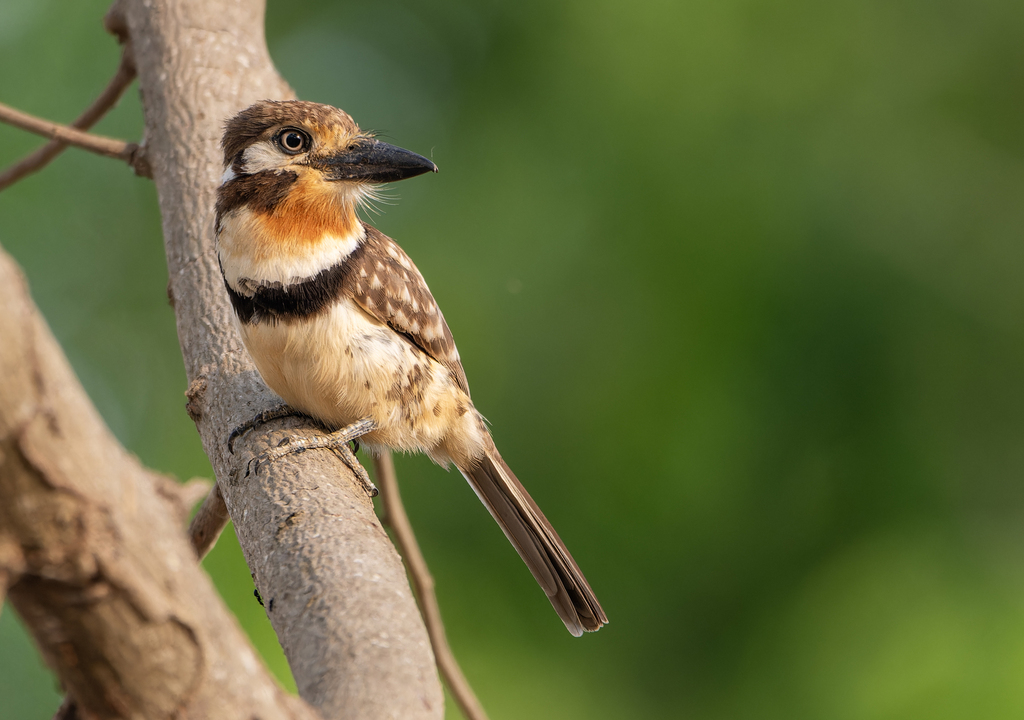
Russet-throated Puffbird
Photo © David F. Belmonte
Photo © David F. Belmonte — CC BY 4.0 — Source: iNaturalist photo #367730964Identification
The russet-throated puffbird is a compact bird measuring 20 to 22 cm long, weighing just 41 to 57 grams. Despite its small size, it is distinctly marked and relatively easy to identify within its range. The most striking feature is the rich rufous throat and upper breast, which gives the species its common name. The crown is dark brown with pale spots, and a distinctive white eye-patch contrasts with a black patch below it. A narrow buffy or white collar adorns the nape.
The upperparts are dull brown with grayish mottling, while the underparts show a characteristic pattern: white chin, russet throat, then a thin white band followed by a bold black band across the chest. The rest of the belly is reddish-buff with black barring on the flanks. The eye is striking yellow to white, and the bill and feet are dark. Geographic variation exists among subspecies, with some populations showing paler plumage, whiter underparts, or deeper orange tones than others.
Range & Habitat
The russet-throated puffbird is endemic to northern South America, found only in Colombia and Venezuela. Four recognized subspecies are distributed across the region, from extreme northeastern Colombia westward into Venezuelan states including Zulia and Falcón, with populations occurring both north and south of Lake Maracaibo. The species is believed to be a year-round resident throughout its range.
This puffbird favors open to semi-open landscapes, including deciduous forest interiors and edges, treed savanna, dense secondary forest, and arid scrub with scattered trees. It occurs from lowlands up to about 700 meters elevation in Venezuela, and reaches approximately 1,300 meters in Colombia, demonstrating adaptability to varying altitudes across its modest range.
Behaviour & Diet
The russet-throated puffbird is a sit-and-wait hunter, perching motionless up to 8 meters above ground before sallying out to snatch prey. It hunts insects from vegetation, branches, trunks, and the ground itself, though it also takes small vertebrates such as lizards and occasionally fruits. This foraging strategy is characteristic of the puffbird family and makes the bird relatively inconspicuous despite its colorful plumage.
Breeding occurs in May in Colombia and August to September in Venezuela. The species typically excavates burrows in arboreal termitaria, though it occasionally adopts abandoned oven-shaped nests built by pale-legged horneros. Clutches contain three eggs. The russet-throated puffbird is vocal, particularly at dawn, delivering a distinctive song of repeated rhythmic "woduk" notes that crescendo for up to 20 seconds before diminishing. Pairs often sing together, and the species also produces a "seeeeep" call.
Best Time & Places to See It
The russet-throated puffbird's year-round residency makes it potentially viewable throughout the year, though breeding activity peaks in May (Colombia) and August to September (Venezuela), when birds are more vocal and active. Dawn hours are the best time to locate this species, as it sings most actively during early morning.
Look for this puffbird in open deciduous forests, treed savannas, and semi-open scrubby habitats within Colombia and Venezuela. The species occurs in at least one protected area in each country, making these reserves good starting points for searches. Its preference for perching 4 to 8 meters up makes it visible from below with patience, though its relatively cryptic brown upperparts can make it challenging to spot among foliage.
Photography Tips
The russet-throated puffbird's small size and preference for perching in mid-story vegetation present both challenges and opportunities for photographers. Position yourself with the morning sun behind or to the side to illuminate the bird's distinctive rufous throat and white eye-patch. A telephoto lens (at least 300mm equivalent) is essential given the bird's size and typical perching height.
Dawn visits, when the bird is most vocal and active, offer the best lighting and behavior opportunities. The white eye-patch and facial markings are particularly striking and should be your focus when framing shots. Patience is key—find a productive perch and wait for the bird to sally, when its full body and colors are most visible. The bird's sit-and-wait hunting style means it returns repeatedly to favored perches, increasing your chances of obtaining quality images.
No community photos yet. Log in to add the first one.
No community observations of this species yet.