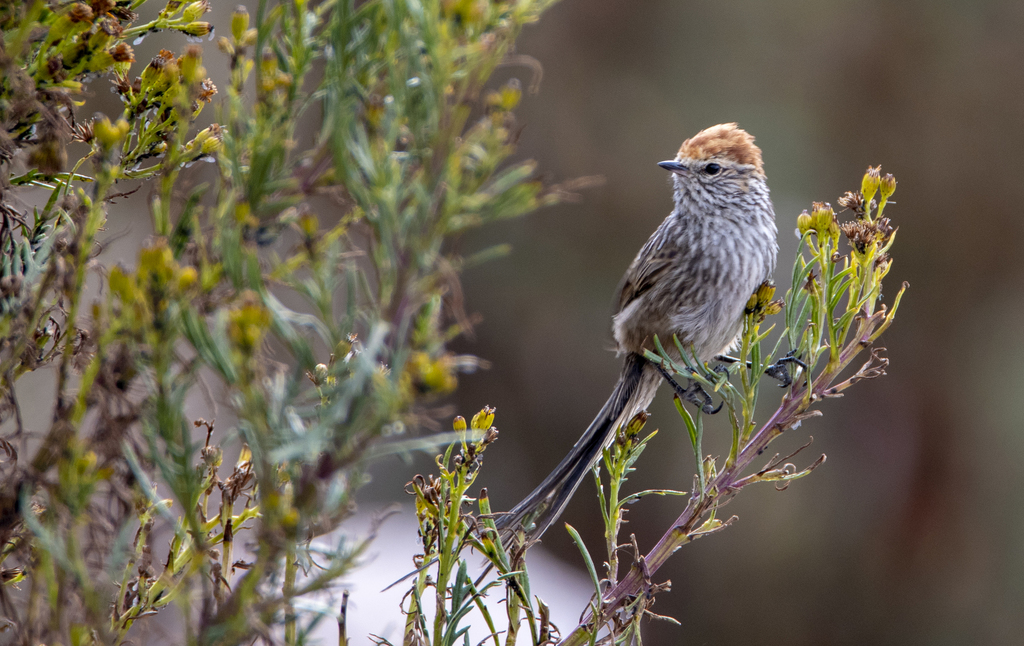
Rusty-crowned Tit-Spinetail
Photo © David F. Belmonte
Photo © David F. Belmonte — CC BY 4.0 — Source: iNaturalist photo #161416789Identification
The rusty-crowned tit-spinetail is a small, compact bird measuring about 15 cm long and weighing 8 to 12.5 grams. It is characterized by a short bill, long tail, and distinctive rusty crown adorned with narrow white streaks. The face is grayish with a faint white supercilium, while the back is blackish with fine white streaking and the rump is light gray-brown. The tail is graduated, with the central feathers dusky brown and the outer pairs progressively paler, becoming almost entirely pale on the outermost feathers. The throat is white with dusky spots, and the breast and belly are light grayish brown with faint whitish streaking. The iris is dark brown, the bill black with a pinkish-gray base, and the legs and feet are gray to black. Three subspecies exist, with slight variations: cajabambae has black rather than white crown streaks, while latistriata displays wider back streaks and darker, more heavily streaked underparts.
Range & Habitat
This species is endemic to the Andes of western Peru, where it occupies three distinct regional populations. The northern subspecies cajabambae is found between Cajamarca and Junín departments, the nominate pileata occurs in the Chillón and Rímac river valleys in Lima Department, and latistriata inhabits the south-central departments of Huancavelica, Ayacucho, and Arequipa. The rusty-crowned tit-spinetail is a year-round resident, never leaving its montane territory. It favors arid montane scrub and relict woodlands, particularly those dominated by Polylepis trees, typically occurring between 2,900 and 4,200 meters elevation, though occasionally found as low as 2,000 meters.
Behaviour & Diet
This species is an active forager that feeds primarily on arthropods, which it obtains through gleaning foliage and twigs and by probing and picking at bark, concentrating its efforts on upper and outer branches. The rusty-crowned tit-spinetail is notably social, regularly joining mixed-species foraging flocks that move through its montane habitat. Its vocalizations are distinctive and frequent: the song consists of a approximately 2-second trill that gradually increases in amplitude and speed, repeated at 3 to 6 second intervals. It also produces several distinctive calls including a simple tsak, a staccato rick teek teek pattern, and a sharp, high tchit sound.
Best Time & Places to See It
As a year-round resident throughout its Peruvian range, the rusty-crowned tit-spinetail can be encountered in any season. The species is considered fairly common within its restricted range, making it a reliable find for travelers exploring the high Andes. To locate this bird, focus on arid montane scrub and Polylepis woodlands between 2,900 and 4,200 meters elevation in the departments where it occurs. Listen for its distinctive trilling song and staccato calls, which often betray the bird's presence before it is seen. Visiting mixed-species foraging flocks will increase your chances of observation.
Photography Tips
The rusty-crowned tit-spinetail's small size and preference for upper and outer branches requires patience and a telephoto lens of at least 300–400 mm. The bird's contrasting plumage—with its rusty crown, streaked back, and pale tail—photographs well in the clear light of high-altitude mornings. Early morning sessions in Polylepis woodlands offer the best lighting conditions and highest activity levels. The bird's tendency to join mixed foraging flocks means staying with these groups increases your chances of repeated views. The habitat's open montane terrain means fewer obstructions, but the high elevation demands acclimation time and sharp autofocus settings to compensate for atmospheric haze.
No community photos yet. Log in to add the first one.
No community observations of this species yet.