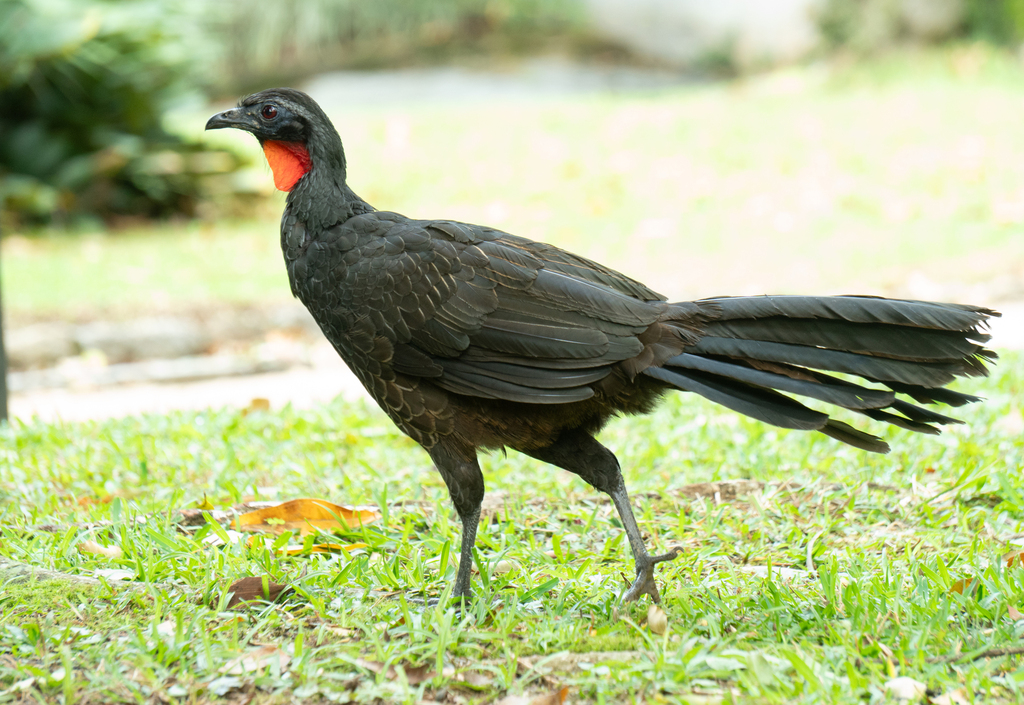
Rusty-margined Guan
Photo © filipeprates
Photo © filipeprates — CC BY 4.0 — Source: iNaturalist photo #571158659Identification
The rusty-margined guan is a medium-sized game bird measuring 55 to 73 cm in length, with weight varying by subspecies from 750 to 1,150 grams. Its most distinctive feature is the rusty-red margining on its wing coverts and scapulars—the characteristic that gives the species its name. The bird's upperparts are dark olive to brownish, while the belly displays the same rusty coloration as the wing edges. A pale face with a prominent supercilium (eyebrow stripe) is another key identifying mark, though the supercilium's color varies among subspecies, ranging from white to buff or ochre. Subspecific differences in plumage are notable: P. s. jacupemba appears paler overall, while P. s. major is notably darker than the nominate subspecies.
Range & Habitat
The rusty-margined guan is found across a wide geographic range spanning Argentina, Bolivia, Brazil, and Paraguay, with four recognized subspecies occupying different portions of this distribution. The nominate subspecies inhabits Amazonian Brazil south of the Amazon River, while P. s. jacupemba ranges from central and southern Brazil into eastern Bolivia. P. s. major occupies extreme southeastern Brazil, eastern Paraguay, and extreme northeastern Argentina.
This adaptable species inhabits diverse lowland landscapes throughout its range, including interior and edge habitats of heavy forest, gallery forest, restinga, woodlands in cerrado grasslands, caatinga scrub, mangroves, and even Eucalyptus plantations. Although primarily a lowland bird, it can be found at elevations up to 1,300 meters in parts of Brazil, demonstrating considerable habitat flexibility.
Behaviour & Diet
The rusty-margined guan is essentially sedentary, though in some areas it makes modest daily movements of up to 400 meters between roosting sites in higher areas and lowland feeding grounds. The species is a reluctant flier, seldom flying more than about 20 meters and typically much less. It forages alone, in pairs, or in small groups of up to ten birds, typically feeding between 5 and 10 meters above ground, though it also frequents the forest floor.
The bird's diet is almost entirely frugivorous, with one study identifying fruit from 117 different plant species in its diet. It supplements this primarily fruit-based diet with small amounts of flowers, leaves, and insects. During breeding season—October to February in Argentina and August to February in southeastern Brazil—pairs establish territories and construct stick platforms lined with leaves in trees, typically laying clutches of three eggs. The species produces a distinctive gruff barking call, probably associated with alarm, and performs a wing-whirring display whose function remains poorly understood.
Best Time & Places to See It
The rusty-margined guan is reasonably common only within protected areas, making national parks and reserves the most reliable locations for viewing. The breeding season from August to February is an excellent time to locate birds, as they are more vocal and active during this period. Early morning hours typically offer the best opportunities for observation, when birds are most active in their feeding areas.
Photography Tips
The guan's habit of feeding in the mid-canopy at heights of 5 to 10 meters makes a telephoto lens essential for photography. Its dark plumage and preference for forested habitats present low-light challenges; a fast lens or high ISO setting will help capture detail. The rusty margins on the wings and the distinctive pale supercilium are key field marks worth highlighting in images. Patient observation near fruiting trees during early morning is likely to yield the best photographic opportunities, as birds concentrate in food-rich areas.
Tijuca National Park
Brazil
+317 birds+13 mammals
Where the Atlantic forest rises steeply from Rio de Janeiro's urban edge, Tijuca National Park encompasses a landscape of dramatic granite peaks, cascading waterfalls, and closed-canopy…
VIEW NATIONAL PARKEmas National Park
Brazil
+333 birds+23 mammals
Across the high plateaux of central Brazil, where the cerrado grasslands roll toward distant horizons under an immense sky, Emas National Park anchors one of South…
VIEW NATIONAL PARKSerra do Cipó National Park
Brazil
+379 birds+5 mammals
Where granite escarpments rise above the Atlantic Forest transition zone in southeastern Brazil, Serra do Cipó National Park unfolds across a landscape of dramatic ridges, cascading…
VIEW NATIONAL PARKItatiaia National Park
Brazil
+519 birds+12 mammals
Where granite peaks pierce the Atlantic rainforest canopy in southeastern Brazil, Itatiaia National Park rises as one of the country's oldest and most ecologically vital protected…
VIEW NATIONAL PARKSaint-Hilaire/Lange National Park
Brazil
+225 birds
Subtropical Atlantic forests rise and fall across the plateaus of inland Paraná, where Saint-Hilaire/Lange National Park protects nearly 578 square kilometres of Brazil's most biodiverse woodland…
VIEW NATIONAL PARKSerra do Itajaí National Park
Brazil
+227 birds+2 mammals
Where the Atlantic rainforest rises steeply from the coastal plains of Santa Catarina, Serra do Itajaí National Park spreads across 1,136 square kilometres of montane wilderness…
VIEW NATIONAL PARKSerra da Bocaina National Park
Brazil
+441 birds+5 mammals
Where the escarpment of the Serra da Bocaina rises sharply from the Atlantic coastal plain, tropical rainforest cloaks steep mountainsides that climb toward peaks exceeding 2,000…
VIEW NATIONAL PARKIguaçu National Park
Brazil
+387 birds+17 mammals
Where the Paraná Plateau plunges toward the Atlantic watershed, six thousand square kilometers of subtropical rainforest cling to steep gorges and river valleys in this corner…
VIEW NATIONAL PARKSerra da Capivara National Park
Brazil
+156 birds+6 mammals
Across the semi-arid plateaus and deeply incised canyons of northeastern Brazil, where Piauí's ancient sandstone formations rise and fall in weathered waves, Serra da Capivara National…
VIEW NATIONAL PARKPau Brasil National Park
Brazil
+211 birds
Tropical Atlantic forest cloaks the rolling terrain of northeastern Bahia, where Pau Brasil National Park protects nearly 390 square kilometers of one of Brazil's most biodiverse…
VIEW NATIONAL PARKSerra dos Órgãos National Park
Brazil
+446 birds+13 mammals
Granite peaks thrust skyward through the Atlantic Forest canopy in the mountains immediately north of Rio de Janeiro, their bare rock faces rising above a landscape…
VIEW NATIONAL PARKSete Cidades National Park
Brazil
+125 birds+1 mammals
Sete Cidades sprawls across 113 square kilometres of northeastern Brazil's interior plateau, where weathered sandstone formations rise dramatically from the cerrado landscape. The park's geology tells…
VIEW NATIONAL PARKChapada dos Guimarães National Park
Brazil
+450 birds+1 mammals
Where weathered sandstone plateaus rise above the cerrado grasslands of central Brazil, Chapada dos Guimarães National Park protects 624 square kilometres of ecological transition zone that…
VIEW NATIONAL PARKChapada dos Veadeiros National Park
Brazil
+324 birds+6 mammals
Where granite plateaus rise above the cerrado savanna in central Brazil, Chapada dos Veadeiros National Park unfolds across 6,665 square kilometres of some of the world's…
VIEW NATIONAL PARKPantanal Matogrossense National Park
Brazil
+322 birds+17 mammals
Where the flooded forests of central Brazil meet vast seasonally inundated grasslands, Pantanal Matogrossense National Park sprawls across nearly 2,900 square kilometers of one of the…
VIEW NATIONAL PARKChapada Diamantina National Park
Brazil
+346 birds+5 mammals
Where granite peaks and sandstone cliffs rise abruptly from the Brazilian interior, Chapada Diamantina National Park sprawls across 4,215 square kilometers of some of Brazil's most…
VIEW NATIONAL PARKSerra do Gandarela National Park
Brazil
+333 birds+3 mammals
Where granite massifs rise through Atlantic Forest in southeastern Brazil's highlands, Serra do Gandarela National Park protects nearly 1,000 square kilometres of montane terrain that few…
VIEW NATIONAL PARKBrasília National Park
Plano Piloto, Brazil
+338 birds+15 mammals
Cerrado grassland and scattered woodland sweep across the central Brazilian plateau where this national park sprawls across more than a thousand square kilometres of the Federal…
VIEW NATIONAL PARKAmazônia National Park
Brazil
+439 birds+6 mammals
Where the Rio Amazonas and its tributaries weave through the heart of Pará state, a vast tapestry of rainforest stretches across 23,611 square kilometers of unbroken…
VIEW NATIONAL PARKSerra Geral National Park
Brazil
+211 birds+2 mammals
Where basalt cliffs and sandstone escarpments rise above the subtropical forests of southern Brazil, Serra Geral National Park preserves one of the Atlantic region's most dramatic…
VIEW NATIONAL PARKIguazú National Park
Puerto Iguazú, Argentina
+346 birds+15 mammals
Where the Paraná Plateau plunges toward the Atlantic watershed, nearly 800 square kilometers of subtropical rainforest drape across Misiones Province in a landscape carved by millennia…
VIEW NATIONAL PARKNo community photos yet. Log in to add the first one.
No community observations of this species yet.