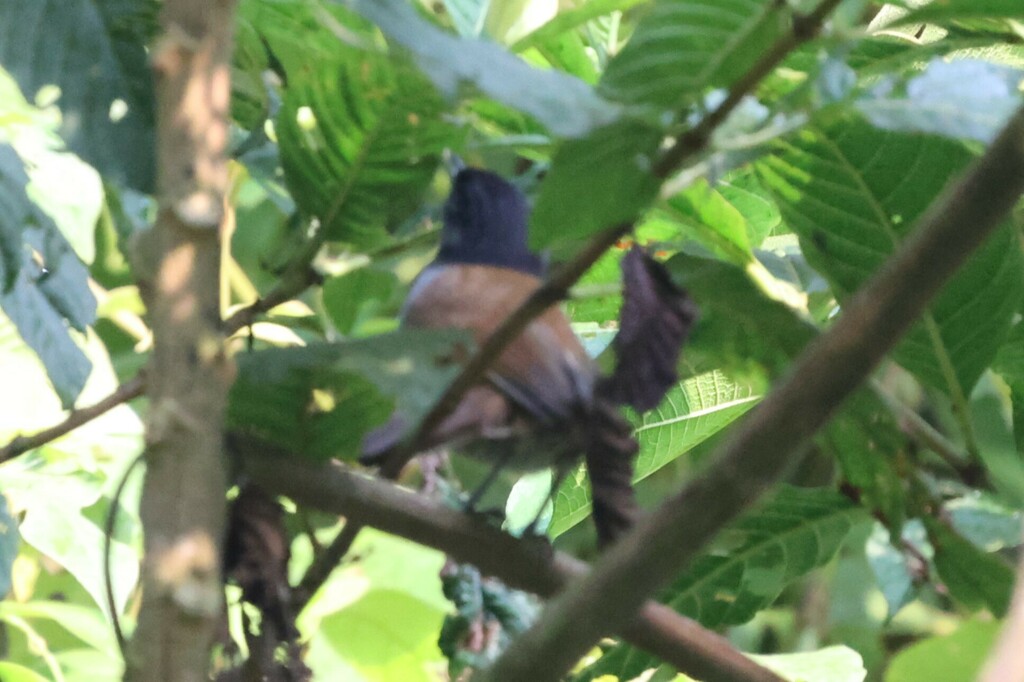
Rwenzori Hill Babbler
Photo © Tommy Andriollo
Photo © Tommy Andriollo — CC BY 4.0 — Source: iNaturalist #250440660The Rwenzori hill babbler (Sylvia atriceps) is a species of passerine bird in the family Sylviidae that is found in Africa. The Rwenzori hill babbler was described by the English zoologist Richard Bowdler Sharpe in 1902 and given the binomial name Turdinus atriceps. The type locality is the Rwenzori Mountains on the border between Uganda and the Democratic Republic of the Congo. The specific epithet atriceps is from the Latin ater for "black" and -ceps for "capped" or "headed". The Rwenzori hill babbler was formerly considered to be a conspecific with the African hill babbler. The species is monotypic.
Virunga National Park
Uganda
+418 birds+13 mammals
Where the Western Rift Valley fractures the landscape of North Kivu, Virunga National Park sprawls across terrain as geologically dramatic as it is ecologically vital. Volcanic…
VIEW NATIONAL PARKBwindi Impenetrable National Park
Kanyashogi, Uganda
+603 birds+26 mammals
Steep ridges cloaked in montane forest rise from Uganda's southwestern borderlands, where the landscape grows so dense and tangled that early explorers named it impenetrable. At…
VIEW NATIONAL PARKVolcanoes National Park
Musanze District, Uganda
+152 birds+6 mammals
Where volcanic cones rise sharply above the montane forests of northern Uganda, Volcanoes National Park protects one of East Africa's most dramatic high-altitude ecosystems. The park's…
VIEW NATIONAL PARKMgahinga Gorilla National Park
Cyanika, Uganda
+429 birds+6 mammals
Where the Virunga Mountains rise steeply from the Uganda–Rwanda–Democratic Republic of Congo frontier, montane forest cloaks the volcanic slopes in a dense, moisture-laden embrace. Mgahinga Gorilla…
VIEW NATIONAL PARKLake Mburo National Park
Uganda
+505 birds+24 mammals
Rolling acacia woodland and scattered lakes define this intimate savanna preserve in southwestern Uganda, where the rift valley's geological drama shapes every water source and grassland.…
VIEW NATIONAL PARKNo community photos yet. Log in to add the first one.
No community observations of this species yet.