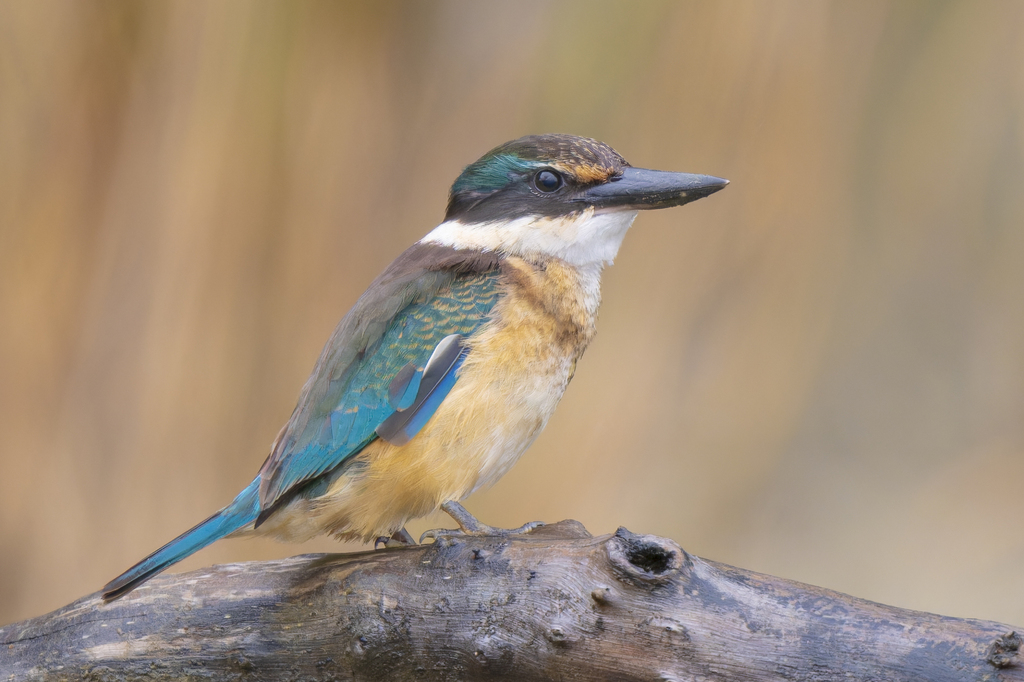
Sacred Kingfisher
Photo © Saryu Mae 前 朝琉
Photo © Saryu Mae 前 朝琉 — CC BY 4.0 — Source: iNaturalist photo #465363188Identification
The Sacred Kingfisher is a medium-sized woodland kingfisher measuring 20–23 cm in length. It is distinguished by its predominantly blue-green to turquoise upperparts contrasted with white underparts and collar feathers. A striking black mask across the face and buff-coloured lores are diagnostic features. Both sexes are similar in appearance, though females tend to be greener, duller, and less buff beneath. Juveniles display buff or mottled brown edges on the collar, underparts, and upper-wing coverts. Males weigh 28–61 g while females are slightly lighter at 28–56 g.
Range & Habitat
This species is distributed across Australia, New Zealand, Lord Howe Island, Norfolk Island, New Guinea, eastern Indonesia, and much of northern and western Melanesia, extending to the Kermadec Islands. Breeding populations are established throughout much of Australia (excluding the dry interior), New Zealand, New Caledonia, and locally in New Guinea. Migratory populations from southern Australia move north after breeding to New Guinea, the eastern Solomon Islands, and Indonesia, returning south in August and September.
The Sacred Kingfisher inhabits open eucalypt forests, melaleuca swamps, mangroves, mudflats, wetlands, and river or lake margins. It also frequents farmland, parks, and gardens. In New Zealand, the subspecies T. s. vagans exhibits altitudinal migration, moving from higher altitudes to coastal areas and from forest to open lands following the breeding season.
Behaviour & Diet
The Sacred Kingfisher is primarily an insectivore, feeding on a wide variety of invertebrates including insects and spiders, supplemented by small crustaceans, frogs, small rodents, and reptiles. Fish and small birds are taken infrequently. The species employs a characteristic hunting technique, perching on low branches and waiting for prey. It then swoops down using either a sally-pounce method (briefly landing) or a sally-strike (hovering), before returning to its perch to beat and consume its catch.
Breeding occurs from August to March, with peak activity between September and January, often producing two broods per season. Both members of a mated pair excavate the nest, which may be located in river banks, hollow branches, or termite mounds. The female lays 3–6 glossy white rounded eggs (25 mm × 22 mm) that are incubated for 17–18 days by both parents, primarily the female. Both parents and occasionally helpers feed nestlings for up to four weeks, with post-fledging care continuing for 7–10 days.
Best Time & Places to See It
The Sacred Kingfisher is best observed during the breeding season from August to March, particularly September to January. In Australia, search open eucalypt forests, mangroves, and wetland margins, particularly near river systems and coastal areas. New Zealand offers excellent viewing opportunities year-round, with populations showing altitudinal variation seasonally. The species also inhabits Lord Howe Island, Norfolk Island, and various locations throughout Melanesia. Early morning visits to suitable habitats, especially near water margins where prey activity is highest, increase encounter rates.
Photography Tips
The Sacred Kingfisher's vibrant blue-green and turquoise plumage is best captured in bright, clear morning light that accentuates the iridescent qualities of its upperparts. Position yourself low and aim to photograph the bird perched on branches overhanging water, as this is its characteristic hunting posture. The contrasting black mask and white collar provide strong compositional elements. Patient observation of predictable perching sites yields the best opportunities to photograph hunting sequences, including sally-pounce and sally-strike moments. Use a fast shutter speed (minimum 1/1000s) to freeze wing movement during prey capture.
Abel Tasman National Park
Aketajawe Lolobata National Park
Annan River (Yuku Baja-Muliku) National Park
Arthur’s Pass National Park
Bald Rock National Park
Barrington Tops National Park
Belair National Park
Ben Boyd National Park
Blue Mountains National Park
Nothing matches these filters.
No community photos yet. Log in to add the first one.
No community observations of this species yet.