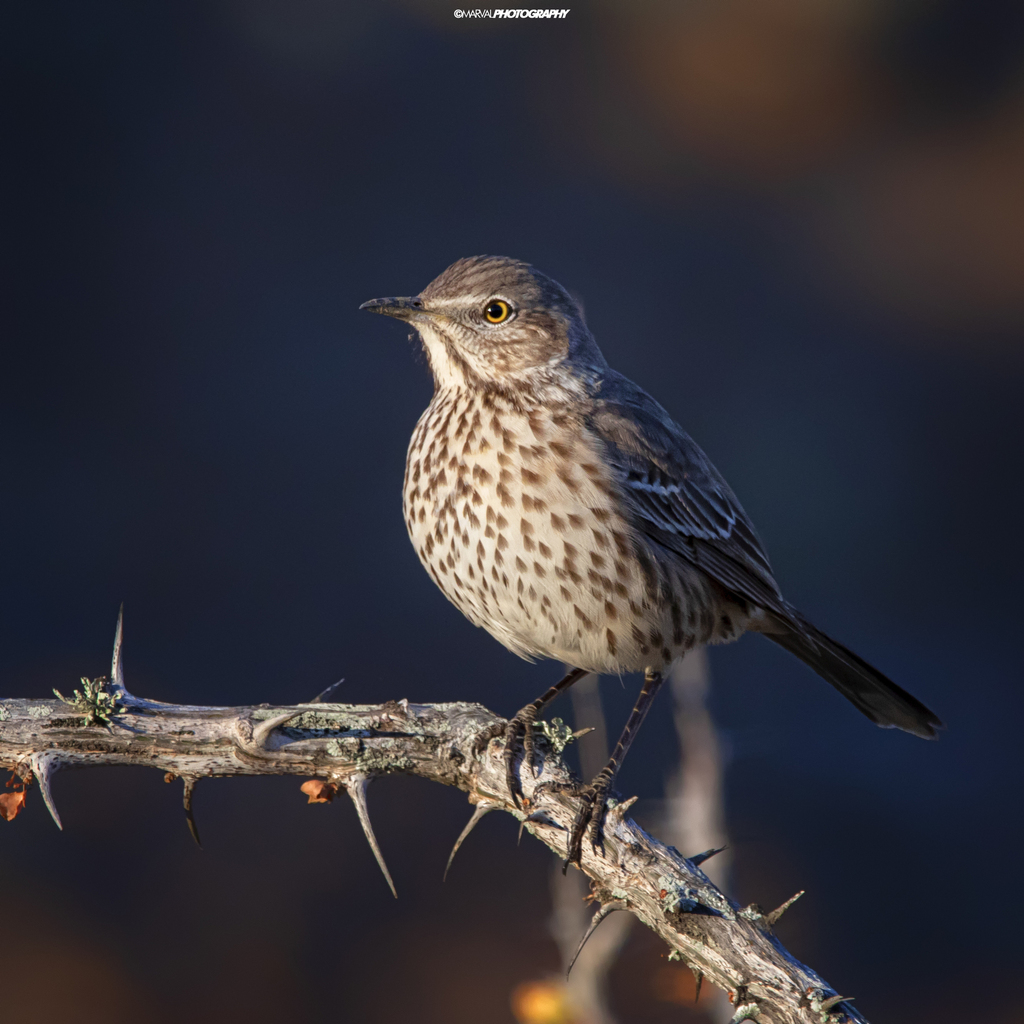
Sage Thrasher
Photo © MarvalPhotography19
Photo © MarvalPhotography19 — CC BY 4.0 — Source: iNaturalist #146894035Identification
The sage thrasher is a medium-sized songbird measuring 20–23 cm in length, making it the smallest of all thrashers. Adults display brownish-gray upperparts with white underparts distinctly marked by dark streaks. The most striking feature is their distinctive lemon-yellow to amber-colored eyes. Juveniles are paler above with lighter streaking below. The sage thrasher can be reliably distinguished from other thrashers by its notably shorter, less curved bill, shorter tail, and overall smaller frame. Plumage remains relatively consistent year-round, making identification straightforward across seasons.
Range & Habitat
This species is found exclusively in western North America, breeding across the Great Basin region from southern British Columbia south through the interior western United States into northern Arizona and New Mexico. The northern breeding limit extends into the Similkameen and Okanagan valleys of south-central British Columbia. As a short-distance migrant, sage thrashers move south in early fall to winter from southern Nevada through Arizona, New Mexico, and west-central Texas, extending into northern Mexico including Baja California, Sonora, Chihuahua, Nuevo León, and Durango.
The sage thrasher is strongly associated with shrubsteppe habitats dominated by big sagebrush (Artemisia tridentata) and three-tip sagebrush (A. tripartita). Sagebrush is essential for nesting and provides critical protection from extreme heat fluctuations and predators. The bird's abundance is positively correlated with sagebrush cover, woody vegetation, and bare ground, but negatively correlated with grass cover.
Behaviour & Diet
Sage thrashers are vocal birds, singing to establish territories and attract mates. Males sing extensively during spring arrival and pair formation, with individual song bouts averaging around three minutes, though some may last up to 22 minutes. Songs typically occur from exposed perches atop surrounding vegetation and consist of long, soft syllables with a moderately musical quality lacking harsh notes. Adults produce distinctive "chuck" alarm calls in response to threats. Like other mimids, sage thrashers are capable of vocal mimicry and incorporate imitations of other species such as Western Meadowlark, Brewer's Sparrow, and Horned Lark into their repertoire.
For breeding, sage thrashers construct cup-shaped nests about 10 cm tall and 18–20 cm in diameter using sagebrush twigs, bark strips, rootlets, and often incorporating cowhair and feathers. Nests are strategically placed in dense vegetation at optimal heights to exploit cooler ground-level air and benefit from temperature-buffering effects of the shrub. Nests are frequently oriented east to capture morning warmth while avoiding intense midday sun exposure. Clutches typically contain four to five blue-green eggs with reddish or dark spotting concentrated at the base. Both sexes participate in incubation.
Best Time & Places to See It
Spring is the optimal season for observing sage thrashers as they return to breeding territories in early spring and are most vocal during territory establishment. The best locations are in sagebrush-dominated landscapes throughout the Great Basin and surrounding regions. Look in areas with extensive big sagebrush cover interspersed with bare ground and scattered woody vegetation. Listening for their moderately musical songs in early morning from exposed perches will help locate these birds. Winter birders should search suitable sagebrush habitat in the southwestern United States and northern Mexico.
Photography Tips
Photographing sage thrashers requires patience and early morning activity, as males are most vocal during territory establishment in spring. Position yourself near dense sagebrush patches where birds are likely to perch for singing. Their preference for open perches atop vegetation, combined with their territorial singing behavior, provides excellent opportunities for photography. The distinctive yellow eyes and streaked plumage photograph well in warm morning light. Wide-angle shots capturing the bird in its characteristic sagebrush habitat convey the species' ecological association effectively. Use sound-activated triggers or wait near established territories for the best results.
Arches National Park
Badlands National Park
Bear River Migratory Bird Refuge
Bic National Park
Big Bend National Park
Bitter Lake National Wildlife Refuge
Black Canyon of the Gunnison National Park
Bosque del Apache National Wildlife Refuge
Bryce Canyon National Park
Nothing matches these filters.
No community photos yet. Log in to add the first one.
No community observations of this species yet.