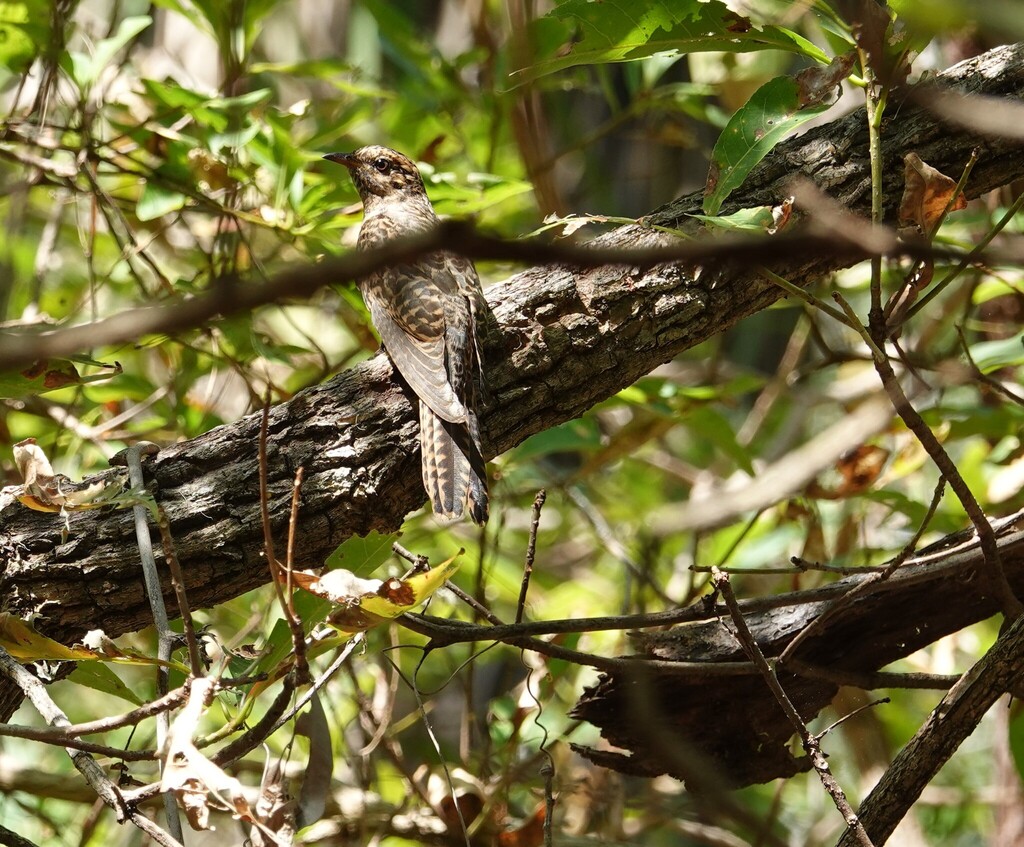
Sahul Brush Cuckoo
Photo © Mark Clarke
Photo © Mark Clarke — CC BY 4.0 — Source: iNaturalist #293003095Identification
The Sahul brush cuckoo is a compact cuckoo measuring 22–26 cm in length, characterised by pale grey upperparts, a distinctive buff breast, and grey-brown back plumage. The tail is brown with white tips and bars, and a narrow pale ring encircles the eye; feet are olive-pink. In flight, the sharply pointed and backswept wings reveal grey-brown underwings with pale buff coverts and a white or pale buff bar. Juvenile birds are heavily barred with dark brown. Adults of both sexes are similar in appearance, though this species can be confused with the pallid, fan-tailed, and chestnut-breasted cuckoos.
Range & Habitat
This widespread species is found across a vast range spanning northern and eastern Australia, the Solomon Islands, New Guinea, Malaysia, and islands across the Indonesian archipelago. It is resident in Thailand, peninsular Malaysia, Cambodia, southern Vietnam, the Philippines, and throughout the Sunda and Maluku islands, though populations in New Guinea and northern Melanesia may migrate locally. Australian populations are migratory in the southern parts of their range. The Sahul brush cuckoo inhabits diverse woodland and forest environments including rainforests, rainforest edges, mangrove forests, secondary forests, and plantations.
Behaviour & Diet
As a brood parasite, the Sahul brush cuckoo does not raise its own young. Instead, females lay polymorphic eggs—meaning individual females produce specific egg types matched to particular host species in their region. Across Australia alone, this cuckoo parasitises at least 58 avian species, though only a small number successfully fledge the chicks. Host species vary by subspecies and region; in eastern Australia, the rose robin, Norfolk robin, leaden flycatcher, restless flycatcher, satin flycatcher, and fantails are regular hosts, while in the north, the purple-crowned fairywren and honeyeaters are exploited. In Indonesia, a diverse array of hosts is used, including various flycatchers, bulbuls, fantails, and white-eyes.
Best Time & Places to See It
In Australia, the best opportunities occur during the breeding season in northern and eastern regions where the bird is present or migratory. Listen for its familiar call—a characteristic sound of the Australian and Indonesian bush that often betrays its presence before visual confirmation. The species is more readily detected by voice than by sight. For visitors to Southeast Asia and Indonesia, year-round residents in forested habitats provide consistent viewing opportunities, particularly in rainforests and well-vegetated secondary growth.
Photography Tips
The Sahul brush cuckoo's small size and preference for dense vegetation make photography challenging. Early morning visits to suitable habitat when birds are most vocal increase chances of locating individuals. Focus on listening for calls to pinpoint birds before attempting photography. The pale eye-ring and buff breast are diagnostic features worth capturing. In flight, the sharply pointed wings and underwing pattern are distinctive; patient positioning near clearings or canopy gaps may provide flight photography opportunities. Overcast conditions suit photography in forested habitats where this species typically occurs.
Aketajawe Lolobata National Park
Alpine National Park
Annan River (Yuku Baja-Muliku) National Park
Bald Rock National Park
Barrington Tops National Park
Ben Boyd National Park
Blue Mountains National Park
Boodjamulla National Park
Bribie Island National Park
Nothing matches these filters.
No community photos yet. Log in to add the first one.
No community observations of this species yet.