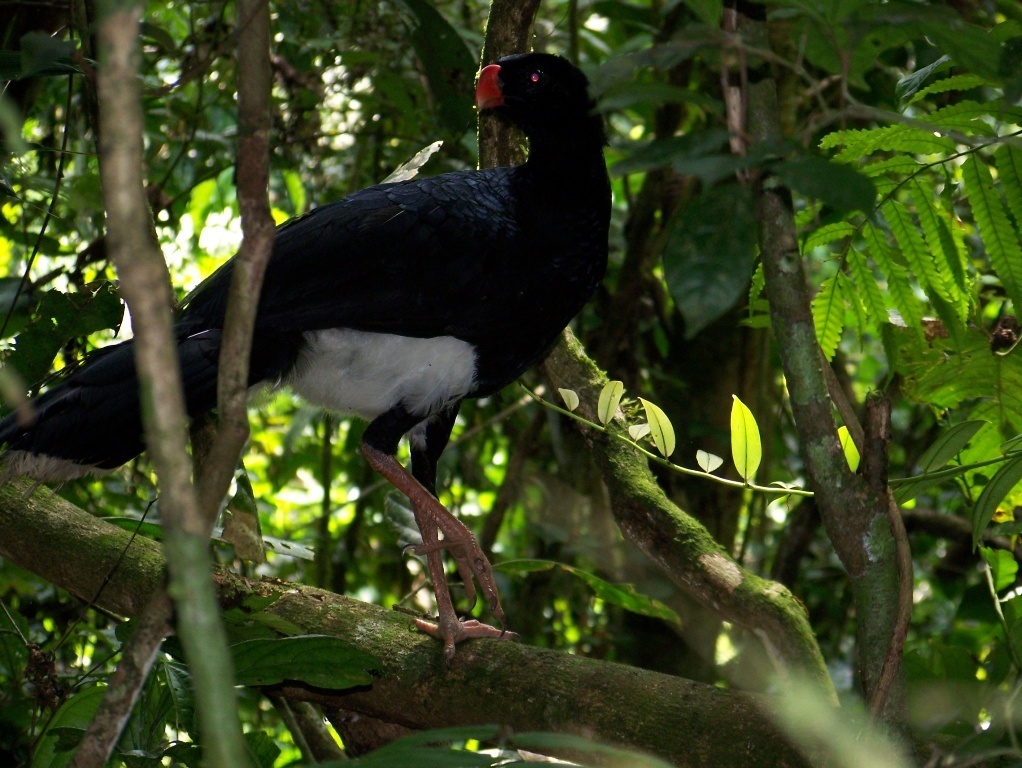
Salvin’s Curassow
Photo © Abby Darrah
Photo © Abby Darrah — CC BY 4.0 — Source: iNaturalist photo #159912813Identification
Salvin's curassow is a large, distinctive ground-dwelling bird measuring 75 to 89 cm in length and weighing approximately 3,100 g. The species is predominantly black with minimal gloss, making it relatively inconspicuous in the forest understory. The most striking field marks are the white belly and white tips on the tail feathers, which provide useful contrast against the dark plumage. The bird possesses an erectile crest that is typically held flat against the head, giving it a sleek appearance when at rest.
Range & Habitat
Salvin's curassow is endemic to the western Amazon Basin, found east of the Andes in southern Colombia, eastern Ecuador, and northern Peru. The species shows a clear preference for primary humid forest, ranging from sea level to approximately 400 metres elevation in Ecuador and 600 metres in Colombia, though historically it occurred up to around 900 metres. The bird exhibits distinct seasonal habitat preferences, favouring terra firme forest primarily during the onset of the wet season from March to April, and shifting to várzea (seasonally flooded forest) before and after this period in response to fruit availability.
Behaviour & Diet
Salvin's curassow is primarily sedentary, though pairs may relocate seasonally to track food sources. The species forages mostly on the ground, either singly, in pairs, or as family groups. Its diet is predominantly frugivorous, comprising approximately 70% fruits and 10% seeds, with the remainder consisting of flowers, leaves, invertebrates, and other items. Like many galliform birds, it ingests sand and small stones to assist digestion and has been observed scavenging animal remains.
Breeding pairs appear to maintain year-round associations without strong territoriality. In Colombia, the nesting season extends from January to May or June, with males constructing multiple nest sites from which females select one. Clutch size is typically two eggs. The species is notably vocal, particularly at dawn and dusk, with males producing a characteristic "booming" song rendered as "mmm mmmMMMM ... BMM'mmmm-mmmm". Females sing a huskier version of this song, while other vocalizations include a "pieew, pieew" alarm note, a "goorh, goorh" threat response, and a "coh coh" contact call.
Best Time & Places to See It
Salvin's curassow is generally common in remote, less accessible primary forest areas, though it becomes scarce near human settlements. The species is most vocal and active at dawn and dusk, making early morning and evening the optimal times for observation and detection. Visiting during the wet season onset (March to April) and the months following may provide good opportunities, as birds concentrate in terra firme and várzea habitats respectively. Accessing protected primary forest areas in the species' range in Colombia, Ecuador, and Peru will offer the best chances of encounters.
Photography Tips
The predominantly black plumage of Salvin's curassow presents both challenges and opportunities for photographers. Fast film speeds or high ISO settings will be necessary in the dim forest understory where this species forages. The white belly and tail-tip markings provide useful compositional elements and help separate the bird from the dark background. Early morning and late afternoon light will improve colour saturation and reveal subtle plumage details. Patient observation near fruiting trees, particularly during seasonal abundance, may yield better photographic opportunities than attempting to locate birds in dense vegetation.
Yasuní National Park
Aguarico, Ecuador
+601 birds+43 mammals
Where the western Amazon basin converges with Ecuador's Orellana Province, lowland rainforest reaches toward the horizon in an unbroken canopy of staggering botanical density. Yasuní National…
VIEW NATIONAL PARKSumaco Napo-Galeras National Park
Loreto, Ecuador
+563 birds+4 mammals
Where Ecuador's Amazon transitions into cloud forest, a massive shield volcano rises from the emerald lowlands of Orellana Province, anchoring one of the continent's most biodiverse…
VIEW NATIONAL PARKNo community photos yet. Log in to add the first one.
No community observations of this species yet.