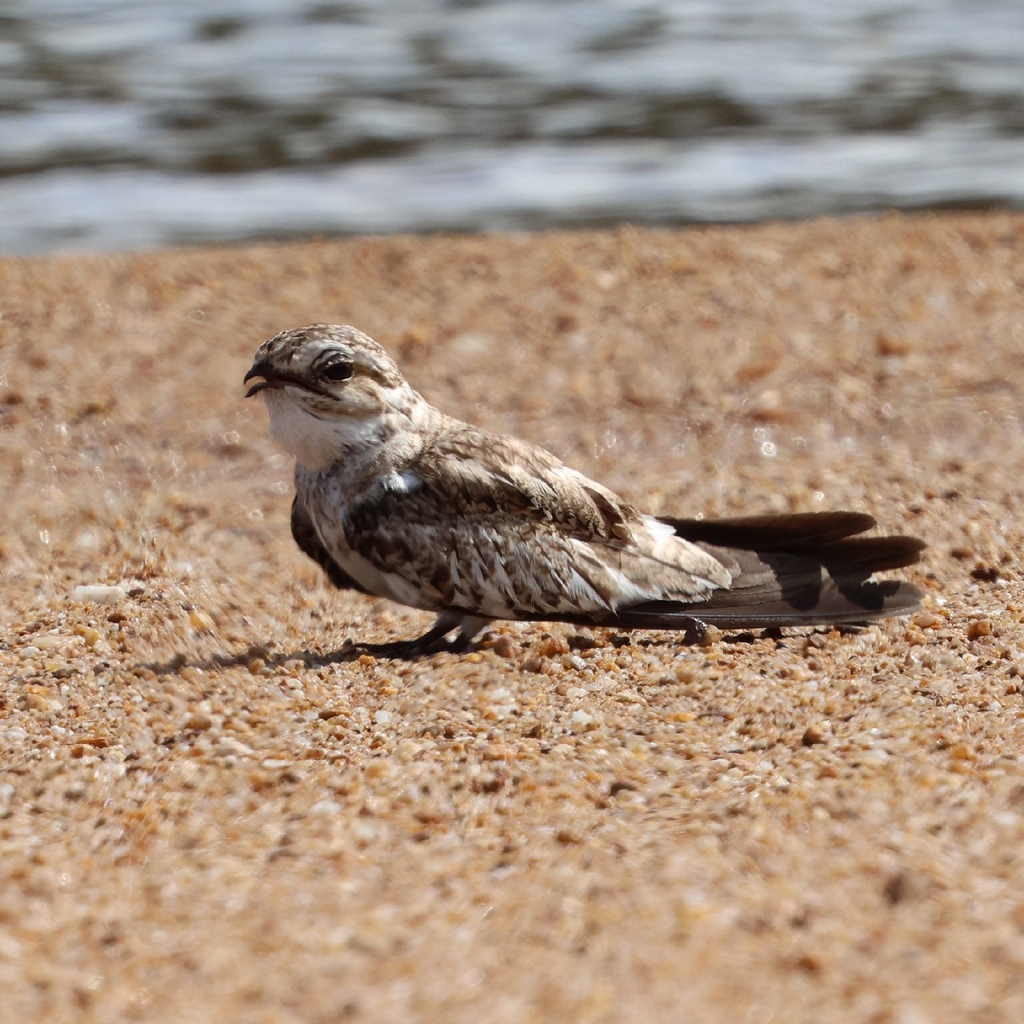
Sand-colored Nighthawk
Photo © Miguel
Photo © Miguel — CC BY-SA 4.0 — Source: iNaturalist #330161072Identification
The Sand-colored Nighthawk is a small nightjar measuring 20.5 to 22 cm in length. True to its name, it displays pale grayish-brown upperparts heavily marked with darker brown streaks, bars, and spots. The throat is distinctively white to buffy white, while the breast is grayish white with a cinnamon tinge and brown barring. The belly is white with brown spotting on its upper portion, and the underwings are predominantly white—a useful field mark when observed in flight. These subtle, cryptic plumage patterns provide excellent camouflage on the sandy and rocky substrates where the bird spends its daylight hours.
Range & Habitat
This species inhabits the western Amazon basin across a vast range spanning Bolivia, Brazil, Colombia, Ecuador, Peru, and Venezuela. The nominate subspecies occupies northwestern Amazonia from southeastern Colombia and southwestern Venezuela through northeastern Peru to northwestern Brazil, with populations also occurring along river corridors in eastern Ecuador and northern Bolivia. The subspecies C. r. xylostictus is restricted to Colombia's Cundinamarca Department. The Sand-colored Nighthawk shows a strong preference for waterside habitats, primarily along major watercourses but also utilizing oxbow lakes and grassy clearings such as airstrips, rarely venturing above 500 meters elevation.
Behaviour & Diet
Crepuscular and nocturnal by nature, this nighthawk roosts during daylight hours on river islands and sandbars, frequently congregating in large numbers. When water levels rise seasonally, birds shift to tree branches overhanging the water. The Sand-colored Nighthawk forages actively at dusk and intermittently through the night, pursuing an entirely insectivorous diet. Its flight style is notably distinctive among nightjars—less erratic than most congeners, with an oddly mechanical flapping motion reminiscent of terns rather than the typical buoyant, erratic flight of other nightjar species.
Best Time & Places to See It
Breeding occurs from May through August in southeastern Peru and June through September in central Brazil, though the season remains undocumented elsewhere in its range. The species nests in loose colonies, often in proximity to colonies of Yellow-billed Terns, Large-billed Terns, and Black Skimmers, laying two eggs in simple scrapes on sandbars. Observers should focus their efforts on major river systems and associated waterside clearings throughout the western Amazon basin during these breeding periods for the best chance of encountering this species.
Photography Tips
The Sand-colored Nighthawk's cryptic plumage makes daylight photography challenging; positioning yourself near known roosting sites on sandbars at dawn or dusk offers the best opportunities. The bird's white throat and underwings provide useful compositional highlights. Early morning and late afternoon light are ideal for capturing the subtle plumage details and the characteristic pale coloration that gives this species its common name. Patience and a sturdy tripod are essential, as birds may remain motionless for extended periods while roosting.
Yasuní National Park
Aguarico, Ecuador
+601 birds+43 mammals
Where the western Amazon basin converges with Ecuador's Orellana Province, lowland rainforest reaches toward the horizon in an unbroken canopy of staggering botanical density. Yasuní National…
VIEW NATIONAL PARKNatural Sierra de la Macarena National Park
Vista Hermosa, Colombia
+566 birds+15 mammals
Across nearly 20,000 square kilometres of Colombia's Meta Department, the terrain rises from lowland savanna into Andean foothills through a mosaic of gallery forests, palm-fringed wetlands,…
VIEW NATIONAL PARKAmacayacu National Park
Leticia, Colombia
+567 birds+25 mammals
Where the Rio Amazonas curves through the tri-border region where Colombia, Peru, and Brazil converge, Amacayacu National Park sprawls across more than 5,250 square kilometres of…
VIEW NATIONAL PARKAmazônia National Park
Brazil
+439 birds+6 mammals
Where the Rio Amazonas and its tributaries weave through the heart of Pará state, a vast tapestry of rainforest stretches across 23,611 square kilometers of unbroken…
VIEW NATIONAL PARKMapinguari National Park
Brazil
+354 birds
Vast tracts of western Amazonian rainforest blanket the remote terrain of this 56,827 square kilometre national park in Amazonas state, where seasonal rivers wind through dense…
VIEW NATIONAL PARKAnavilhanas National Park
Brazil
+468 birds+8 mammals
Across the Rio Negro in central Amazonas, an archipelago of over a thousand islands rises from the world's largest rainforest river system, creating a labyrinth of…
VIEW NATIONAL PARKCampos Amazónicos National Park
Amazonas, Brazil
+434 birds+7 mammals
Sprawling across the southwestern Amazon basin in Amazonas state, this 27,263-square-kilometre national park encompasses some of the region's most pristine lowland rainforest, where terra firme forest…
VIEW NATIONAL PARKSerra do Divisor National Park
Brazil
+448 birds+10 mammals
Where the western Amazon meets the Andes foothills, Serra do Divisor National Park sprawls across one of South America's most biodiverse and least accessible frontiers. Spanning…
VIEW NATIONAL PARKManu National Park
Manu, Peru
+892 birds+26 mammals
Across the eastern slopes of the Peruvian Andes, tropical rainforest descends into the Amazon basin with a complexity that few terrestrial ecosystems match. Manu National Park…
VIEW NATIONAL PARKBahuaja Sonene National Park
San Pedro de Putina Punco, Peru
+602 birds+8 mammals
Where the Madre de Dios and Heath rivers converge in southeastern Peru rises one of South America's most biodiverse wilderness regions: a vast protected realm of…
VIEW NATIONAL PARKNo community photos yet. Log in to add the first one.
No community observations of this species yet.