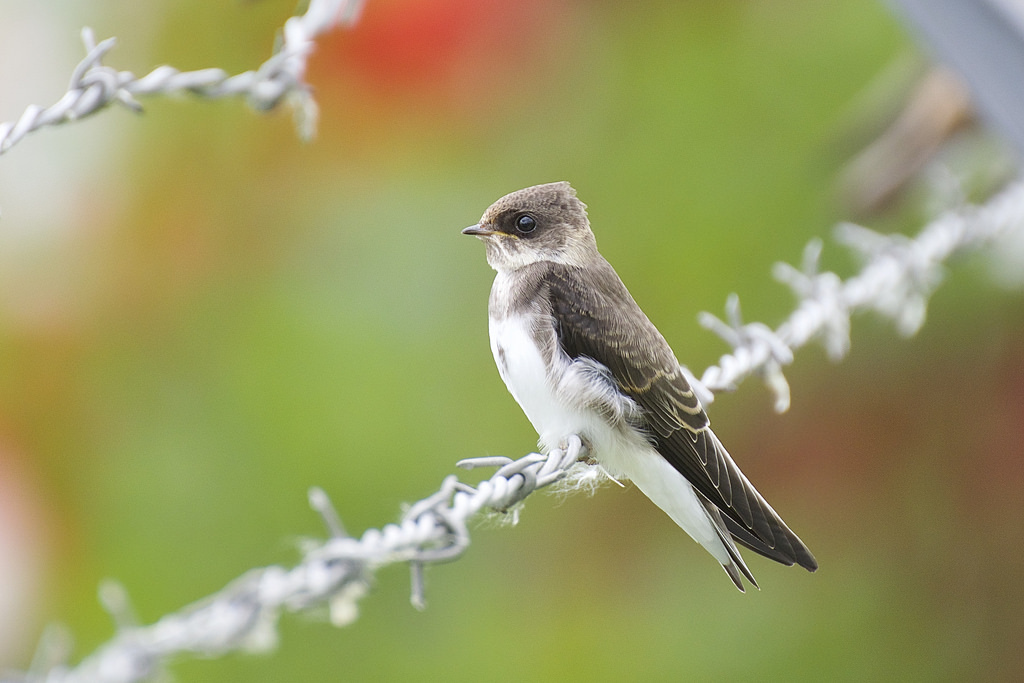
Sand Martin
Photo © Owen Strickland
Photo © Owen Strickland — CC BY 4.0 — Source: iNaturalist photo #26271643Identification
The sand martin is a small, elegant swallow measuring 12–13 cm in length with a wingspan of 26.5–29 cm. It is brown above with a distinctive narrow brown band across the breast, contrasting sharply with its white throat and underparts. The bill is black and the legs are brown. Young birds show rufous tips to the wing coverts and margins to the secondaries. Its small size, brown back, breast band, white throat, and characteristically quick, jerky flight distinguish it from similar species such as the house martin, cliff swallow, and tree swallow.
Range & Habitat
The sand martin has an extraordinarily wide summer range, breeding across practically the whole Holarctic area—from Europe through Asia to the Pacific Ocean, and throughout North America. It is highly migratory, wintering in eastern and southern Africa, southern Asia, and South America. The species is strongly associated with water throughout the year and is generally found near larger bodies of water such as rivers, lakes, and even coastal areas.
Sand martins breed in colonies in sandy or gravelly banks and cliffs, where they excavate tunnel burrows ranging from a few inches to three or four feet in length. The birds favour loess as a particular type of substrate for nesting and are particularly attracted to sheer sandy hills with suitable burrowing opportunities.
Behaviour & Diet
The sand martin is highly sociable and colonial, with breeding colonies ranging from a dozen to many hundred pairs nesting close together in suitable habitat. Nests are positioned at the end of burrows, with the actual nest chamber lined with straw and feathers. Clutches of four or five white eggs are laid around mid-to-late May, and a second brood is usual except in the most northerly breeding sites.
The species feeds exclusively on small insects, primarily gnats and other flies whose aquatic larvae are found in the water bodies near their colonies. The song is a continuous gravelly twittering in flight, becoming a conversational undertone when birds settle at the roost. When threatened by predators such as falcons or crows, sand martins produce a harsh alarm call and combine their efforts to drive away intruders.
Best Time & Places to See It
Sand martins are among the earliest swallows to arrive on breeding grounds in spring. In Britain, they typically appear from mid-March onwards, arriving a week or two before barn swallows. In northern Ohio and similar latitudes, they arrive in numbers by mid-April. Early in the season, birds can be found alone over larger bodies of water searching for early flies; later they associate with other swallow species. The birds depart early from their breeding range, with most having left by the end of September. Look for them flitting low over rivers, lakes, and reservoirs during the breeding season.
Photography Tips
Sand martins are challenging but rewarding photographic subjects due to their rapid, erratic flight and small size. Position yourself near their breeding colonies or favoured water bodies at dawn or dusk, when activity is greatest and light is most favorable. The birds' habit of gathering in enormous numbers at nightly roosts in late summer and early autumn provides excellent opportunities for flight photography and behaviour documentation. Their distinctive silhouette—compact body, pointed wings, and shallow tail fork—makes them identifiable even in flight. Focus on capturing their characteristic quick, jerky flight pattern and their interaction with water as they hawk insects in low, graceful passes over the surface.
Bwindi Impenetrable National Park
Lake Mburo National Park
Mabamba Swamp
Murchison Falls National Park
Queen Elizabeth National Park
Tombstone Territorial Park
Aberdare National Park
Abijata-Shalla Lakes National Park
Abruzzo, Lazio and Molise National Park
Nothing matches these filters.
No community photos yet. Log in to add the first one.
No community observations of this species yet.