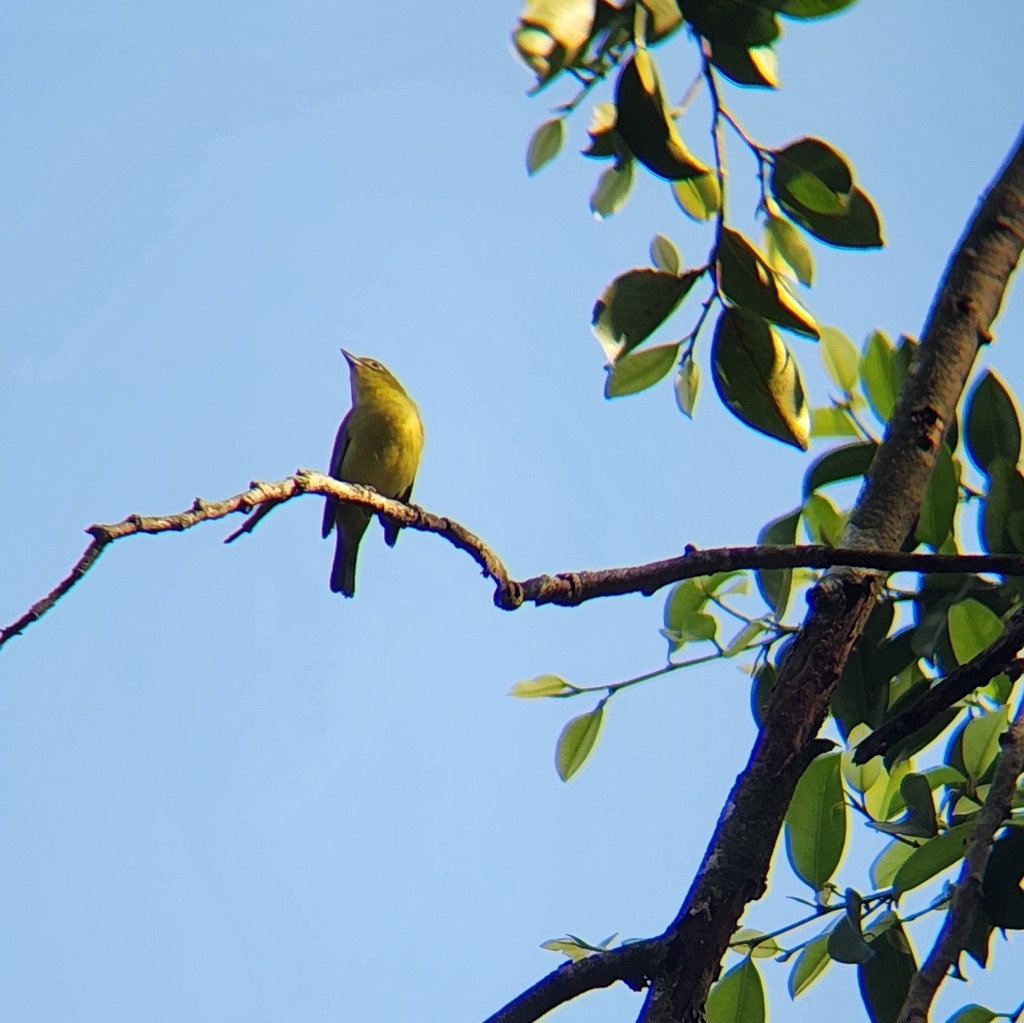
Sangkar White-eye
Photo © Octavianti Shanna
Photo © Octavianti Shanna — CC BY 4.0 — Source: iNaturalist #207098587The sangkar white-eye (Zosterops melanurus) is a bird species in the family Zosteropidae. It is also known as the Sunda white-eye. It is found in forested habitats on the Indonesian islands of Java and Bali. In Java it is typically found at elevations between 200–1,600 m (660–5,250 ft), but it sometimes occurs at lower elevations as well. This species was formerly treated as conspecific with the Indian white-eye (previously the Oriental white-eye, Zosterops palpebrosus), but based on the results of a molecular phylogenetic study published in 2018, it was promoted to species rank. The sangkar white-eye has two subspecies, Zosterops melanurus melanurus in eastern Java and Bali and Z. m. buxtoni in western Java. (A population of white-eyes on Sumatra that was historically considered part of the latter subspecies may in fact belong to Hume's white-eye.) The two subspecies differ notably in appearance: Z. m. melanurus has entirely yellow underparts, while Z. m. buxtoni has a grey belly. They differ little genetically, however, and commonly interbreed where their ranges overlap. The sangkar white-eye feeds on insects, and favours the introduced Sesbania grandiflora when hunting. The breeding season is from January to October, with a peak in May and June. The…
No community photos yet. Log in to add the first one.
No community observations of this species yet.