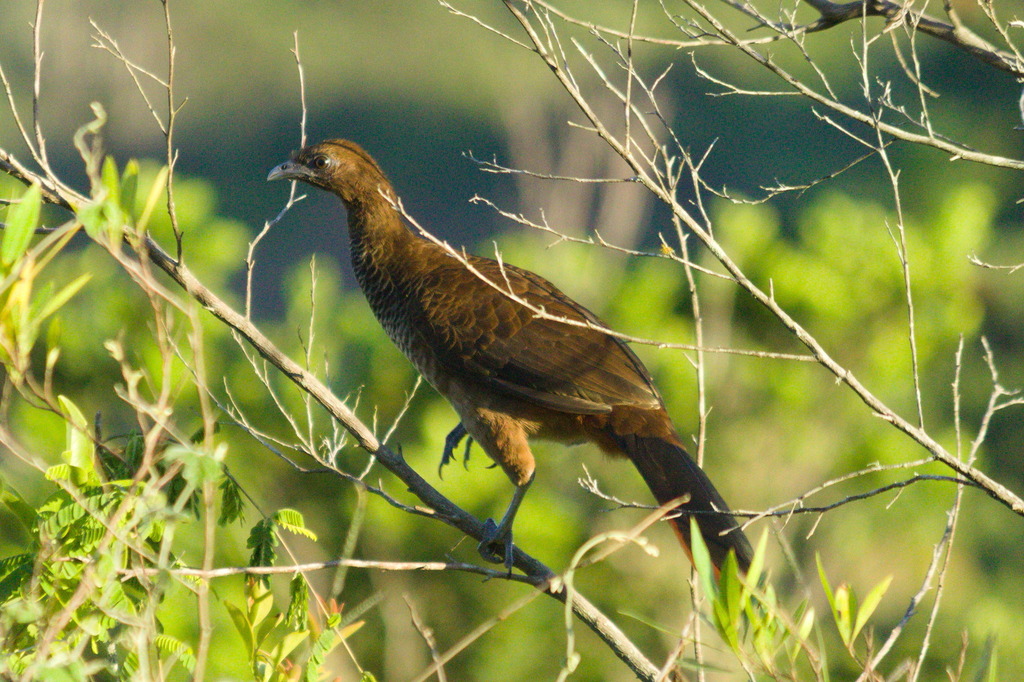
Scaled Chachalaca
Photo © Fernando Sessegolo
Photo © Fernando Sessegolo — CC0 1.0 — Source: iNaturalist photo #270880805Identification
The scaled chachalaca is a medium-sized bird measuring about 50 cm in length, with males typically weighing around 620 g and females approximately 498 g. Its plumage is predominantly brown, with darker tones on the upperside contrasting with a buffy belly and chestnut vent. The bird's most distinctive feature is the pale-edged feathering on its dark brown breast, which creates a striking scalloped or scaly effect—the feature that gives the species its name. A small pinkish throat patch and slate-gray bare skin around its dark eye provide additional identifying marks.
Range & Habitat
This species is endemic to southeastern Brazil, occurring from southern São Paulo through Paraná and Santa Catarina into Rio Grande do Sul. Historical records suggest it may have also inhabited southeastern Paraguay through the late 1800s. The scaled chachalaca favors the edges of tropical evergreen forests and occupies both the interior and margins of restinga and mangrove stands dominated by Laguncularia racemosa. The bird's elevational range extends from sea level to 800 m.
Behaviour & Diet
Scaled chachalacas are social birds typically encountered in small family groups. Their diet consists primarily of fruits and leaves, though they also opportunistically visit feeding stations offering bananas and suburban gardens. The breeding season appears to span from October through February or March. Nesting birds construct shallow bowls of twigs and leaves, usually placing them in concealed tree forks up to about 3 m above ground, with clutches typically comprising three eggs.
The scaled chachalaca is highly vocal, producing a distinctive raucous and highly variable song that is often given in duet or chorus by multiple individuals. The vocalizations include loud calls described as "cacataPOOP, cacataPOP, cacataWHUMP, cacataWEEcata" on a single pitch, alongside irregular but sometimes rhythmic cackling and throaty bubbling sounds.
Best Time & Places to See It
The breeding season from October to February or March offers the best opportunity to locate this species, as birds are most vocal and visible during this period. Within its Brazilian range, the scaled chachalaca is at least locally common in several parts, making it accessible to dedicated birdwatchers willing to explore tropical forest edges, restinga, and mangrove habitats in the southeastern states.
Photography Tips
The scaled chachalaca's preference for concealed nesting sites and interior forest edges means patience and careful stalking are essential. Early morning hours, when birds are most vocal and active, offer the best opportunities for photography. The striking scalloped breast pattern and warm brown plumage photograph well in soft, diffused light. Recording the bird's loud, variable vocalizations can help locate family groups, which will typically remain in the same small area.
Saint-Hilaire/Lange National Park
Brazil
+225 birds
Subtropical Atlantic forests rise and fall across the plateaus of inland Paraná, where Saint-Hilaire/Lange National Park protects nearly 578 square kilometres of Brazil's most biodiverse woodland…
VIEW NATIONAL PARKSerra Geral National Park
Brazil
+211 birds+2 mammals
Where basalt cliffs and sandstone escarpments rise above the subtropical forests of southern Brazil, Serra Geral National Park preserves one of the Atlantic region's most dramatic…
VIEW NATIONAL PARKNo community photos yet. Log in to add the first one.
No community observations of this species yet.