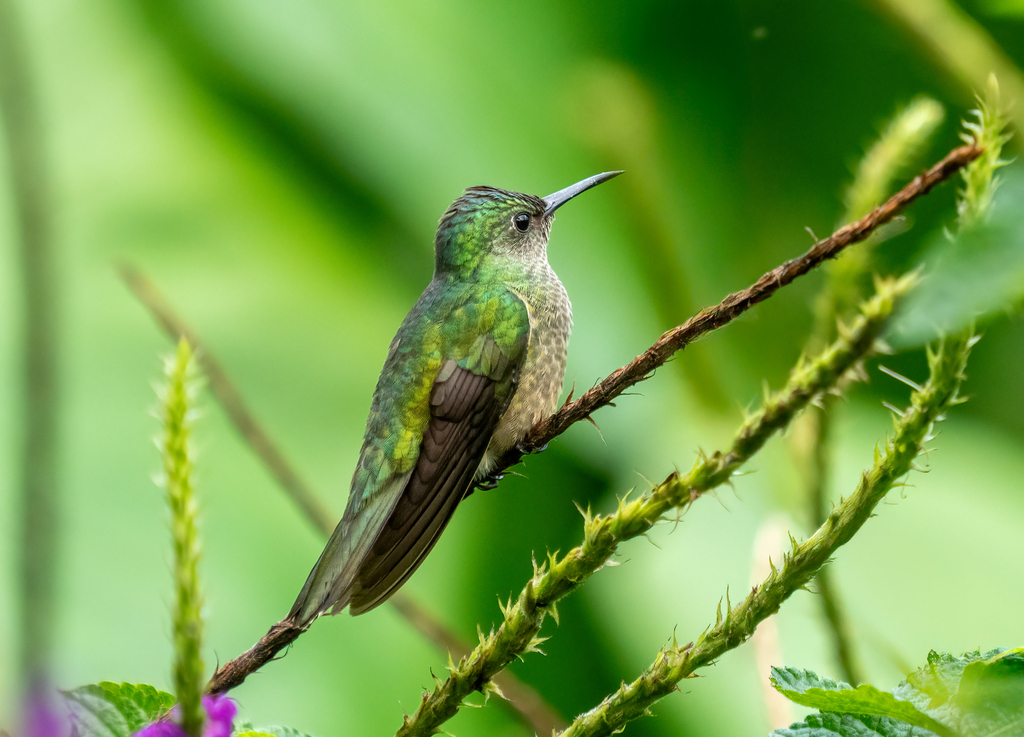
Scaly-breasted Hummingbird
Photo © rhododendrites
Photo © rhododendrites — CC BY-SA 4.0 — Source: iNaturalist photo #556063412Identification
The Scaly-breasted Hummingbird is a small emerald hummingbird measuring 11.5 to 13 cm in length and weighing approximately 8 to 10 grams. Males and females share identical plumage, though females possess a noticeably longer bill. Most subspecies display a mostly black bill with a pink base on the mandible, with the exception of P. c. roberti, which has an entirely black bill.
Plumage varies subtly among the six recognized subspecies. The nominate subspecies P. c. cuvierii, the smallest and palest form, is predominantly bronzy green with a grayish buff belly. The feathers of the underparts have distinctive buffy edges that create a characteristic scaly appearance—the feature that gives this species its common name. The tail is mostly bronzy, with white tips on the outer two or three tail feather pairs. Other subspecies show darker throats, variations in belly coloration, and differences in tail patterning, with P. c. saturatior representing the largest and darkest form.
Range & Habitat
The Scaly-breasted Hummingbird is distributed across Central America and into South America, with populations found in Mexico, Guatemala, Belize, Honduras, Nicaragua, Costa Rica, Panama, and Colombia. Different subspecies occupy distinct geographical areas, from the Caribbean slope of southeastern Mexico through Central America to the Pacific slopes and lowlands of Panama and northern Colombia.
This species favors semi-open to open landscapes and actively avoids the interior of closed forest. It inhabits dry forest, forest edges and clearings, gallery and humid forest, mangroves, secondary forest, scrublands, and gardens. The species typically occurs from the understory to mid-strata levels, though it also forages in the canopy at forest edges. It is primarily found at low elevations but occurs locally at elevations as high as 1,200 meters in Costa Rica.
Behaviour & Diet
The Scaly-breasted Hummingbird is predominantly sedentary but makes local movements to track flowering events. It feeds on nectar from a variety of flowering trees, shrubs, and bromeliads, foraging both by hovering and by perching on larger blooms. The species is notably aggressive, actively defending flowering patches and dominating smaller hummingbird species at food sources. Beyond nectar, it supplements its diet with arthropods, capturing prey both through hawking and by gleaning insects from vegetation.
Breeding occurs during the rainy season, from May through December in Guatemala and May to January in Costa Rica. Males gather at leks to display for females. The female constructs a distinctive cup nest from plant down and spiderweb, decorating the exterior with moss and lichen. The nest is typically positioned as a saddle on a horizontal branch 2 to 8 meters above the ground in a small tree. The female incubates a clutch of two eggs for 17 to 19 days, with fledging occurring 22 to 29 days after hatching. The species produces a loud, variable, continuous warble composed of chips, sharp squeaks, and short trills, with additional vocalizations including a high-pitched descending trill during chases and various other calls.
Best Time & Places to See It
The Scaly-breasted Hummingbird is considered uncommon to locally common throughout its range. The rainy season, from May through January depending on location, offers the best opportunity to observe this species, particularly during breeding season when males are most vocal and active at leks. The species occurs in several protected areas across its range, making these reserves reliable destinations for viewing.
Since different subspecies occupy distinct regions, visitors should target specific areas: the Caribbean slope of Central America for P. c. roberti, the Pacific slope of Costa Rica for P. c. maculicauda, and Panama and Colombia for the remaining subspecies. Look for this species in semi-open habitats with flowering shrubs and trees, particularly in secondary forest, forest edges, and cultivated gardens where flowering plants attract feeding birds.
Photography Tips
Photograph the Scaly-breasted Hummingbird in its preferred semi-open habitats where flowering trees and shrubs provide both subjects and natural perches. Early morning light works well for capturing the subtle iridescence of the bronzy-green plumage and the distinctive scaly pattern of the underparts. Position yourself near flowering plants or bromeliads where the species forages to capture hovering shots and perched feeding behavior.
The species' aggressive territorial behavior can be advantageous for photography; males actively defend flowering patches and will return repeatedly to the same feeding sites. Focus on capturing the longer bill of females and the subtle plumage differences among subspecies if working in areas where multiple forms occur. Use fast shutter speeds to freeze wing motion during hovering, and pay particular attention to the white-tipped tail feathers, which are a key field mark against the darker bronzy plumage.
Corcovado National Park
Puerto Jiménez, Costa Rica
+444 birds+48 mammals
Where the Osa Peninsula juts into the Pacific, rainforest descends almost to the tide line, and Corcovado National Park protects one of Central America's most intact…
VIEW NATIONAL PARKManuel Antonio National Park
Quepos, Costa Rica
+426 birds+22 mammals
Where tropical rainforest descends steeply to a rocky Pacific coastline, Manuel Antonio National Park distills Central American biodiversity into one of Costa Rica's most compressed and…
VIEW NATIONAL PARKArenal Volcano National Park
Peñas Blancas, Costa Rica
+551 birds+21 mammals
Straddling the border between Alajuela and Guanacaste in northwestern Costa Rica, this national park rises dramatically around one of Central America's most active volcanic systems. The…
VIEW NATIONAL PARKBraulio Carrillo National Park
Las Horquetas, Costa Rica
+547 birds+18 mammals
Where the Caribbean slope descends from the central volcanic cordillera toward the humid lowlands of Heredia, Braulio Carrillo National Park preserves one of Costa Rica's most…
VIEW NATIONAL PARKPiedras Blancas National Park
Golfito, Costa Rica
+386 birds+24 mammals
Where the Golfo Dulce meets the southwestern Pacific coast of Costa Rica, Piedras Blancas National Park protects a dramatic transition zone where lowland rainforest descends toward…
VIEW NATIONAL PARKSanta Rosa National Park
Santa Elena, Costa Rica
+359 birds+30 mammals
Where Pacific-facing slopes descend from volcanic uplands toward the Guanacaste lowlands, Santa Rosa National Park unfolds across a mosaic of tropical dry forest, gallery woodland, and…
VIEW NATIONAL PARKGuanacaste National Park
Santa Elena, Costa Rica
+461 birds+17 mammals
Where the Pacific slopes of northwestern Costa Rica rise toward the Continental Divide, dry tropical forest gives way to cloud-laden peaks and misty ridges—a landscape that…
VIEW NATIONAL PARKNatural Catatumbo Barí National Park
Convención, Colombia
+13 birds
Where the Andes descend into the humid lowlands of Norte de Santander, the 2,817-square-kilometre expanse of Natural Catatumbo Barí National Park spans a mosaic of montane…
VIEW NATIONAL PARKCoiba National Park
Montijo, Panama
+260 birds+10 mammals
An archipelago of volcanic and sedimentary islands rises from the Pacific waters off Panama's southwestern coast, its densest rainforest canopy unbroken for millennia. Coiba National Park…
VIEW NATIONAL PARKSoberanía National Park
Cristóbal, Panama
+495 birds+34 mammals
Rainforest and riverine woodland blanket the rolling terrain of this 714-square-kilometre national park in Colón Province, where the Caribbean watershed feeds a maze of streams and…
VIEW NATIONAL PARKChagres National Park
Caimitillo, Panama
+486 birds+19 mammals
Where the Chagres River carves through the humid tropics of central Panama, a vast montane and lowland forest sprawls across more than 2,300 square kilometers, anchoring…
VIEW NATIONAL PARKDarién National Park
Tucutí, Panama
+534 birds+13 mammals
Where the spine of Central America crumbles into wetland and rainforest, Darién National Park sprawls across more than 20,000 square kilometres of some of the tropics'…
VIEW NATIONAL PARKPortobelo National Park
Portobelo, Panama
+366 birds+9 mammals
Where the Caribbean's turquoise waters meet the Darién's verdant shore, Portobelo National Park sprawls across 570 square kilometers of coastal forest, mangrove wetland, and coral-fringed islands…
VIEW NATIONAL PARKMarino Golfo de Chiriquí National Park
Boca Chica, Panama
+82 birds+2 mammals
Where mangrove forests meet tropical Pacific waters, Marino Golfo de Chiriquí National Park spans 463 square kilometers of one of Central America's most biodiverse coastal systems.…
VIEW NATIONAL PARKMontes Azules
Candelaria, Mexico
+395 birds+47 mammals
Where jungle-clad limestone plateaus plunge into canyon systems carved by the Usumacinta River, Mexico's most pristine rainforest reserve unfolds across the Lacandón region of Chiapas. Montes…
VIEW BIOSPHERE RESERVETikal National Park
Tikal, Guatemala
+399 birds+16 mammals
Dense rainforest canopy rises above the limestone plateau of Petén, where archaeological wonder and ecological richness merge seamlessly across one of Central America's most biodiverse landscapes.…
VIEW NATIONAL PARKLaguna del Tigre National Park
Petén, Guatemala
+399 birds+29 mammals
Where the Petén lowlands dissolve into wetland and forest, Laguna del Tigre National Park protects one of Guatemala's most ecologically vital landscapes. This sprawling reserve encompasses…
VIEW NATIONAL PARKSierra del Lacandón National Park
Petén, Guatemala
+348 birds+7 mammals
Where the Petén rainforest rises into limestone ridges and deep ravines, Sierra del Lacandón National Park protects one of Central America's most intact tropical wilderness zones.…
VIEW NATIONAL PARKCarara National Park
Tárcoles, Costa Rica
+397 birds+19 mammals
Where the Pacific coastal plain meets transitional forest, Carara National Park straddles one of Central America's most dynamic ecological boundaries. The park's landscape encompasses lowland deciduous…
VIEW NATIONAL PARKPalo Verde National Park
Bagaces, Costa Rica
+318 birds+24 mammals
Dry forest spreads across Palo Verde's low-lying terrain in northwestern Guanacaste, where seasonal rivers and lagoons etch through deciduous woodland that sheds its canopy each winter.…
VIEW NATIONAL PARKCahuita National Park
Talamanca, Costa Rica
+359 birds+15 mammals
Where the Caribbean shoreline dissolves into mangrove creeks and coral gardens, Cahuita's mosaic of habitats unfolds across the Limón coast. The park's signature feature—a living coral…
VIEW NATIONAL PARKRincón de la Vieja National Park
Liberia, Costa Rica
+451 birds+30 mammals
Where volcanic slopes rise abruptly from the Guanacaste lowlands, Rincón de la Vieja National Park sprawls across a landscape shaped by geothermal drama and seasonal extremes.…
VIEW NATIONAL PARKTapantí Macizo de la Muerte National Park
Orosi, Costa Rica
+503 birds+18 mammals
Where montane cloud forest rises steeply from the Orosi Valley, Tapantí Macizo de la Muerte National Park enfolds a landscape of perpetual moisture and emerald complexity.…
VIEW NATIONAL PARKLa Amistad International Park
Crorina, Costa Rica
+532 birds+20 mammals
Where the Caribbean slopes of Costa Rica's Talamanca Mountains rise steeply inland from Limón, the boundary between two nations dissolves into an unbroken expanse of rainforest.…
VIEW NATIONAL PARKVolcán Tenorio National Park
Guatuso, Costa Rica
+480 birds+12 mammals
Where volcanic slopes rise through Costa Rica's northwestern borderlands, Volcán Tenorio National Park sprawls across terrain shaped by ancient lava flows and mineral-rich springs. The park's…
VIEW NATIONAL PARKMarino Ballena National Park
Bahía Ballena, Costa Rica
+336 birds+8 mammals
Where mangrove forests meet coral-fringed shorelines along Costa Rica's southern Pacific coast, Marino Ballena National Park encompasses a marine and terrestrial mosaic that ranks among Central…
VIEW NATIONAL PARKMarino Las Baulas National Park
Santa Cruz, Costa Rica
+246 birds+9 mammals
Where the Pacific meets a mosaic of dry forest and mangrove estuary, this coastal national park protects one of Central America's most dynamic wildlife theatres. The…
VIEW NATIONAL PARKCaño Negro National Wildlife Refuge
Caño Negro District, Costa Rica
+486 birds+16 mammals
Where the San Juan River's seasonal floodplain opens into expansive wetlands, Caño Negro Wildlife Sanctuary sprawls across one of Central America's most productive freshwater ecosystems. This…
VIEW WILDLIFE SANCTUARYGandoca-Manzanillo National Wildlife Refuge
Manzanillo, Costa Rica
+394 birds+18 mammals
Where the Caribbean coastal plain surrenders to water-logged forest and mangrove tangles, Gandoca-Manzanillo Wildlife Sanctuary shelters one of Costa Rica's most biodiverse lowland wetland ecosystems. The…
VIEW WILDLIFE SANCTUARYBarra del Colorado National Wildlife Refuge
Tortuguero, Costa Rica
+462 birds+36 mammals
Where the Caribbean's restless waters meet the Limón Province coastline, Barra del Colorado National Wildlife Sanctuary unfolds across a landscape of extraordinary ecological complexity. This equatorial…
VIEW WILDLIFE SANCTUARYCurú National Wildlife Refuge
Paquera, Costa Rica
+249 birds+8 mammals
Where the Pacific coast of Puntarenas dissolves into dry deciduous forest and mangrove fringe, Curú Wildlife Sanctuary holds one of Costa Rica's most ecologically vital yet…
VIEW WILDLIFE SANCTUARYNo community photos yet. Log in to add the first one.
No community observations of this species yet.