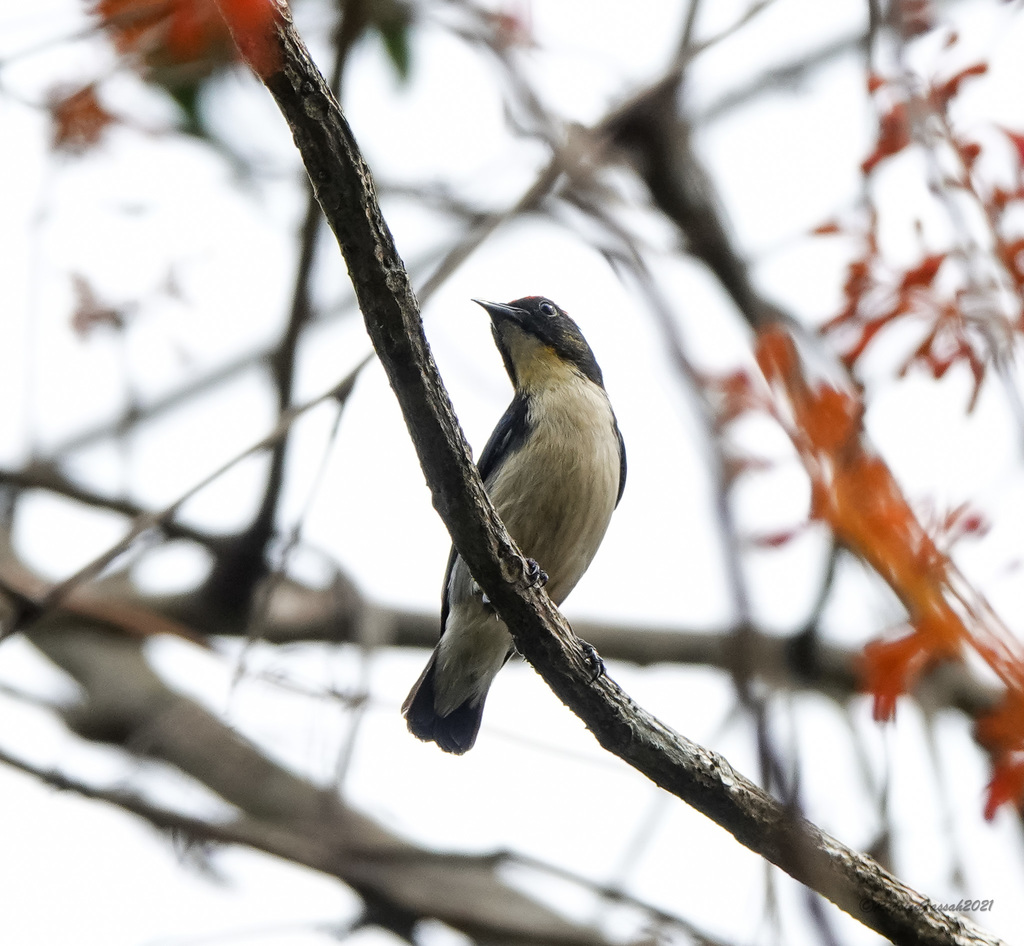
Scarlet-backed Flowerpecker
Photo © Rejoice Gassah
Photo © Rejoice Gassah — CC BY 4.0 — Source: iNaturalist #73372315Identification
The scarlet-backed flowerpecker is a tiny bird measuring just 9 cm with a short tail and weighing only 7–8 grams. Sexual dimorphism is striking: males display navy blue upperparts contrasted by a brilliant red stripe running from the crown down the back to the upper tail coverts, creating one of Asia's most distinctive small-bird patterns. Females and juveniles are predominantly olive green with black tails, though females retain scarlet upper tail coverts and rump. Both sexes share creamy white underparts, black eyes and legs, and a dark grey arched bill. Juveniles resemble females but have an orange bill and lack the bright red rump.
Range & Habitat
This flowerpecker is widespread across South and East Asia, found in Bangladesh, Bhutan, Brunei, Cambodia, China, India, Indonesia, Laos, Malaysia, Myanmar, Nepal, Singapore, Thailand, and Vietnam. Six recognized subspecies reflect this distribution, from the eastern Himalayas across Indochina to the Indonesian archipelago. The species inhabits subtropical and tropical moist lowland forests up to 1,000 metres elevation, as well as wooded areas and gardens. It is thought to be common throughout most of its range, particularly in Thailand, though considered rare in Bhutan and Nepal.
Behaviour & Diet
The scarlet-backed flowerpecker feeds primarily on figs, with records of it visiting Ficus fistulosa and F. grossularoides. In urban environments such as Hong Kong, it readily visits cultivated Syzygium jambos trees, demonstrating adaptability to human-modified landscapes. During breeding, pairs weave distinctive pouch-shaped nests suspended from high branches, featuring the characteristic side entrance typical of flowerpeckers—a remarkable engineering feat for such a diminutive bird.
Best Time & Places to See It
Thailand offers the most reliable opportunities for encountering this species, where it is considered common. Singapore's Bukit Timah Nature Reserve provides excellent chances, particularly where fig trees fruit. Urban gardens and parks across its range, especially in Hong Kong and other Southeast Asian cities, offer accessible viewing opportunities. The bird's small size and activity in fruiting trees means patient observation of flowering and fruiting vegetation increases sighting success.
Photography Tips
The male's striking red back provides excellent contrast for photography against green foliage. Look for birds visiting fig and Syzygium trees, where they may linger longer than in open branches. Their small size demands careful focusing and adequate shutter speed to freeze movement. Early morning light in gardens and forest edges will best showcase the brilliant red plumage of males. Patience near fruiting trees during fig and fruit seasons yields the most consistent photo opportunities.
Bako National Park
Gaoligong Mountain National Nature Reserve
Gunung Mulu National Park
Hat Noppharat Thara-Mu Ko Phi Phi National Park
Kaeng Krachan National Park
Kaziranga National Park
Kerinci Seblat National Park
Khao Laem National Park
Khao Laem Ya-Mu Ko Samet National Park
Nothing matches these filters.
No community photos yet. Log in to add the first one.
No community observations of this species yet.