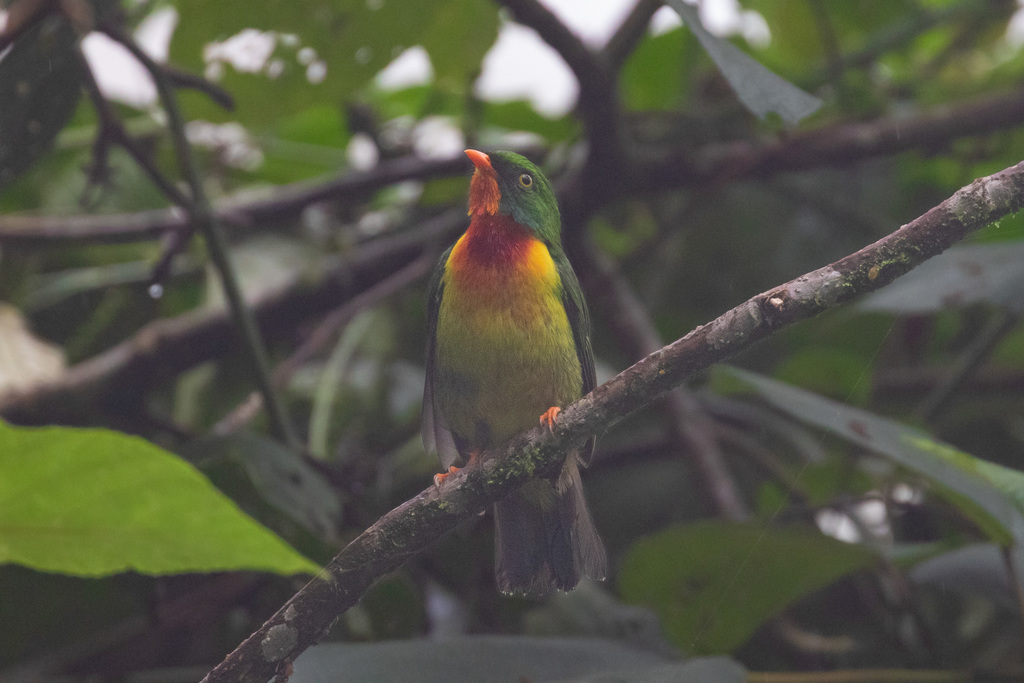
Scarlet-breasted Fruiteater
Photo © Thibaud Aronson
Photo © Thibaud Aronson — CC BY-SA 4.0 — Source: iNaturalist #69089260The scarlet-breasted fruiteater (Pipreola frontalis) is a species of bird in the family Cotingidae. It is found in Bolivia, Ecuador, and Peru where its natural habitat is subtropical and tropical moist montane forests. Two subspecies are recognised though some researchers consider these should be regarded as distinct species. It is a plump green bird with a black head, the males having red throats and the females yellow. It is a relatively common species with a wide range, and the International Union for Conservation of Nature has rated its conservation status as being "least concern". == Taxonomy and systematics == First described by British ornithologist Philip Sclater in 1858, the scarlet-breasted fruiteater is one of eleven species in the genus Pipreola. Its holotype is held at the Academy of Natural Sciences of Drexel University, in Philadelphia. The species is closely related to the fiery-throated fruiteater, but is found at higher elevations. There are two subspecies, which some taxonomists think represent two distinct species. P. f. frontalis occurs from central Peru into western Bolivia. P. f. squamipectus occurs from northern Ecuador into northwestern Peru. First described by Frank Chapman in 1925, it is smaller and less colorful than the nominate subspecies. The…
Sumaco Napo-Galeras National Park
Loreto, Ecuador
+563 birds+4 mammals
Where Ecuador's Amazon transitions into cloud forest, a massive shield volcano rises from the emerald lowlands of Orellana Province, anchoring one of the continent's most biodiverse…
VIEW NATIONAL PARKAntisana National Park
Quijos, Ecuador
+432 birds+21 mammals
Where the eastern Andean slopes descend into the Amazon basin, Antisana National Park sprawls across roughly 2,500 square kilometers of some of South America's most dramatic…
VIEW NATIONAL PARKBahuaja Sonene National Park
San Pedro de Putina Punco, Peru
+602 birds+8 mammals
Where the Madre de Dios and Heath rivers converge in southeastern Peru rises one of South America's most biodiverse wilderness regions: a vast protected realm of…
VIEW NATIONAL PARKNo community photos yet. Log in to add the first one.
No community observations of this species yet.