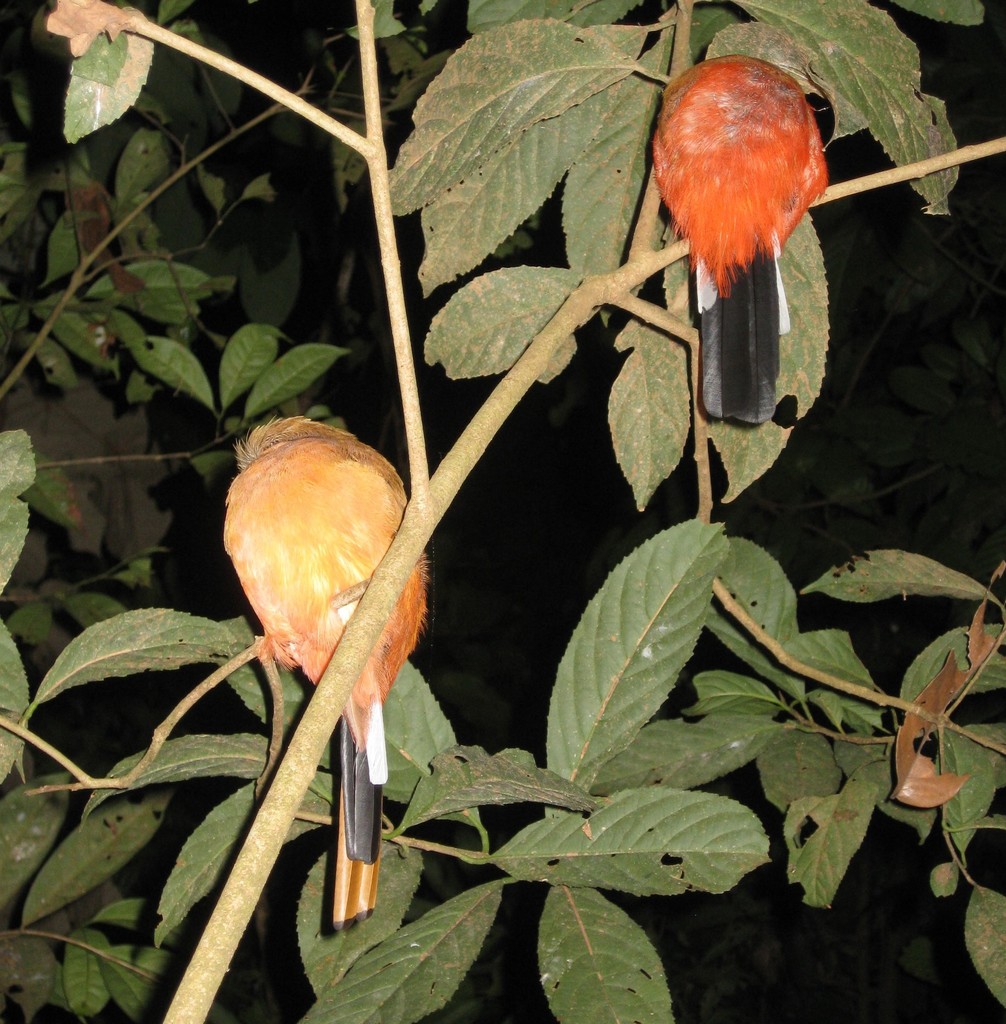
Scarlet-rumped Trogon
Photo © Ken Kneidel
Photo © Ken Kneidel — CC0 1.0 — Source: iNaturalist #70219456Identification
The scarlet-rumped trogon holds the distinction of being the world's smallest trogon, measuring just 23–24 cm in length and weighing between 34 and 43 grams. Despite its diminutive size, this species is instantly recognizable by its striking plumage and distinctive reddish rump, which gives it its common name. Males are particularly eye-catching, displaying a contrasting black head, neck, and throat that contrasts sharply with brilliant red underparts, rump, and uppertail coverts, complemented by rich buff or yellowish-brown upperparts. Females and juveniles are considerably duller, with buffy-brown breasts, reddish-pink bellies, and pinkish rumps, though juveniles lack the pink tones and appear more rufously colored. Both sexes share distinctive features including a blue bill, blue eyebrow stripe, thin eye ring, and white-and-black underside to the tail.
Range & Habitat
The scarlet-rumped trogon is a native resident of lowland forests across Southeast Asia, with a range spanning southern Thailand, southern Myanmar, the Malay Peninsula, Sumatra, and numerous Indonesian islands including Borneo, Bangka, Belitung, and the Riau Archipelago. This species shows a strong preference for the middle storeys of lowland semi-evergreen and evergreen forests, including freshwater swamp forests, and has a particular affinity for areas with abundant lianas. While it may occasionally venture into lower storeys and forest borders or mature secondary growth, it typically avoids mangroves, cultivated areas, and open country. Elevation varies considerably by location, ranging from around 400 meters in Thailand to 1,500 meters on Mount Kinabalu.
Behaviour & Diet
The scarlet-rumped trogon is generally a solitary bird except during breeding season, when pairs form to raise young. Individuals may occasionally join mixed-species flocks or follow foraging groups of babblers. Once perched on branches in the dense jungle, the bird's highly reduced leg muscles prevent it from walking or turning around without using its wings—a trait typical of trogons. Males emit rapid, accelerating "yau" calls that are quicker than those of other trogon species, while females produce quiet rattles and both sexes utter soft "kir-r-r-r" alarm calls.
As still-hunting predators, scarlet-rumped trogons wait patiently on branches before rushing at prey, much like shrikes. Their diet consists primarily of insects including moths, beetles, stick insects, caterpillars, and larvae, along with small fruits and vertebrates small enough to swallow whole.
Best Time & Places to See It
The breeding period from February to June offers the best opportunity to locate this species, as increased calling activity makes detection easier. March and May are particularly productive months in Peninsular Malaysia and Perak. Look for this bird in lowland forest reserves and national parks across its range, particularly in areas with intact semi-evergreen and evergreen forest with abundant lianas. Early morning when calling activity peaks provides the best chances of spotting this secretive, solitary species in its preferred middle-storey habitat.
Photography Tips
Photographing the scarlet-rumped trogon requires patience and careful positioning. The bird's preference for the middle storeys of dense jungle means positioning yourself at appropriate heights and looking upward. The male's striking scarlet underparts and black head provide excellent contrast and color saturation, particularly in dappled forest light. Keep shutter speeds high to freeze any movement as the bird hunts, and be prepared for rapid flights between perches. Early morning light during the breeding season will illuminate the male's brilliant plumage while the bird's calling behavior keeps it more vocal and active than usual.
Bako National Park
Kuching, Malaysia
+210 birds+17 mammals
Weathered sandstone cliffs rise dramatically from the South China Sea, their ochre faces sculpted by millennia of wind and tide into a landscape of extraordinary geological…
VIEW NATIONAL PARKTaman Negara National Park
Kampong Samas, Malaysia
+393 birds+48 mammals
Where ancient rainforest meets limestone peaks, one of Southeast Asia's oldest protected wilderness preserves sprawls across 4,343 square kilometers of primordial landscape. Dipterocarp giants tower overhead,…
VIEW NATIONAL PARKTaman Negara Bukit Lambir National Park
Miri, Malaysia
+153 birds+7 mammals
Rainforest cascades down sandstone ridges where crystal streams carve through ancient geology, creating a landscape of profound biological richness in Sarawak's interior. This 68-square-kilometre sanctuary protects…
VIEW NATIONAL PARKGunung Mulu National Park
Long Seridan, Malaysia
+280 birds+39 mammals
Where granite monoliths pierce the rainforest canopy of Sarawak, an ancient limestone karst landscape reveals one of Southeast Asia's most biodiverse strongholds. Soaring peaks cloaked in…
VIEW NATIONAL PARKKerinci Seblat National Park
Kerinci, Indonesia
+228 birds+16 mammals
Across nearly 67,000 square kilometres of Sumatra's spine, a mountainous realm of equatorial rainforest rises from steaming lowlands to volcanic peaks shrouded in cloud. Kerinci Seblat…
VIEW NATIONAL PARKWay Kambas National Park
Lampung Timur, Indonesia
+237 birds+20 mammals
Across the low swamplands of eastern Lampung, where freshwater wetlands merge into tidal mangrove forests along the Sunda Strait, sprawls one of Sumatra's most vital sanctuaries.…
VIEW NATIONAL PARKNo community photos yet. Log in to add the first one.
No community observations of this species yet.