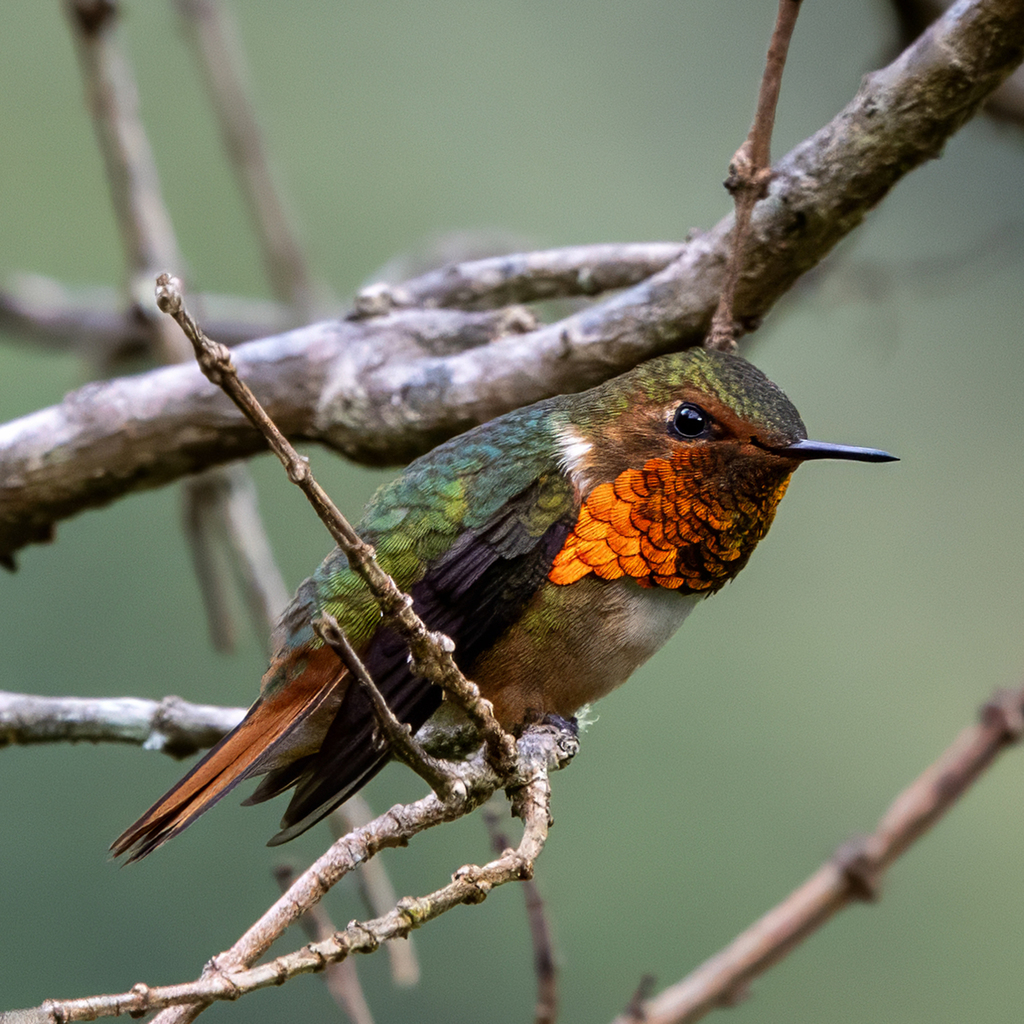
Scintillant Hummingbird
Photo © Dan Vickers
Photo © Dan Vickers — CC BY 4.0 — Source: iNaturalist #255947547Identification
The scintillant hummingbird is among the tiniest birds on Earth, measuring just 6.5–8 cm (2.6–3.1 in) in length and weighing a mere 2–2.3 grams—marginally larger than the bee hummingbird itself. Males are particularly striking, with bronze-green upperparts, a brilliant red throat separated from cinnamon underparts by a distinctive white neck band, and a rufous and black-striped tail. Females are subtly different: their throats are buff with small green spots, and their flanks display richer rufous coloration. Both sexes possess a short, straight black bill. Young birds resemble females but show rufous fringes on their upperpart plumage.
Range & Habitat
The scintillant hummingbird is endemic to Costa Rica and Panama, where it occupies a specific ecological niche at middle elevations. This tiny species inhabits brushy forest edges, coffee plantations, and occasionally gardens, typically found between 900 and 2,000 meters in elevation, though it may venture up to 2,500 meters during non-breeding periods. At higher elevations, its range is replaced by the closely related volcano hummingbird.
Behaviour & Diet
Like all hummingbirds, the scintillant feeds primarily on nectar from small flowers, including Salvia and insect-pollinated species, supplementing this diet with tiny insects for essential protein. During breeding season, males adopt a highly territorial lifestyle, perching conspicuously in open areas with abundant Salvia flowers and defending their feeding territories with aggressive diving displays. Their presence is announced by a liquid tsip call.
Breeding falls entirely to the female, who constructs a delicate cup nest from plant floss, positioned 1–4 meters high in scrub vegetation. She lays two white eggs, which require 15–19 days of incubation, followed by another 20–26 days until fledging—a remarkable investment from such a diminutive parent.
Best Time & Places to See It
Seek scintillant hummingbirds in the highland regions of Costa Rica and Panama, particularly in areas with coffee plantations and brushy forest edges at elevations between 900 and 2,000 meters. The breeding season is the most productive time for observation, when males actively defend territories and perch conspicuously in open areas with flowering Salvia.
Photography Tips
Photographing such a minute subject demands patience and appropriate equipment. Focus on areas where males are defending territories during breeding season, as they are most likely to remain perched and visible. Early morning light is ideal for capturing the iridescent brilliance of the male's red throat. A telephoto lens is essential given the bird's small size, and fast shutter speeds are necessary to freeze the rapid movement of these hyperactive creatures.
Chirripó National Park
Rivas, Costa Rica
+274 birds+6 mammals
Where the volcanic spine of Costa Rica's Central Cordillera reaches its apex, Chirripó National Park encompasses a landscape that shifts dramatically with elevation, from montane cloud…
VIEW NATIONAL PARKBraulio Carrillo National Park
Las Horquetas, Costa Rica
+547 birds+18 mammals
Where the Caribbean slope descends from the central volcanic cordillera toward the humid lowlands of Heredia, Braulio Carrillo National Park preserves one of Costa Rica's most…
VIEW NATIONAL PARKVolcán Poás National Park
Toro Amarillo, Costa Rica
+237 birds+4 mammals
Where volcanic slopes rise sharply from the Central Valley floor, Volcán Poás National Park protects one of Costa Rica's most active and accessible volcanic systems. The…
VIEW NATIONAL PARKBaru Volcano National Park
Cerro Punta, Panama
+402 birds+6 mammals
Where the land rises sharply toward the Caribbean's western spine, Baru Volcano National Park sprawls across roughly 220 square kilometres of southwestern Panama, anchored by the…
VIEW NATIONAL PARKParque Internacional la Amistad
Teribe, Panama
+325 birds+11 mammals
Where the continental divide rises between the Caribbean and Pacific watersheds, a wilderness of extraordinary biological richness unfolds across the Talamanca Range and into lowland rainforest—a…
VIEW NATIONAL PARKLos Quetzales National Park
Copey, Costa Rica
+232 birds+3 mammals
Cloud forest sweeps across the upper slopes of the Central Valley watershed, where elevation and persistent moisture forge an ecosystem unlike any other in Costa Rica.…
VIEW NATIONAL PARKTapantí Macizo de la Muerte National Park
Orosi, Costa Rica
+503 birds+18 mammals
Where montane cloud forest rises steeply from the Orosi Valley, Tapantí Macizo de la Muerte National Park enfolds a landscape of perpetual moisture and emerald complexity.…
VIEW NATIONAL PARKLa Amistad International Park
Crorina, Costa Rica
+532 birds+20 mammals
Where the Caribbean slopes of Costa Rica's Talamanca Mountains rise steeply inland from Limón, the boundary between two nations dissolves into an unbroken expanse of rainforest.…
VIEW NATIONAL PARKNo community photos yet. Log in to add the first one.
No community observations of this species yet.