Identification
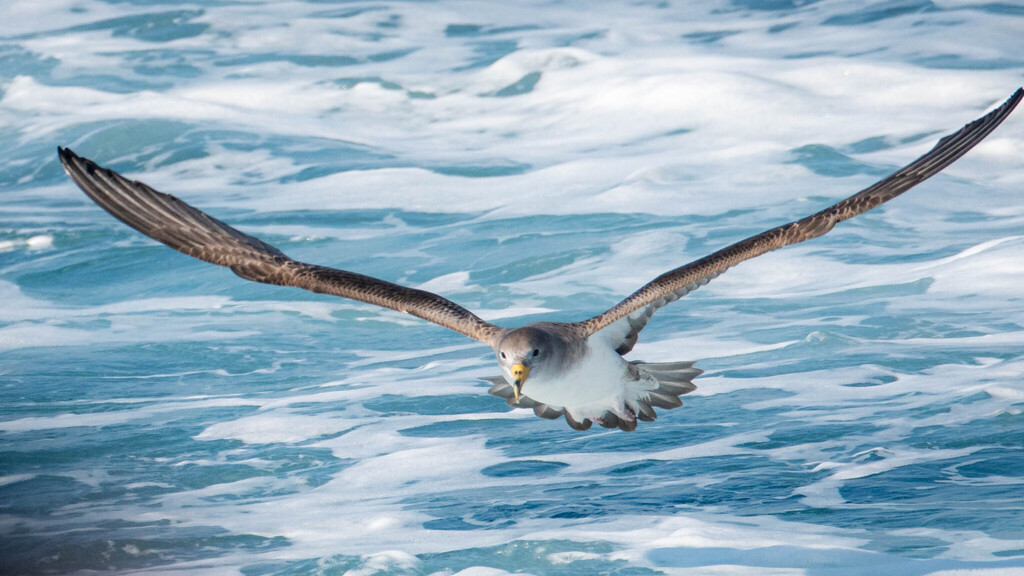
Scopoli's shearwater is a medium-sized seabird measuring 45–52 cm in length with a wingspan of 112–122 cm. It is brownish-grey above with darker brown wings, while the underparts are predominantly white with a brown border most visible along the trailing edge of the wing. The bill is pale yellow with a distinctive dark patch near the tip, and the legs and feet are pale flesh-coloured. The sexes are similar in appearance, though males are on average slightly larger than females.
This species closely resembles Cory's shearwater, and the two can be challenging to distinguish in the field. A helpful identifying feature is that Scopoli's shearwater has more white on the underside of the primary feathers at the wingtip, particularly the outermost large feather. The Cape Verde shearwater, by contrast, is smaller and significantly darker above.
Range & Habitat
Scopoli's shearwater breeds on rocky islands and steep coasts throughout the Mediterranean, ranging from the Chafarinas Islands off the Moroccan coast in the west to the Dodecanese in Greece in the east. The species' largest colony is found on Zembra, a rocky island 13 km off the Tunisian coast, which contains between 141,000 and 223,000 breeding pairs—representing more than 75 percent of the global population. Other significant colonies occur on the island of Linosa in the Strait of Sicily and on the Balearic Islands.
Outside the breeding season, these birds undertake a remarkable migration to the Atlantic. After breeding concludes in late October, they migrate through the Strait of Gibraltar and disperse across Atlantic upwelling regions. Studies using light-level geolocators show that birds wintered either off the coast of West Africa in the Canary Current upwelling or further south in the Benguela Current off Namibia. They return to the Mediterranean at the end of February.
Behaviour & Diet
Scopoli's shearwater is primarily piscivorous but also consumes cephalopods and crustaceans. It forages by skimming over the water surface or engaging in surface feeding, and only rarely plunges completely beneath the surface. An opportunistic feeder, it sometimes follows whales and tuna to pick up food scraps and to catch small fish driven to the surface, and will also scavenge discards from fishing vessels.
Best Time & Places to See It
To observe Scopoli's shearwater during the breeding season, visit Mediterranean rocky islands and coastal areas between late February and October. The Zembra island colony off Tunisia offers the highest concentration, while the Balearic Islands and Linosa in the Strait of Sicily provide more accessible viewing opportunities. Outside the breeding season, the species is best encountered in Atlantic waters off West Africa and southern Africa.
Photography Tips
Photographing Scopoli's shearwater in its natural habitat requires patience and a good vantage point on or near breeding colonies during the breeding season. When at sea, look for the characteristic pale bill with dark tip and the white underparts with brown trailing edge visible in flight. The bird's skimming behaviour over water makes for dynamic action shots, though the underside of the wings—with their relatively white primary feathers—provide distinctive identification features worth capturing. Early morning light often renders the brownish-grey upperparts and white underparts in sharp relief.
S’Albufera Natural Park
Platja de Muro, Spain
+253 birds+6 mammals
Where Mediterranean lagoons meet the Balearic coast, S'Albufera stretches across nearly 1,600 hectares of wetland and dune systems that rank among Europe's most ecologically vital shallow-water…
VIEW NATURAL PARKL’Albufera Natural Park
València, Spain
+321 birds+18 mammals
Where shallow lagoons meet Mediterranean coastal marshland, L'Albufera Nature Park unfolds as one of Spain's most vital wetland complexes. This protected landscape, designated under IUCN Category…
VIEW NATURAL PARKCabo de Gata-Níjar Natural Park
San José, Spain
+274 birds+11 mammals
Where volcanic ridges plunge toward the Mediterranean, Cabo de Gata-Níjar Nature Park unfolds across one of Europe's most arid coastlines, a landscape sculpted by tectonic violence…
VIEW NATURAL PARKPenínsula de Llevant Natural Park
Betlem, Spain
+79 birds+1 mammals
Where low limestone hills descend toward crystalline Mediterranean waters, the Península de Llevant Nature Park unfolds as a tapestry of drylands, scrubland, and rocky coves that…
VIEW NATURAL PARKParcial C Marina de les Medes Nature Reserve
Torroella de Montgrí, Spain
+93 birds
Where the Costa Brava's limestone cliffs plunge into crystalline Mediterranean waters, the Parcial C section of Marina de les Medes Nature Reserve protects one of Catalonia's…
VIEW NATURE RESERVEDelta de l’Ebre Natural Park
Eucaliptus, Spain
+341 birds+18 mammals
Where the Ebro River spreads into a vast labyrinth of shallow lagoons, reed beds, and brackish marshes before surrendering to the Mediterranean, one of southern Europe's…
VIEW NATURAL PARKCap de Creus Natural Park
Roses, Spain
+245 birds+23 mammals
Where the Pyrenees tumble into the Mediterranean, Cap de Creus Nature Park unfolds across 300 square kilometres of one of northeastern Spain's most dramatic coastal wilderness…
VIEW NATURAL PARKParc del Garraf
Rat-Penat, Spain
+190 birds+15 mammals
Where limestone ridges rise abruptly from the Mediterranean coastal plain, Parc Natural del Garraf unfolds across 319 square kilometers of one of Catalonia's most dramatic protected…
VIEW NATURAL PARKEspacio Natural Remolar-Filipinas
El Prat del Llobregat, Spain
+297 birds+7 mammals
Where the Llobregat River delta meets the Mediterranean, a patchwork of salt marshes, reed beds, and shallow lagoons creates one of Catalonia's most dynamic wetland ecosystems.…
VIEW NATURE RESERVECamargue Regional Nature Park
Saintes-Maries-de-la-Mer, France
+378 birds+48 mammals
Where the Rhône Delta sprawls into the Mediterranean, a landscape of stark and haunting beauty emerges—vast salt marshes punctuated by shallow lagoons, reed beds, and scrubland…
VIEW NATURAL PARKEstrecho Natural Park
Pedro Valiente, Spain
+281 birds+20 mammals
Where Mediterranean pine forests meet wind-sculpted coastal cliffs, one of Europe's most dynamic ecological crossroads unfolds across the Strait of Gibraltar. Spanning 686 square kilometers of…
VIEW NATURAL PARKCirceo National Park
Italy
+232 birds+6 mammals
Where limestone headlands plunge toward the Tyrrhenian Sea, Circeo National Park preserves a rare mosaic of Mediterranean coastal habitats that few Italian reserves can match. The…
VIEW NATIONAL PARKLa Maddalena Archipelago National Park
La Maddalena, Italy
+86 birds+1 mammals
Crystalline waters lap against granite islands scattered across the Tyrrhenian Sea, where Dell'Arcipelago di la Maddalena unfolds as a Mediterranean archipelago of raw geological beauty and…
VIEW NATIONAL PARKTuscan Archipelago National Park
Rio, Italy
+174 birds+8 mammals
Where the Tyrrhenian Sea fragments into granite and schist islands, the Arcipelago Toscano National Park protects one of the Mediterranean's most biodiverse maritime realms. Scattered across…
VIEW NATIONAL PARKGargano National Park
Cagnano Varano, Italy
+219 birds+7 mammals
Where the Gargano Peninsula's limestone plateaus descend toward the Adriatic, Cagnano Varano sits at the threshold of one of southern Italy's most ecologically vital landscapes. The…
VIEW NATIONAL PARKAsinara National Park
Porto Torres, Italy
+103 birds+5 mammals
Rocky limestone cliffs plunge toward the Tyrrhenian Sea where Dell'Asinara National Park guards a slender island sanctuary off Sardinia's northwestern coast. The park's terrain is a…
VIEW NATIONAL PARKMount Ainos National Park
Sami Municipal Unit, Greece
+118 birds+1 mammals
Where limestone and conglomerate peaks rise dramatically above the Ionian Sea, Mount Ainos commands the landscape of Kefalonia with a rugged majesty that few Mediterranean summits…
VIEW NATIONAL PARKButrint National Park
Vagalat, Albania
+140 birds+3 mammals
Where the Ionian coast meets ancient alluvial plains, Butrint National Park spans a landscape of extraordinary ecological complexity that has shaped human settlement for three millennia.…
VIEW NATIONAL PARKSamaria National Park
Chania Regional Unit, Greece
+103 birds+1 mammals
Vertical walls of pale limestone rise nearly a kilometre from the Cretan seabed, their flanks carved by the Samaria Gorge into one of Europe's most dramatic…
VIEW NATIONAL PARKCabo Peñas
Susacasa, Spain
+303 birds+21 mammals
Where sea cliffs rise sheer from the Bay of Biscay, Susacasa's observation point commands one of Asturias's most dramatic coastal vistas. The landscape here is defined…
VIEW OBSERVATION POINTPort-Cros National Park
Hyères, France
+271 birds+29 mammals
Where Mediterranean granite islands rise from crystalline waters off the Provençal coast, Port-Cros National Park protects one of Europe's most intact marine and terrestrial ecosystems. The…
VIEW NATIONAL PARKCalanques National Park
Bouches-du-Rhône, France
+233 birds+42 mammals
Where limestone cliffs plunge dramatically into crystalline Mediterranean waters, Calanques National Park preserves one of Europe's most striking coastal landscapes. These steep-sided inlets, carved by erosion…
VIEW NATIONAL PARKCinque Terre National Park
Riomaggiore, Italy
+135 birds+1 mammals
Steep terraced cliffs plunge toward the Ligurian Sea where five villages cling to a Csb-climate coastline shaped by centuries of viticulture and stone masonry. Riomaggiore, the…
VIEW NATIONAL PARKMerritt Island National Wildlife Refuge
Brevard County, United States
+341 birds+19 mammals
Brackish marshes and palmetto scrub define this wildlife sanctuary spanning the coastal lowlands of central Florida, where the Atlantic tide meets freshwater systems in a dynamic…
VIEW WILDLIFE SANCTUARYChincoteague National Wildlife Refuge
Chincoteague, United States
+362 birds+16 mammals
Across the barrier islands and salt marshes of Virginia's Eastern Shore, where Atlantic tides sculpt an intricate mosaic of sandy spits and tidal flats, lies one…
VIEW WILDLIFE SANCTUARYPea Island National Wildlife Refuge
Dare County, United States
+356 birds+15 mammals
Where the Outer Banks taper toward the Atlantic, a sliver of barrier island creates a microcosm of coastal ecology. Pea Island National Wildlife Sanctuary spans over…
VIEW WILDLIFE SANCTUARYNo community photos yet. Log in to add the first one.
No community observations of this species yet.