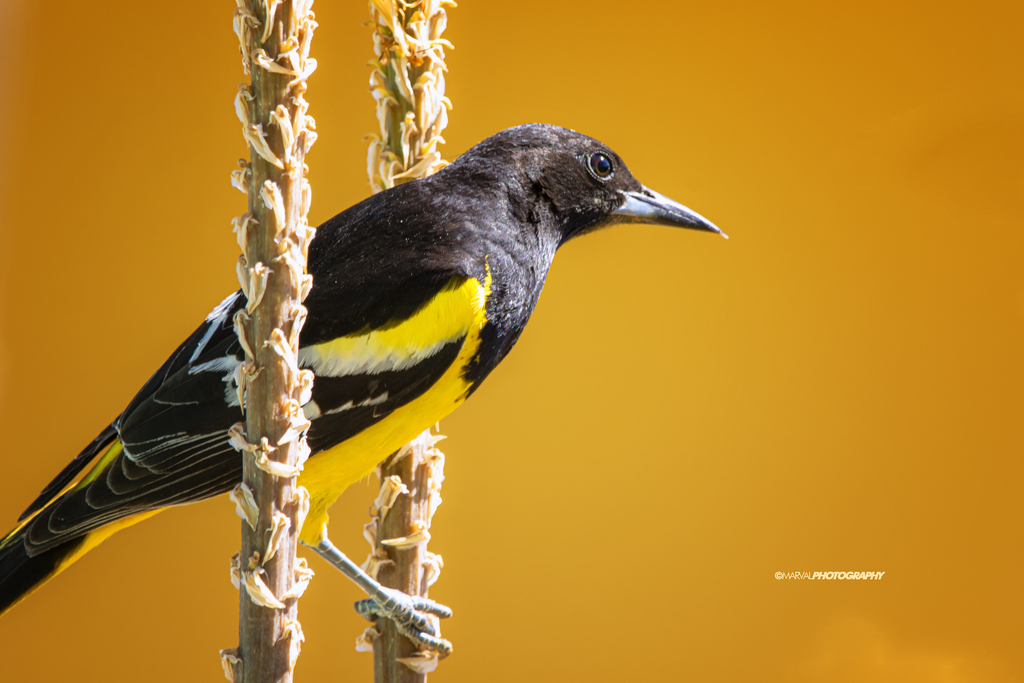
Scott’s Oriole
Photo © MarvalPhotography19
Photo © MarvalPhotography19 — CC BY 4.0 — Source: iNaturalist photo #277376784Identification
Scott's Oriole is a medium-sized songbird measuring about 23 cm long with a 32 cm wingspan. Adult males are unmistakable in breeding plumage: they display a striking black head, back, throat, and breast contrasting sharply with bright lemon-yellow rump and underparts. The wings are black with pale yellow shoulder patches (epaulets) and distinctive white wing bars, while tail feathers are mostly black with yellow and white tips that increase in size toward the outer feathers. Adult females are more subdued, with grayish-olive upperparts and streaking, a black chin and upper breast, and pale olive-yellow underparts. Both sexes share a black or bluish-black bill with a gray base, dark iris, and slate-colored legs.
Range & Habitat
Scott's Oriole inhabits the southwestern United States and Mexico, with a discontinuous range across southern California, Utah, Arizona, New Mexico, and western Texas, extending throughout the Baja California peninsula and mainland Mexico south to Oaxaca. The species prefers moderately elevated arid landscapes but avoids true deserts without trees, thriving in pinyon-juniper woodlands, pine-oak forests, scrublands, and areas with yucca plants. Elevation ranges from sea level to 3,000 meters. As a partial migrant, the species is a year-round resident in southern Baja California and central mainland Mexico, but populations in the northern part of its range breed seasonally.
Behaviour & Diet
Scott's Oriole is primarily insectivorous, gleaning adult and larval insects from ground and vegetation, supplemented by fruit, nectar, and occasionally small lizards. During breeding season it forages singly, in pairs, or in family groups, while in winter it often joins mixed-species feeding flocks. The breeding season extends from mid-May through mid-August, with females constructing distinctive hanging cup nests woven from yucca leaf strips and lined with grass and seed down, typically placed 3.5 to 6.5 meters high. Clutches of one to five eggs (usually three) are incubated by females for 11 to 15 days, with young fledging about 14 days after hatching.
Best Time & Places to See It
Spring migration (early April to early May) and fall migration (mid-August to mid-September) offer the best opportunities to encounter Scott's Oriole during movement periods. Year-round residents can be found in southern Baja California and central Mexican highlands, while breeding season (mid-May through mid-August) is optimal for northern range locations in the southwestern United States. The species tends to be uncommon in the U.S. portion of its range but is more readily found in suitable habitat within Mexico. Yucca-dotted scrublands and juniper-oak woodlands are prime habitats to search.
Photography Tips
The male's striking black-and-yellow plumage provides excellent contrast for photography, particularly in breeding plumage during late spring and early summer. Position yourself near yucca plants and low scrubby vegetation where nests are often built, as this allows close approach without disturbance. Early morning light best illuminates the yellow undersides and epaulets. Females are more challenging to photograph due to their muted olive and yellow coloration; use patient waiting near foraging areas. The species' habit of hanging nests makes them visible photographic subjects, though care should be taken not to approach active nests during breeding season.
Big Bend National Park
Brewster County, United States
+345 birds+34 mammals
Where the Chisos Mountains rise abruptly from the Sonoran Desert floor, Big Bend National Park spans over 7,300 square kilometers of one of North America's most…
VIEW NATIONAL PARKCanyonlands National Park
Wayne County, United States
+186 birds+15 mammals
Where the Colorado River has carved an intricate labyrinth through the high desert plateau of southeastern Utah, Canyonlands National Park sprawls across nearly 3,030 square kilometres…
VIEW NATIONAL PARKSaguaro National Park
Rincon Valley, United States
+354 birds+40 mammals
Where the Sonoran Desert meets sky-island mountains, two geographically separated districts of Saguaro National Park sprawl across nearly two thousand square kilometers of Arizona's most iconic…
VIEW NATIONAL PARKJoshua Tree National Park
Riverside County, United States
+221 birds+23 mammals
Across 5,610 square kilometers of Riverside County's high desert, a landscape of geological drama unfolds where granite monoliths pierce through bajadas of creosote scrub and Joshua…
VIEW NATIONAL PARKGreat Basin National Park
White Pine County, United States
+170 birds+19 mammals
Where the Great Basin's high desert plateaus rise above 10,000 feet, ancient bristlecone pines endure on moonscape ridges of limestone and quartzite, creating one of North…
VIEW NATIONAL PARKCarlsbad Caverns National Park
Eddy County, United States
+309 birds+18 mammals
Beneath the Chihuahuan Desert floor of southern New Mexico lies one of North America's most spectacular subterranean landscapes. Carlsbad Caverns National Park encompasses over 518 square…
VIEW NATIONAL PARKArches National Park
Grand County, United States
+185 birds+20 mammals
Where rust-red sandstone fins rise abruptly from high desert scrubland, Arches National Park spans 548 square kilometers of one of North America's most sculptural landscapes. The…
VIEW NATIONAL PARKZion National Park
Washington County, United States
+244 birds+30 mammals
Towering sandstone cliffs in shades of crimson, rust, and cream rise abruptly from the Virgin River's winding canyon floor, their sculpted faces bearing witness to millions…
VIEW NATIONAL PARKMesa Verde National Park
Montezuma County, United States
+166 birds+10 mammals
Across the high desert plateau of southwestern Colorado, where sandstone mesas rise abruptly from piñon-juniper scrubland, Mesa Verde National Park preserves one of North America's most…
VIEW NATIONAL PARKCapitol Reef National Park
Garfield County, United States
+196 birds+22 mammals
Wrinkled ridges of crimson and gold sandstone rise from the floor of south-central Utah, their weathered faces carved by the Fremont River into one of the…
VIEW NATIONAL PARKDeath Valley National Park
Inyo County, United States
+339 birds+25 mammals
Across nearly 3.5 million acres of southeastern California's Inyo County, vast salt flats meet sculpted badlands and alluvial fans in a landscape so extreme it defines…
VIEW NATIONAL PARKEl Vizcaíno
Laguna San Ignacio, Mexico
+317 birds+29 mammals
Where the Baja California peninsula thins into a tapestry of salt lagoons and coastal desert, one of Mexico's most biodiverse reserves sprawls across half a million…
VIEW BIOSPHERE RESERVEParque Nacional Cerro de la Estrella
Mexico
+126 birds+4 mammals
Where volcanic peaks rise sharply above Mexico City's sprawling metropolis, Parque Nacional Cerro de la Estrella offers a rare glimpse of high-altitude terrain within one of…
VIEW NATIONAL PARKTutuaca
Tosanachi, Mexico
+147 birds+13 mammals
Where copper canyons plunge deeper than the Grand Canyon itself, Mexico's remote Sierra Madre Occidental unfolds in dramatic vertical relief. Tutuaca anchors this wilderness realm, a…
VIEW PROTECTED LANDSCAPEBryce Canyon National Park
Tropic, United States
+202 birds+20 mammals
Hoodoos rise like a forest of stone pillars from an amphitheater carved into Utah's high plateau, where the Paunsaugunt elevates the landscape to over 9,000 feet…
VIEW NATIONAL PARKChannel Islands National Park
Santa Barbara County, United States
+330 birds+15 mammals
A chain of eight volcanic islands rises from the cold Pacific waters off the California coast, their rugged sea cliffs and windswept terrain shaped by millions…
VIEW NATIONAL PARKGrand Canyon National Park
United States
+277 birds+35 mammals
A mile-deep chasm of rust-red rock and purple shadow cuts through the high desert plateau of northern Arizona, revealing nearly two billion years of geological history…
VIEW NATIONAL PARKGuadalupe Mountains National Park
Culberson County, United States
+262 birds+14 mammals
Where fossil-laden limestone ridges thrust skyward above the Chihuahuan Desert floor, Guadalupe Mountains National Park reveals a landscape sculpted by ancient seas and relentless aridity. These…
VIEW NATIONAL PARKPetrified Forest National Park
Apache County, United States
+206 birds+23 mammals
Across the high desert plateau of northeastern Arizona, where the climate swings between scorching summer days and frost-laden winters, badlands of raw earth and timber-turned-to-stone dominate…
VIEW NATIONAL PARKWhite Sands National Park
Otero County, United States
+178 birds+6 mammals
Across the Tularosa Basin in south-central New Mexico sprawls an otherworldly landscape of gypsum dunes—the largest gypsum field on Earth and a stark desert playground shaped…
VIEW NATIONAL PARKBosque del Apache National Wildlife Refuge
Socorro County, United States
+345 birds+17 mammals
Where the Rio Grande emerges from its desert canyon in central New Mexico, a narrow ribbon of riparian woodland defies the arid landscape that surrounds it.…
VIEW WILDLIFE SANCTUARYCabeza Prieta National Wildlife Refuge
United States
+155 birds+6 mammals
Across southwestern Arizona's harshest terrain, where the Colorado River marks the border with Mexico, lies a sanctuary shaped entirely by heat and aridity. Cabeza Prieta National…
VIEW WILDLIFE SANCTUARYKofa National Wildlife Refuge
Yuma County, United States
+142 birds+10 mammals
Desert mountains rise in sculptured ridges across northwestern Arizona, where the Colorado River's distant influence fades into some of the most austere terrain in the American…
VIEW WILDLIFE SANCTUARYSalton Sea National Wildlife Refuge
Imperial County, United States
+289 birds+4 mammals
Across the floor of California's inland desert, where summer temperatures soar and rainfall is measured in tenths of inches, lies an improbable oasis of shallow water…
VIEW WILDLIFE SANCTUARYBitter Lake National Wildlife Refuge
Chaves County, United States
+284 birds+10 mammals
Across the high desert floor of southeastern New Mexico, where elevation and aridity shape every living thing, shallow alkaline lakes and marshes form an unexpected oasis…
VIEW WILDLIFE SANCTUARYNo community photos yet. Log in to add the first one.
No community observations of this species yet.