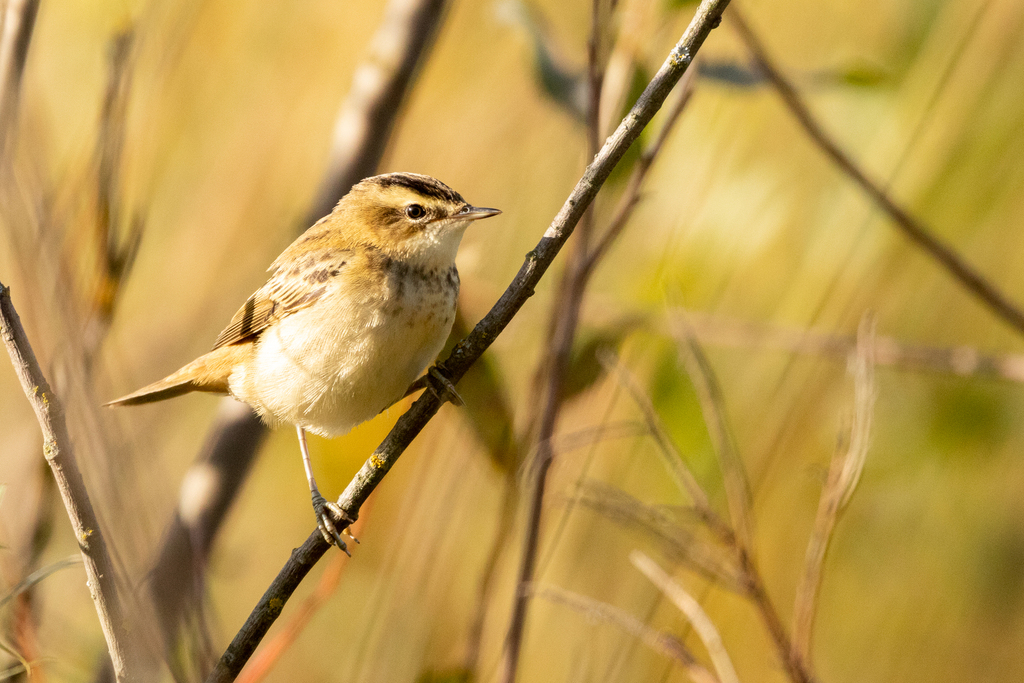
Sedge Warbler
Photo © Константин Шатилов
Photo © Константин Шатилов — CC BY 4.0 — Source: iNaturalist photo #430997267Identification
The sedge warbler is a medium-sized warbler, measuring 11.5–13 cm long and weighing around 12 g. Its most distinctive feature is a prominent whitish supercilium (eyebrow stripe) set against a streaked brown crown and back. The plumage overall is warm brown and streaked on the back and wings, with pale underparts and an unstreaked, warm-brown rump that contrasts noticeably with the duller wings. The forehead is flattened, the bill is strong and pointed, and the legs are greyish. The sexes are identical in appearance. Juveniles can be trickier to identify, showing dark spots on the breast and a pale central crown stripe that may cause confusion with aquatic warblers, moustached warblers, and Pallas's grasshopper warblers.
Range & Habitat
The sedge warbler breeds across Europe and western and central Asia, making it unusual among Acrocephalus warblers for its range stretching from the Arctic to mid-latitudes. It is a long-distance migrant, with populations rapidly crossing southern Europe and the Sahara Desert between August and September to reach their African wintering grounds. All sedge warblers winter in sub-Saharan Africa, from Senegal in the west to Ethiopia in the east, and as far south as the eastern Cape Province of South Africa and northern Namibia. Remarkably, studies suggest that individual birds return to the same wintering sites year after year.
This species is adapted to cool, cloudy and moist conditions. During the breeding season, sedge warblers favour reedbeds, often with scrub and ditches, but can also breed in hedgerows, patches of stinging nettles, and arable crops up to 500 metres or more away from water. On African wintering grounds, they inhabit reedbeds, papyrus, sedge, reedmace, and tall elephant grass, sometimes at elevations of 1,800–2,400 metres in Ethiopia.
Behaviour & Diet
Male sedge warblers begin singing within hours of arriving on their breeding territory. The song is distinctive: varied, rushed, and chattering, composed of random phrases that are never quite the same twice. It includes sweeter notes and mimicry of other species. Males deliver their song from bare perches such as reed stems or bushes, and perform spectacular song-flights, rising to around 2–5 metres before descending slowly with wings held in a 'v' shape. Interestingly, the song functions primarily to attract mates rather than to repel rival males, and ceases once a mate is found. Early-arriving males secure the best breeding territories. Contact calls are described as chirr or kerr sounds, which can be repeated rapidly to form a rattling alarm call.
The sedge warbler is mostly insectivorous, feeding on insects throughout the year. Before migration, birds engage in intensive feeding to build up energy reserves for their crossing of the Sahara, and likely feed at wetlands again after crossing the desert.
Best Time & Places to See It
Sedge warblers return to Europe from March onwards after wintering in Africa, making spring the ideal season for observing breeding birds in their northern range. Birds begin leaving Africa in late February and fatten up at wetlands before crossing the Sahara. In the breeding season, look for them in reedbeds and scrubby wetland habitats across Europe and western Asia. The species has a large global population estimated between 8.8 million and 15 million birds in Europe alone, making it relatively common within its range, though its secretive habits require patience and careful listening.
Photography Tips
The sedge warbler's streaked plumage provides excellent camouflage in reed and scrub habitats, so patience and a keen ear are essential. Listen for the distinctive random, chattering song to locate birds. The best photographic opportunities come during the spectacular song-flights, when males rise and descend with wings held high. Early morning during the breeding season offers the most vocal activity. Position yourself near reedbeds or scrubby vegetation where birds are known to occur, and wait for males to perform from exposed perches. The pale supercilium and warm rump are key field marks worth capturing to aid identification. Approach slowly and quietly to avoid alarming the bird, as sudden movements may trigger the rattling alarm call and cause it to disappear into cover.
Lake Mburo National Park
Mabamba Swamp
Queen Elizabeth National Park
Aberdare National Park
Abijata-Shalla Lakes National Park
Alpilles Regional Nature Park
Alta Murgia National Park
Amboseli National Park
Arabuko Sokoke Forest Reserve
Nothing matches these filters.
No community photos yet. Log in to add the first one.
No community observations of this species yet.