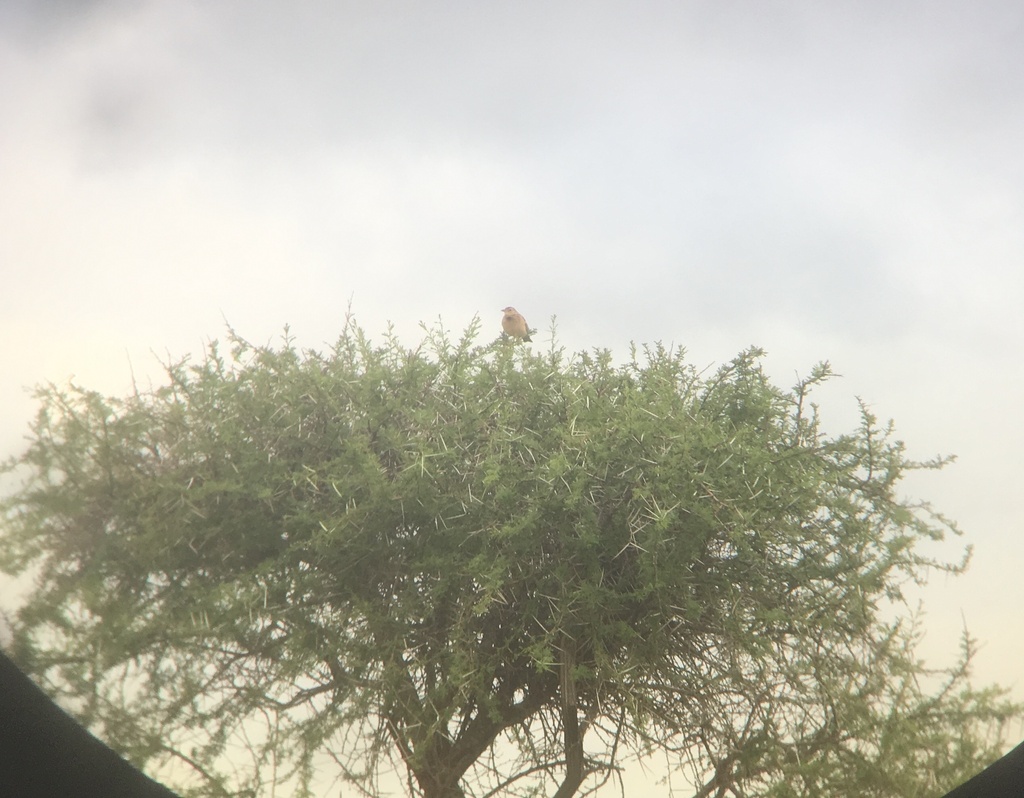
Sentinel Lark
Photo © harrier
Photo © harrier — CC BY 4.0 — Source: iNaturalist #197278340The sentinel lark (Corypha athi) is a species of lark in the family Alaudidae found in Kenya and Tanzania. It was formerly treated as a subspecies of the rufous-naped lark. == Taxonomy == The sentinel lark was formally described in 1900 by the German ornithologist Ernst Hartert based on a specimen collected on the plains of the Athi River in Kenya. He considered it to be a subspecies of the rufous-naped lark and coined the trinomial name Mirafra africana athi. The sentinel lark is now treated as a separate species and placed in the genus Corypha. This placement is based on the results of two molecular phylogenetic studies by a team of ornithologists led by Per Alström that were published in 2023 and 2024. Two subspecies are recognised: C. a. athi (Hartert, EJO, 1900) – central Kenya to northeast Tanzania C. a. harterti (Neumann, 1908) – central south Kenya
Amboseli National Park
Etonet/Lenkism ward, Kenya
+501 birds+43 mammals
Where the Amboseli basin opens toward the Tanzanian frontier, a shallow alkaline lake mirrors vast skies across one of East Africa's most iconic savanna landscapes. The…
VIEW NATIONAL PARKNairobi National Park
Nairobi, Kenya
+515 birds+35 mammals
Just minutes from Kenya's capital, where the Nairobi River winds through acacia woodland and open grassland, lies one of Africa's most paradoxical wildlife sanctuaries. The park's…
VIEW NATIONAL PARKLake Nakuru National Park
Nakuru West, Kenya
+494 birds+32 mammals
Alkaline waters ringed by acacia woodland and grassland create one of East Africa's most distinctive wetland ecosystems, where the interplay of geology and climate sustains a…
VIEW NATIONAL PARKHell’s Gate National Park
Olkaria ward, Kenya
+388 birds+18 mammals
Volcanic scarps and geothermal vents dominate the floor of Hell's Gate, where the East African Rift has carved a dramatic gorge through crystalline rock formations. The…
VIEW NATIONAL PARKNo community photos yet. Log in to add the first one.
No community observations of this species yet.