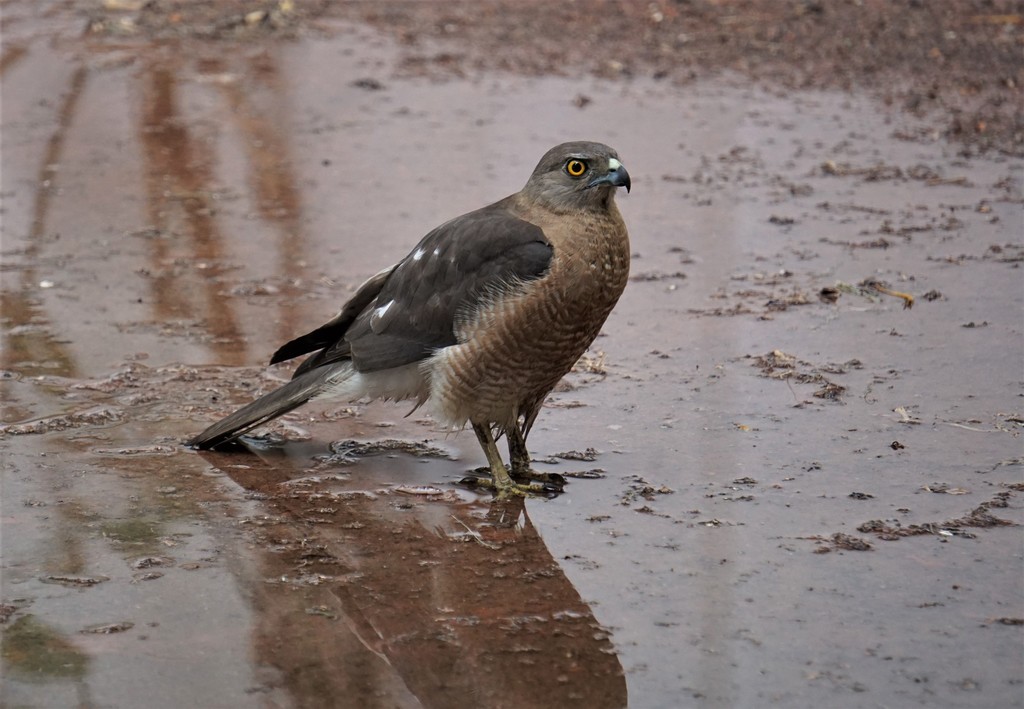
Shikra
Photo © Aravinth
Photo © Aravinth — CC BY 4.0 — Source: iNaturalist photo #146116193Identification
The shikra is a small raptor measuring 26–30 cm in length, characterized by short rounded wings and a narrow, somewhat long tail. Adults display whitish underparts with fine rufous barring, while upperparts are grey. Males have a distinctive red iris, whereas females possess a less vibrant yellowish-orange iris and brownish upperparts with heavier barring below. Females are slightly larger than males. The throat bears a dark but narrow mesial stripe. In flight, males reveal light wing linings with blackish wing tips when viewed from below; from above, tail bands are faintly marked on lateral feathers and lack the strong marking seen in the Eurasian sparrowhawk. The central tail feathers remain unbanded except for a dark terminal band. Juveniles display dark streaks and spots on the upper breast with narrowly barred wings and dark, narrow tail bands. The shikra's distinctive two-note call—"pee-wee," with the first note higher and the second longer—is characteristic, though calls in flight become shorter and sharper as "kik-ki...kik-ki."
Range & Habitat
The shikra is widely distributed across Asia and Africa, with six recognized subspecies occupying distinct regions. The African forms may represent separate species but are typically considered subspecies. In Asia, populations range from southwest India and Sri Lanka through central India and Bangladesh to south China, Indochina, and northern Sumatra, with populations also found in the Caucasus, central Asia, and northwest India. African subspecies are distributed from Senegal and Gambia through southwest Arabia to southern Africa. The species occupies diverse habitats including forests, farmland, and urban areas, demonstrating considerable adaptability. The Indian population inhabits plains and lower hills, reaching elevations up to 1,400 meters in the Himalayas.
Behaviour & Diet
Shikras are typically observed singly or in pairs, employing a characteristic flap-and-glide flight style. During breeding season, pairs soar on thermals and stoop at each other, their flight patterns frequently alarming smaller birds and squirrels. The species feeds on rodents, squirrels, small birds, small reptiles (primarily lizards, occasionally small snakes), and insects. Small birds often escape by diving through foliage, while babblers have been observed rallying together to drive away hunting shikras. Additional prey includes emerging winged termites, small bats hunted at dusk, and rarely, carrion. The shikra's calls are notably imitated by drongos, a behavior thought to aid food theft by alarming birds that associate the calls with predator presence.
Best Time & Places to See It
The shikra's wide distribution across multiple subspecies means that optimal viewing times and locations vary by region. In India, the breeding season from March to June offers good viewing opportunities as pairs engage in conspicuous soaring and stooping displays. The species' presence in both urban and rural environments makes it accessible to observers in various habitat types across its range. Northern populations of subspecies cenchroides are migratory, while African and Asian populations show varying degrees of migratory or nomadic behavior, influencing seasonal availability in specific locations.
Photography Tips
Photographers should focus on capturing the shikra's distinctive aerial displays, particularly during breeding season when pairs soar and interact conspicuously on thermals. The sexual dimorphism—males with bright red iris and lighter coloring versus females with yellowish-orange iris and darker upperparts—offers compositional opportunities. Underwing patterns are distinctive when the bird is photographed from below in flight, showing the characteristic light wing linings and blackish tips. The shikra's tail pattern, with faintly marked lateral feathers and unbanded central feathers, provides identifying features best captured with side or slightly above-angle positioning. Patient observation in varied habitats from urban to forest settings increases encounter opportunities with this adaptable raptor.
Where to stay to see the Shikra
Minneriya National Park
Sri Lanka
+158 birds+9 mammals
Across the dry zone of Sri Lanka's North Central Province spreads a landscape of shallow tanks, grassland margins, and scattered dry forest—a mosaic of water and…
VIEW NATIONAL PARKTsavo West National Park
Mwatate, Kenya
+513 birds+49 mammals
Where volcanic ridges and weathered lava flows meet the semi-arid lowlands of south-central Kenya, Tsavo West National Park unfolds across a landscape sculpted by fire and…
VIEW NATIONAL PARKRanthambhore National Park
Sawai Madhopur, India
+294 birds+20 mammals
Granite ridges and ravines carved through the Aravalli Range frame this protected landscape in eastern Rajasthan, where deciduous forest mingles with open scrubland and seasonal water…
VIEW NATIONAL PARKKhao Yai National Park
Prachantakham District, Thailand
+377 birds+46 mammals
Evergreen dipterocarp forest blankets the rolling terrain of this national park in eastern Thailand, where limestone hills rise abruptly from the forest floor and seasonal streams…
VIEW NATIONAL PARKQueen Elizabeth National Park
Uganda
+672 birds+30 mammals
Across the southwestern escarpment of Uganda, where the Western Rift Valley descends through ancient volcanic terrain, Queen Elizabeth National Park sprawls across more than 8,300 square…
VIEW NATIONAL PARKZiwa Rhino and Wildlife Ranch
Nakasongola, Uganda
+359 birds+11 mammals
Where papyrus wetlands merge into sprawling savanna, Uganda's central landscape opens into one of East Africa's most vital rhino recovery zones. Ziwa Rhino and Wildlife Ranch…
VIEW WILDLIFE SANCTUARYKanha Tiger Reserve
Kanha Kisli F.V., India
+321 birds+23 mammals
Where sal forests give way to emerald meadows and crystalline streams carve through ancient valleys, one of India's finest wilderness reserves unfolds across the Maikal Range.…
VIEW NATIONAL PARKTadoba National Park
Palasgaon Singru, India
+270 birds+20 mammals
Where sal forests meet open grasslands and rocky outcrops rise from red laterite soil, central India's landscape unfolds in raw, untamed beauty. Ancient teak woodlands and…
VIEW NATIONAL PARKBandhavgarh National Park
Garhpuri, India
+285 birds+17 mammals
Where granite ridges rise dramatically above sal and bamboo forests, one of India's most pristine tiger reserves unfolds across the Vindhyan plateau. Ancient rock formations tower…
VIEW NATIONAL PARKPanna National Park
Badgadi Kalan, India
+271 birds+17 mammals
Where granite gorges slice through central India's Vindhyan plateau, a landscape of stark beauty unfolds across nearly six hundred square kilometers. The Ken River carves through…
VIEW NATIONAL PARKKaziranga National Park
Kohora, India
+422 birds+26 mammals
Dawn breaks over the floodplains of the Brahmaputra, where tall grasslands stretch endlessly beneath monsoon-heavy skies. This sprawling wilderness of northeastern Assam is a mosaic of…
VIEW NATIONAL PARKKeoladeo National Park
Shreenagar Rural, India
+326 birds+14 mammals
Where shallow wetlands shimmer beneath vast Rajasthani skies, one of Asia's finest bird sanctuaries pulses with extraordinary life. This former maharaja's hunting reserve, now spanning 29…
VIEW NATIONAL PARKPampadum Shola National Park
Vattavada, India
+258 birds+14 mammals
Where misty shola forests cling to the high plateaus of the Nilgiri Mountains, ancient evergreen remnants create a world apart. This 2,316-hectare reserve protects one of…
VIEW NATIONAL PARKBandipur National Park
Hirehalli, India
+302 birds+19 mammals
Where the Western Ghats descend into the Deccan plateau, ancient deciduous forests blanket a landscape carved by the Nugu River. Bandipur unfolds across 880 square kilometres…
VIEW NATIONAL PARKNagarahole Tiger Reserve
Nalkeri Forest, India
+323 birds+23 mammals
Where granite escarpments rise above dense deciduous forests and the Kabini River carves through pristine wilderness, one of India's most biodiverse landscapes unfolds across the Western…
VIEW NATIONAL PARKEtosha National Park
Namibia
+356 birds+58 mammals
Across northern Namibia's stark semi-arid plateau, a vast shallow depression transforms seasonally into one of Africa's most dramatic wildlife theaters. Etosha National Park, encompassing more than…
VIEW NATIONAL PARKNo community photos yet. Log in to add the first one.
No community observations of this species yet.