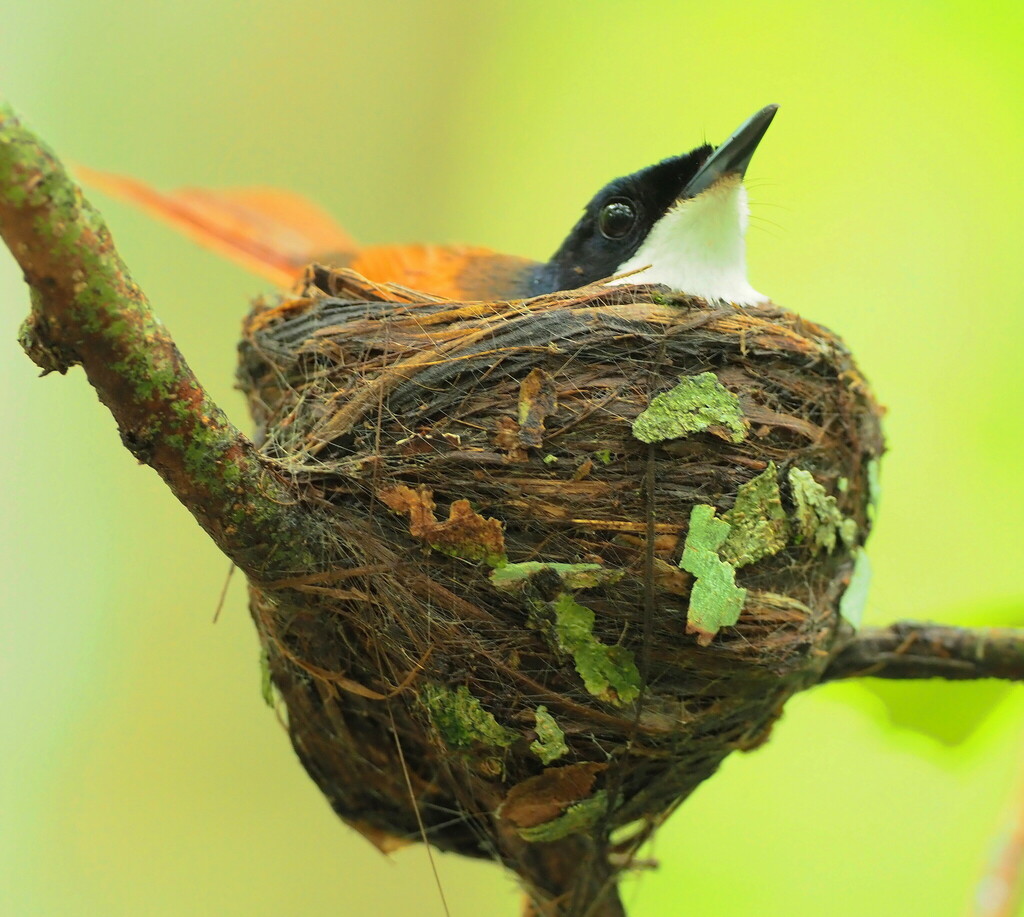
Shining Flycatcher
Photo © Rosario Douglas
Photo © Rosario Douglas — CC BY 4.0 — Source: iNaturalist #263950294Identification
The Shining Flycatcher is a long-tailed, slender songbird with a fine, pointed bill. Sexual dimorphism is striking: males are entirely glossy blue-black, presenting an iridescent sheen that gives the species its common name, while females are rich chestnut above with white underparts, a black crown, and black facial markings. In poor light conditions, females may appear uniformly dark, which can cause confusion with the Restless and Paperbark flycatchers. The species produces a clear, whistled song rendered as "towhit-too-towhit."
Range & Habitat
The Shining Flycatcher occurs across a wide geographical range spanning from the Moluccas through the Indonesian archipelago to the Bismarck Archipelago, and southward to northern Australia. Eight recognized subspecies occupy different portions of this range, reflecting adaptations to local conditions. The species shows a preference for subtropical and tropical moist lowland forests, as well as mangrove forests, where it forages among dense vegetation and waterside habitats.
Behaviour & Diet
As a member of the monarch flycatcher family, the Shining Flycatcher is an active insectivore that pursues prey from perches within forest canopy and understory. The species is vocal and conspicuous within its preferred habitats, often announcing its presence with its distinctive clear whistle. Its slender bill and long tail are adaptations suited to acrobatic foraging among branches and foliage.
Best Time & Places to See It
Travellers seeking the Shining Flycatcher should focus on lowland tropical forest reserves and mangrove systems throughout its range. In Australia, northern regions offer the best opportunity, while in eastern Indonesia and Papua New Guinea, moist lowland forests adjacent to coastal areas are particularly productive. The species' vocal nature and active foraging behaviour make it relatively detectable within suitable habitat, though patience and careful listening for its distinctive song will improve chances of encounter.
Photography Tips
The brilliant blue-black plumage of males provides excellent contrast and requires careful exposure metering to preserve detail in the glossy feathers; slight underexposure may help retain iridescence. Females, by contrast, present a warm chestnut and white palette that is more forgiving. The species' active, acrobatic foraging behaviour demands a fast shutter speed and continuous autofocus. Position yourself near flowering or fruiting trees and listen for the characteristic whistled call to anticipate movement and secure sharp images of this striking bird.
Kakadu National Park
Kakadu, Australia
+273 birds+46 mammals
Kakadu National Park is Australia’s largest national park and one of the world’s most remarkable protected areas, covering nearly 20,000 square kilometres in the tropical north…
VIEW NATIONAL PARKDaintree National Park
Dedin, Australia
+362 birds+37 mammals
Daintree National Park is one of the world’s oldest and most biologically diverse tropical rainforests, protecting an extraordinary landscape where ancient forests meet the Great Barrier…
VIEW NATIONAL PARKEndeavour River National Park
Philadelphia, Australia
+203 birds+1 mammals
Where the Endeavour River winds through northeastern Queensland's tropical lowlands, a compact mosaic of rainforest, open woodland, and riverine corridor creates one of Australia's most ecologically…
VIEW NATIONAL PARKRinyirru National Park
Lakefield, Australia
+258 birds+7 mammals
Where the savanna grasslands of far north Queensland meet seasonal wetlands and eucalypt woodlands, Rinyirru National Park sprawls across more than 12,500 square kilometres of rugged,…
VIEW NATIONAL PARKBribie Island National Park
Brisbane, Australia
+284 birds+20 mammals
Across tidal flats and shallow waterways north of Brisbane, Bribie Island National Park spreads across nearly four hundred square kilometres of subtropical coastal wilderness—a patchwork of…
VIEW NATIONAL PARKAketajawe Lolobata National Park
Oba Tengah, Indonesia
+123 birds+2 mammals
Across the northeastern arm of Halmahera, where the Wallace Line once marked the boundary between Asian and Australasian fauna, lies a sprawling wilderness of over 13,800…
VIEW NATIONAL PARKLitchfield National Park
Australia
+175 birds+15 mammals
Where weathered sandstone plateaus rise above the savanna woodlands of Australia's Top End, Litchfield National Park unfolds as a landscape of dramatic contrasts shaped by a…
VIEW NATIONAL PARKNitmiluk National Park
Australia
+186 birds+27 mammals
Dramatic sandstone gorges carved by the Katherine River slice through the tropical savanna of Australia's Top End, creating a landscape where escarpments tower above crystalline pools…
VIEW NATIONAL PARKGreat Sandy National Park
Australia
+306 birds+40 mammals
Where coastal dunes rise inland from the Queensland coastline, Great Sandy National Park encompasses a landscape of remarkable ecological diversity shaped by subtropical humid conditions year-round.…
VIEW NATIONAL PARKGirringun National Park
Australia
+231 birds+10 mammals
Where granite gorges cleave through subtropical woodland in North Queensland, Girringun National Park unfolds across rugged terrain shaped by millions of years of weathering and erosion.…
VIEW NATIONAL PARKWooroonooran National Park
Australia
+240 birds+28 mammals
Where the Great Dividing Range rises sharply inland from Queensland's tropical coast, Wooroonooran National Park encompasses a landscape of steep, forested gorges and cascading waterways carved…
VIEW NATIONAL PARKNo community photos yet. Log in to add the first one.
No community observations of this species yet.