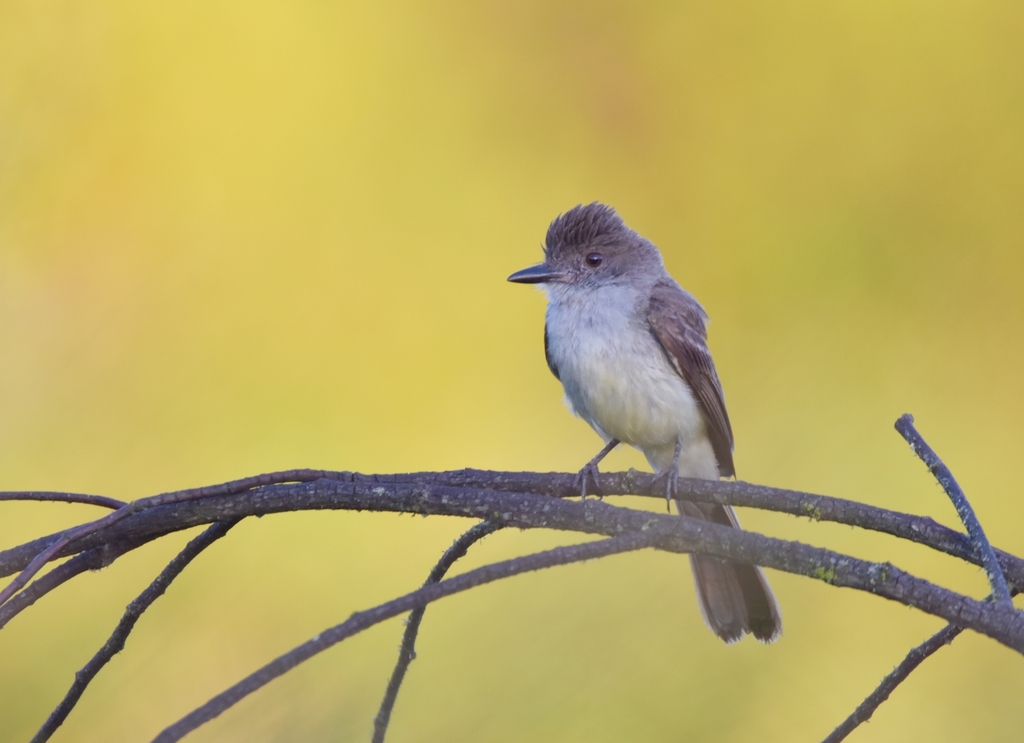
Short-crested Flycatcher
Photo © Gabriel Martínez
Photo © Gabriel Martínez — CC BY 4.0 — Source: iNaturalist photo #251080296Identification
The Short-crested Flycatcher is a small passerine measuring about 18 cm in length. Adults display a smoky brown crown with a slight crest, gray face, and dark brown wings marked with two distinctive pale fuscous wing bars formed by the greater and median coverts. The tail is dark with rufous edges that wear away over time. The throat and breast are gray, contrasting with a yellow belly and undertail coverts. All birds show a dark iris, dark bill, and dark legs. The three subspecies show subtle variation: M. f. brunnescens has lighter brown upperparts and olive-green flanks, while M. f. australis is similar but with less brown on the crissum. Juveniles are distinguished by rufous tips on wing coverts and rufous edges on tertials and outer tail feathers.
Range & Habitat
This species is found across mainland South America in three subspecies, absent only from Chile. The nominate subspecies occupies the largest range, spanning the Amazon Basin from southern Colombia through Ecuador and Peru into Bolivia, and across Venezuela, the Guianas, and northern Brazil. M. f. australis extends from southeastern Bolivia across central and southern Brazil, Paraguay, and into northern Argentina and Uruguay. M. f. brunnescens is restricted to the Llanos of northeastern Colombia and Venezuela. The Short-crested Flycatcher favors semi-open habitats including forest clearings and edges, várzea and igapó forests, cerrado, riparian corridors, and agricultural areas, ranging from lowlands to 1,100 m elevation depending on region.
Behaviour & Diet
A year-round resident throughout its range, the Short-crested Flycatcher is an insectivore and frugivore that forages singly or in pairs from low to mid-forest levels. It employs an active hunting strategy, making upward sallies to snatch prey from vegetation or briefly hovering to capture insects in flight. The species breeds between July and December in northern populations; clutches contain two or three eggs laid in tree cavities lined with plant material, feathers, fur, and snake skin. Its vocalizations are distinctive: the song consists of short, slowly modulated whistles given infrequently at dawn and during the day, while calls include rasping whistles, hiccups, and strident rattles.
Best Time & Places to See It
The Short-crested Flycatcher is common to fairly common throughout its range, particularly widespread in Colombia, Ecuador, Brazil, and Peru, where it is the most common and widely distributed Amazonian Myiarchus. It is fairly common across most of Venezuela but patchier in the Llanos. The species thrives in secondary growth and open habitats, making it accessible in many protected areas and disturbed landscapes. Year-round residency means it can be encountered in any season, though breeding activity (July to December in northern populations) may increase visibility as birds become more vocal and active.
Photography Tips
The Short-crested Flycatcher's small size and habit of foraging in low to mid-story vegetation make it moderately challenging to photograph. Position yourself in semi-open habitats—forest edges, riparian corridors, or clearings—where birds are more exposed than in dense forest. Early morning when the species is most vocal may help locate individuals. The pale wing bars and yellow underparts provide useful field marks to confirm identification in images. Watch for characteristic sallying behavior; anticipating upward lunges toward vegetation will increase your chances of capturing dynamic feeding shots. The slight crest on the crown and dark facial pattern are diagnostic features worth highlighting in close-up frames.
Amacayacu National Park
Amazônia National Park
Anavilhanas National Park
Araucárias National Park
Bahuaja Sonene National Park
Brasília National Park
Campos Amazónicos National Park
Cantão State Park
Carlos Botelho State Park
Nothing matches these filters.
No community photos yet. Log in to add the first one.
No community observations of this species yet.