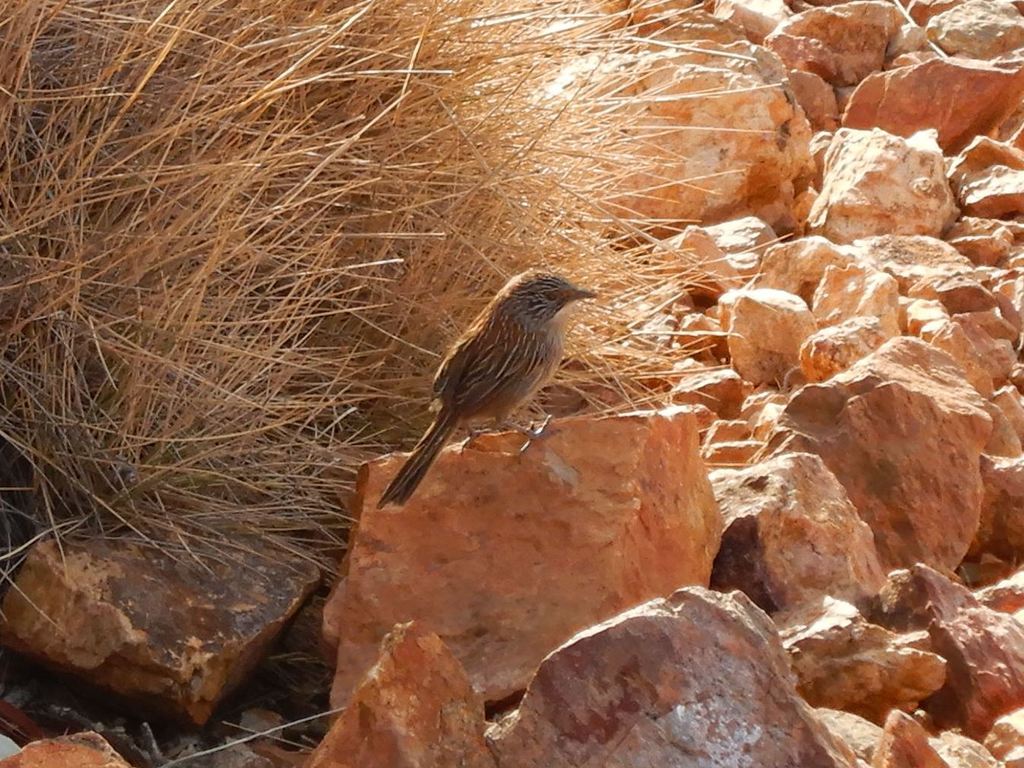
Short-tailed Grasswren
Photo © Steve Doyle
Photo © Steve Doyle — CC BY 4.0 — Source: iNaturalist #13389864The short-tailed grasswren (Amytornis merrotsyi) is a small passerine bird in the family Maluridae, commonly known as the Australasian wrens. It is endemic to Australia, where it has a highly restricted distribution in the arid interior of South Australia, particularly the Flinders and Gawler Ranges. This species inhabits rocky hillsides and ranges dominated by spinifex (Triodia) grasses, typically within temperate shrubland and semi-arid environments. It is strongly associated with stony terrain and dense ground vegetation, which provide both shelter and foraging opportunities. == Description == The short-tailed grasswren is a small, cryptic bird, measuring around 15–16 cm (5.9–6.3 in) in length, with predominantly brown, streaked plumage that provides effective camouflage against its arid surroundings. It is distinguished from related grasswrens by its relatively short tail, compact body, and subtle facial markings, including a darker mask-like pattern around the eyes. == Behavior == The short-tailed grasswren (Amytornis merrotsyi) shows behavior typical of grasswrens but with some distinctive traits linked to its rocky, spinifex-dominated habitat. It is primarily terrestrial and highly secretive, spending most of its time moving through dense ground vegetation rather than flying. When disturbed, it prefers to run or dart between clumps of spinifex instead of taking to the…
Ikara-Flinders Ranges National Park
Australia
+149 birds+10 mammals
Where ancient quartzite ridges rise across the semi-arid heart of South Australia, Ikara-Flinders Ranges National Park unfolds across nearly two thousand square kilometres of one of…
VIEW NATIONAL PARKVulkathunha-Gammon Ranges National Park
Australia
+97 birds+8 mammals
Granite ridges and quartzite peaks rise abruptly from the red earth of South Australia's mid-north, their steep slopes carved into gorges where seasonal waterfalls cascade through…
VIEW NATIONAL PARKNo community photos yet. Log in to add the first one.
No community observations of this species yet.