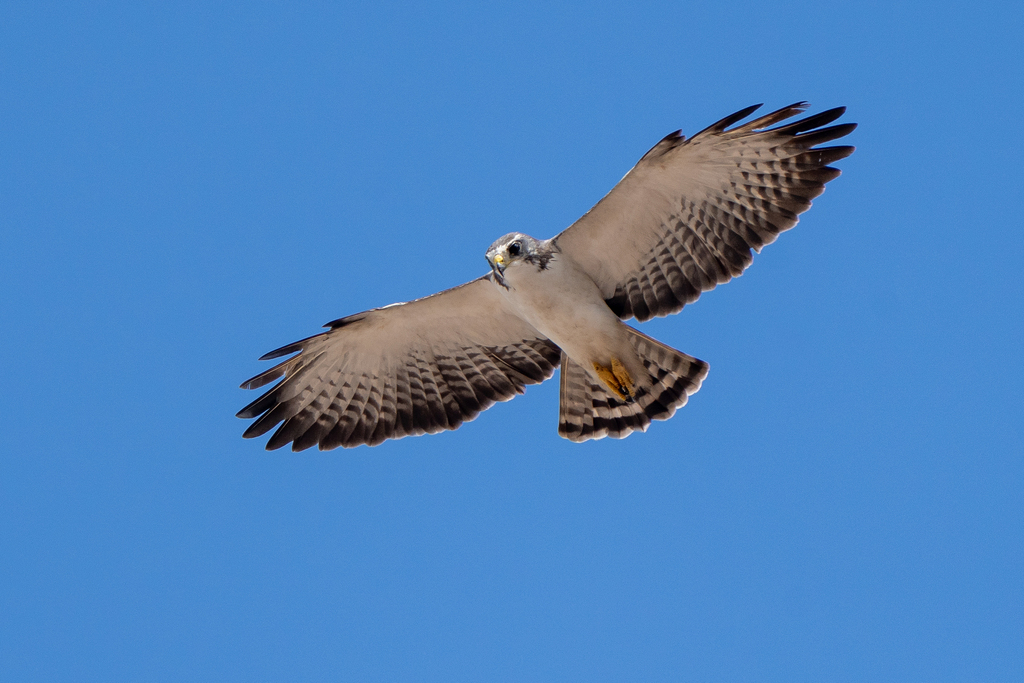
Short-tailed Hawk
Photo © Anthony Batista
Photo © Anthony Batista — CC BY 4.0 — Source: iNaturalist photo #628087922Identification
The short-tailed hawk is a compact member of the genus Buteo, making it a buteo rather than a true hawk despite its common name. It is best identified in flight, where its relatively short tail is evident compared to other raptors. The species is somewhat difficult to detect when perched, as it often remains concealed within dense canopy or shows only its head, unlike most other Buteo hawks that prefer more prominent perching positions.
Range & Habitat
This American raptor breeds throughout the tropical and subtropical Americas, from southeastern Brazil and northern Argentina northward through Central America to the mountains along the Mexico-Arizona border, as well as in southern Florida and on the island of Trinidad. The species is generally found below 4,500 feet in elevation, with most populations occurring below 2,500 feet. Year-round resident in most of its range, though Florida's population migrates southward during winter. The short-tailed hawk is somewhat habitat-adaptable, favoring wooded savannahs, patchy woodlands near water, cypress swamps, mangrove swamps, and high pine-oak woodlands, with lowland foothills being most common in tropical regions.
Behaviour & Diet
The short-tailed hawk is a specialized aerial predator that hunts from soaring flight, typically along the borders between wooded and open areas. It employs a distinctive hunting technique called "kiting," holding itself stationary into the wind before executing nearly vertical stoops at prey, sometimes using a "stair-step" pattern of descent. In Florida, it feeds primarily on smaller birds including ground doves, warblers, bobwhites, and icterids—particularly red-winged blackbirds, which can comprise up to 95% of a single bird's diet. Despite frequent hunting attempts, success rates are relatively low at around 11%. Tropical populations supplement their diet more heavily with frogs, lizards, snakes, large insects, and occasionally small mammals, whereas Florida birds rely predominantly on avian prey.
Best Time & Places to See It
Short-tailed hawks are uncommon and local throughout most of their range, and sightings of soaring birds are fairly frequent within suitable habitat during the breeding season (January through June in Florida). They are quite difficult to locate when perched, so watching for them in flight over woodland edges and open areas near water offers the best opportunity. The species may be regularly overlooked in the field, and no comprehensive population surveys have been completed. Florida's population is considered critically imperiled, while the Arizona population is imperiled.
Photography Tips
Patience and timing are essential for photographing this elusive raptor. Since short-tailed hawks are aerial hunters, positioning yourself along the edges of woodlands with clear sightlines to the sky during mid-morning hours will maximize your chances of capturing them in soaring flight. Use a fast shutter speed to freeze their quick stooping dives. When perched, approach slowly and use binoculars first to locate the bird—look for just the head visible above dense canopy. Early morning light is ideal for capturing sharp detail during their active hunting periods.
Amacayacu National Park
Amazônia National Park
Anavilhanas National Park
Araucárias National Park
Arenal Volcano National Park
Bahuaja Sonene National Park
Barra del Colorado National Wildlife Refuge
Baru Volcano National Park
Big Bend National Park
Nothing matches these filters.
No community photos yet. Log in to add the first one.
No community observations of this species yet.