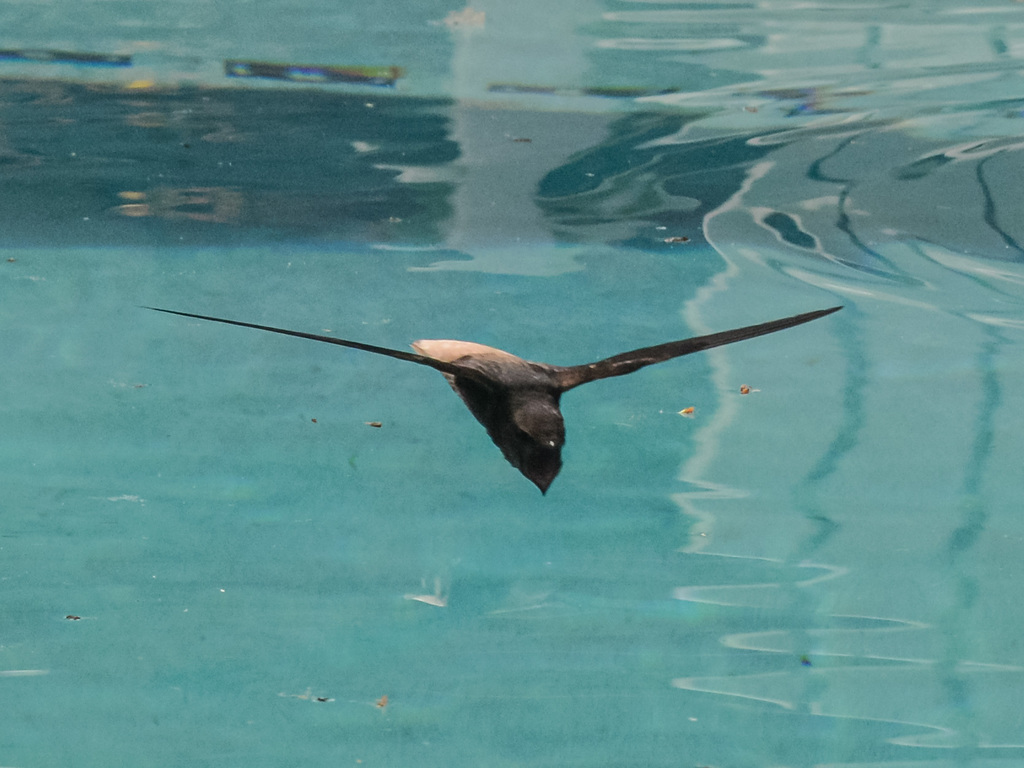
Short-tailed Swift
Photo © William Stephens
Photo © William Stephens — CC BY 4.0 — Source: iNaturalist photo #63558674Identification
The short-tailed swift is a small bird, about 10.5 cm long and weighing just 20 g. It is characterized by its long narrow wings, robust body, and distinctively short tail. The plumage is mainly black with a pale rump and tail, and the sexes are similar in appearance. It can be reliably distinguished from related species in its range, such as the band-rumped swift and gray-rumped swift, by the lack of contrast between its rump and tail—in those species, the tail is much darker than the rump, creating a distinct two-toned effect.
Range & Habitat
This swift is a common resident of Trinidad, Tobago, Grenada, and Saint Vincent, with a wider range across tropical South America from Panama, Colombia, and the Guianas south through Ecuador, Peru, and Brazil. Throughout its range, it favors low elevations, rarely occurring above 800 m, though it has been recorded as high as 1,300 m in mountainous terrain. It inhabits diverse habitats including savanna, open woodland, and cultivated areas.
Behaviour & Diet
The short-tailed swift is highly gregarious and forms communal roosts outside the breeding season. Its distinctive flight call is a rapid chittering pattern: sti-sti-stew-stew-stew. Like other swifts, it feeds entirely in flight, capturing flying insects including winged ants and termites. During breeding, it constructs a shallow half-saucer nest about 5 cm wide from twigs and saliva, adhering it to vertical surfaces—often man-made structures such as chimneys or manholes, though natural caves and tree cavities are also used. Both parents incubate the clutch of white eggs (typically 3 or 4, up to 7) for 17–18 days. Young fledge after two weeks but remain near the nest for another two weeks, clinging to the cavity wall without flying.
Best Time & Places to See It
The short-tailed swift's gregarious nature and preference for open habitats make it relatively conspicuous throughout its range. It is particularly common in Trinidad and Tobago, where it can be observed year-round as a common resident. Look for flocks in flight over savanna, open woodland, and cultivated areas at lower elevations. Early morning and late afternoon often provide the best viewing opportunities when feeding activity is most active.
Photography Tips
Photographing swifts in flight presents significant technical challenges. Fast shutter speeds (1/2000 s or faster) and continuous autofocus are essential to freeze their rapid, erratic movements. The short-tailed swift's small size and dark plumage require careful exposure metering to avoid underexposure. Positioning yourself near known roost sites or over open habitats where feeding birds congregate will increase your chances. Telephoto lenses (500mm or longer) are recommended, and backlighting can help separate the bird from the sky background.
Amacayacu National Park
Amazônia National Park
Anavilhanas National Park
Antisana National Park
Bahuaja Sonene National Park
Campos Amazónicos National Park
Cerros de Amotape National Park
Chagres National Park
Chapada dos Guimarães National Park
Nothing matches these filters.
No community photos yet. Log in to add the first one.
No community observations of this species yet.