Siberian Jay
Photo © Diederik
Photo © Diederik — CC BY 4.0 — Source: iNaturalist photo #621519520Identification
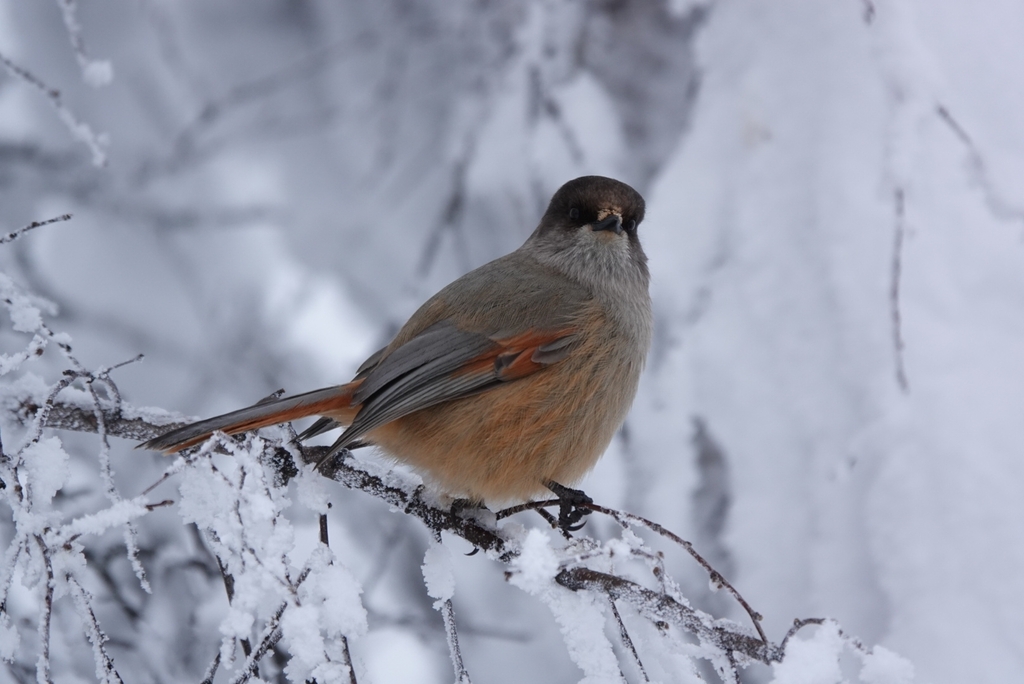
The Siberian jay is the smallest of the western Palearctic corvids, measuring about 30 centimetres in length and weighing 75 to 90 grams. Its plumage is distinctively greyish-brown with a darker brown crown, paler forehead, and buff breast. The rump is yellowish, while the chin and throat are grey. A striking feature is the rusty-red colouration found on a panel near the wing-bend, on the undertail coverts, and on the sides of the tail. The bill and legs are black. The sexes are similar in appearance. Overall, the bird's colouration is fairly inconspicuous, serving as camouflage within its forest habitat. The plumage is notably soft and downy, providing excellent insulation against the extreme cold of northern winters.
Range & Habitat
The Siberian jay is resident throughout the boreal coniferous forests of North Eurasia, with an extensive range stretching from Scandinavia through northern Russia and Siberia. The species is native to Norway, Sweden, Finland, Russia, Mongolia, Kazakhstan, and China, with occasional vagrant records in Belarus, Estonia, Latvia, Poland, Slovakia, and Ukraine. Five subspecies are recognised across this vast distribution.
This jay is highly selective about its habitat, preferring dense, mature coniferous forests with closed canopies in lowland and foothill areas. Spruce forests are particularly favoured for both foraging and nesting, as the denser foliage provides superior concealment from predators compared to other local conifers. Territories typically comprise old dense spruce swamp with abundant vegetation cover, often incorporating structurally diverse elements such as scrub of various ages, groves, and flood meadows.
Behaviour & Diet
Siberian jays are mostly silent birds, though they can emit a loud screech resembling that of a buzzard. Both sexes perform a complex song heard mainly during breeding season, comprising a wide repertoire ranging from soft and harsh notes to whistling, creaking, and trilling sequences. Remarkably, they are skilled vocal mimics, recorded imitating the calls of 20 bird species as well as Eurasian red squirrels. The birds engage in nepotistic alarm calls that warn family members of approaching predators, with experimental studies showing these calls improve survival rates among non-breeding individuals. Females appear more adept than males at distinguishing kin from non-kin.
Unlike their relatives the Canada jay and Sichuan jay, Siberian jays display group-living behaviour where non-breeding individuals do not help raise offspring—a trait likely representing historic selection against cooperative breeding as an anti-predator strategy. Siberian jays appear specially adapted to navigate dense forest despite being cumbersome flyers in open terrain, a limitation that increases their vulnerability to raptor predation outside forests.
Best Time & Places to See It
The Siberian jay is a common bird throughout its range and is classified as being of "least concern" by the International Union for Conservation of Nature. The species is largely sedentary year-round, though some southward movement may occur in winter among eastern populations. Birdwatchers seeking this species should focus on dense, mature spruce forests with closed canopies, particularly old spruce swamps where structural diversity provides optimal habitat. The breeding season, from mid-June to mid-September, is when song activity peaks and birds are more vocal, making detection easier.
Photography Tips
The Siberian jay's inconspicuous plumage and preference for dense forest cover present challenges for photographers. Position yourself within mature spruce forest habitat during breeding season when birds are more vocal and active. The soft, downy texture of the plumage and the rusty-red panels on the wings and tail are key features to capture. The bird's clumsiness in open flight compared to its agility within dense forest means photography opportunities are best within or near its preferred spruce habitat. Early morning visits during breeding season, when song activity is highest, offer the best chance of locating and photographing this elusive species.
Muddus / Muttos National Park
Norrbottens län, Sweden
+128 birds+7 mammals
Where boreal forest meets wetland across the high plateaus of Swedish Lapland, Muddus National Park unfolds as one of northern Europe's most pristine wilderness sanctuaries. Vast…
VIEW NATIONAL PARKPyhä-Luosto National Park
Pelkosenniemi, Finland
+113 birds+6 mammals
Where boreal forest meets fell landscape in Finnish Lapland, Pyhä-Luosto National Park sprawls across 616 square kilometres of terrain that embodies the raw essence of the…
VIEW NATIONAL PARKPallas-Yllästunturi National Park
Muonio, Finland
+137 birds+19 mammals
Where boreal forest meets fell, across the Finnish Arctic frontier, nearly 3,650 square kilometres of pristine subarctic wilderness unfold in a landscape sculpted by glacial epochs…
VIEW NATIONAL PARKPatvinsuo National Park
Lieksa, Finland
+134 birds+1 mammals
Across eastern Finland's borderlands, where boreal forest meets waterlogged terrain, Patvinsuo National Park sprawls across roughly 185 square kilometers of one of northern Europe's most intact…
VIEW NATIONAL PARKSyöte National Park
Taivalkoski, Finland
+80 birds+1 mammals
Across nearly two thousand square kilometres of North Ostrobothnian wilderness, Syöte National Park unfolds a landscape where boreal forest meets open fell, where swift rivers carve…
VIEW NATIONAL PARKUrho Kekkonen National Park
Sodankylä, Finland
+122 birds+11 mammals
Across nearly 2,700 square miles of boreal wilderness in Lapland, where the Arctic Circle's influence shapes every ecosystem, lies a landscape dominated by dense spruce and…
VIEW NATIONAL PARKSkuleskogen
Nätra District, Sweden
+158 birds+11 mammals
Where boreal forest meets the raw Höga Kusten coastline, Skuleskogen National Park unfolds across nearly 47 square kilometers of one of northern Sweden's most dramatic landscapes.…
VIEW NATIONAL PARKStora Sjöfallet
Norrbotten County, Sweden
+150 birds+10 mammals
Where granite plateaus rise above boreal forest and ice-carved valleys plunge toward rushing rivers, Stora Sjöfallet unfolds across nearly 3,300 square kilometres of pristine subarctic wilderness…
VIEW NATIONAL PARKSarek
Norrbotten County, Sweden
+119 birds+8 mammals
Where granite gorges cut through boreal wilderness and meltwater streams cascade across weathered plateaus, Sarek National Park sprawls across nearly 3,100 square kilometres of Swedish Lapland's…
VIEW NATIONAL PARKTransbaikal National Park
Barguzinsky Rayon, Russia
+83 birds+7 mammals
Where the eastern shore of Lake Baikal meets the Barguzinsky Range, a vast wilderness of boreal forest, alpine tundra, and rocky shoreline unfolds across more than…
VIEW NATIONAL PARKYugyd Va National Park
Vuktyl Municipal District, Russia
+37 birds+3 mammals
Where granite massifs pierce the boreal wilderness of Russia's far northeast, Yugyd Va sprawls across one of Europe's largest intact forest ecosystems. Spanning nearly 54,000 square…
VIEW NATIONAL PARKLemmenjoki National Park
Inari, Finland
+87 birds+1 mammals
Where granite gorges cut through pristine boreal forest and the Lemmenjoki River winds through one of Europe's last great wilderness corridors, Finland's Arctic heart reveals itself…
VIEW NATIONAL PARKPaanajärvi National Park
Panozero, Russia
+27 birds+1 mammals
Where granite peaks rise abruptly from boreal wilderness, pristine lakes mirror Nordic skies across one of Europe's last genuinely wild frontiers. This remote corner of northwestern…
VIEW NATIONAL PARKKhoridol Saridag National Park
Khatgal, Mongolia
+164 birds+6 mammals
Where granite peaks thrust skyward across Mongolia's remote southeastern reaches, a landscape of raw geological drama unfolds. Deep river gorges carved through ancient stone create a…
VIEW NATIONAL PARKZyuratkul National Park
Satkinsky District, Russia
+72 birds+7 mammals
Where granite ridges rise above the southern Urals, Zyuratkul National Park unfolds across a landscape shaped by continental climate and ancient geology. The park's defining feature…
VIEW NATIONAL PARKNo community photos yet. Log in to add the first one.
No community observations of this species yet.