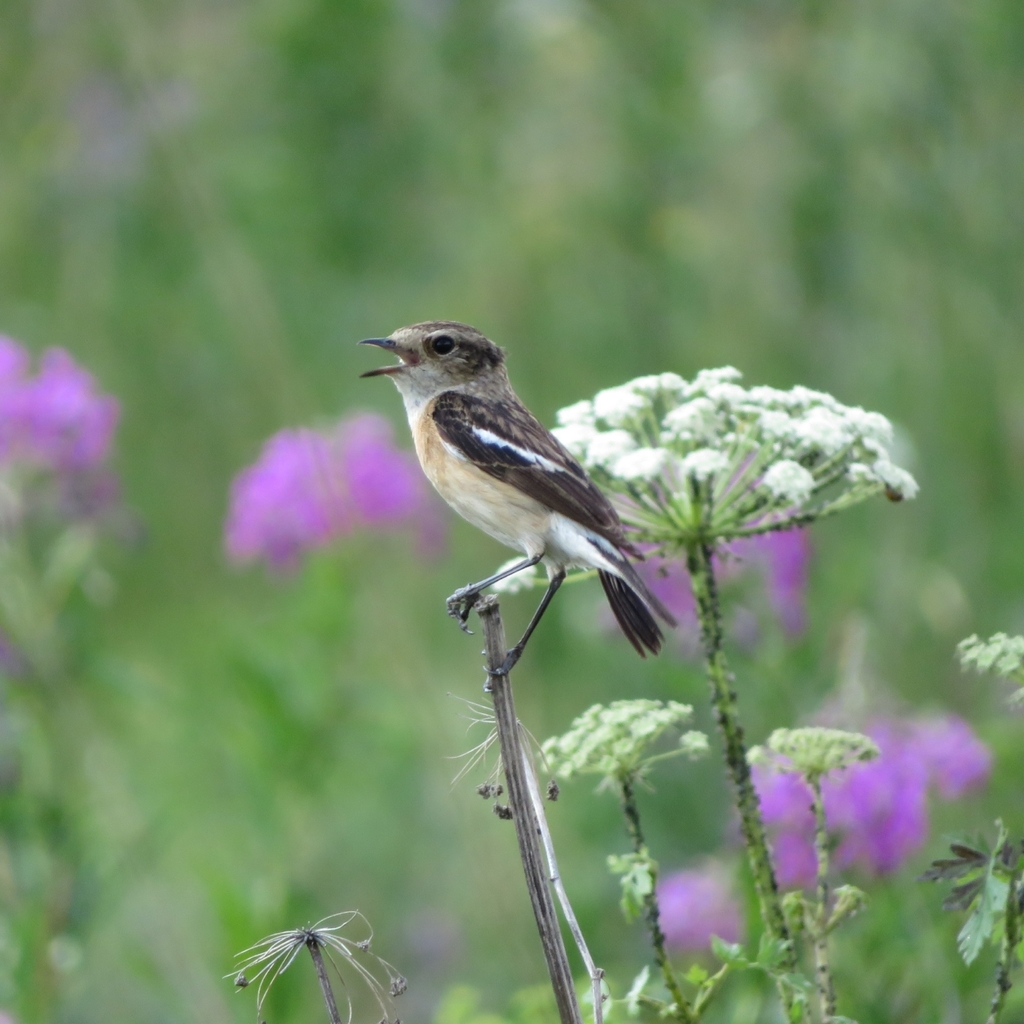
Siberian Stonechat
Photo © Марина
Photo © Марина — CC BY 4.0 — Source: iNaturalist #84542272Identification
The Siberian stonechat is a compact Old World flycatcher closely resembling the European stonechat but typically darker above and paler below. Males in breeding plumage are strikingly handsome: jet-black upperparts and head, contrasting with a conspicuous white collar, scapular patch, and rump, plus a restricted orange-buff throat. Females are much duller, with pale brown upperparts, white neck patches (not a full collar), and a pale pinkish-yellow rump. Winter males are intermediate, showing a supercilium that recalls the whinchat. At close range, note the distinctly longer primary feathers compared to the European stonechat—an adaptation for long-distance migration. The bird's clicking call resembles two pebbles knocked together, while its song is high and twittering, reminiscent of a dunnock.
Range & Habitat
This migratory species breeds across most of temperate Asia, from about 71°N in Siberia southward to the Himalaya and southwest China, with its western limit near eastern Turkey and the Caspian Sea. Small breeding populations occasionally reach as far west as Finland. In winter, the species retreats to tropical regions from southern Japan through Thailand and India, west to northeast Africa. Six recognised subspecies occupy different portions of this vast range, with S. m. maurus and S. m. stejnegeri being the most widespread across northern and central Asia.
The Siberian stonechat breeds in open rough scrubland and rough grassland with scattered shrubs, from sea level to 4,000 m or higher. It avoids even cool temperate conditions, remaining at northern latitudes only during the hot continental summer months.
Behaviour & Diet
This insectivorous flycatcher hunts in its open grassland and scrubland habitat, actively foraging for invertebrate prey. During migration in montane regions—such as the Himalayan foothills of Bhutan—small numbers can be seen foraging in fields and pastures above 2,000 m before moving further south and downslope to winter in tropical lowlands. The species is widespread and common throughout its range and is not considered threatened.
Best Time & Places to See It
Summer visits to breeding grounds in Siberia, central Asia, and the Himalayan region offer the best opportunity to encounter males in their striking breeding plumage. Winter birdwatchers should target tropical wintering grounds from southern Japan through Thailand, Myanmar, and the Indian subcontinent. Migration periods bring occasional vagrants to western Europe and, exceptionally, to North America (Alaska), offering chance sightings for alert observers.
Photography Tips
Breeding males in summer plumage offer the most dramatic photographic opportunities, with their bold black-and-white contrast and orange accents. Position yourself near open grassland or scrubland edges at dawn when birds are most active. The species' preference for perching on low shrubs and grass stems makes it relatively accessible for photography. Winter plumage and female birds are more subdued but still photographable; capture their pale coloration against darker backgrounds. The whiter rump and longer wing primaries are useful fieldmarks to include in documentary shots. Be patient—the bird's clicking calls often precede visual contact.
Kanha Tiger Reserve
Altai Tavan Bogd National Park
Awash National Park
Baikal National Park
Baima Snow Mountain National Nature Reserve
Bale Mountains National Park
Bandhavgarh National Park
Bandipur National Park
Banke National Park
Nothing matches these filters.
No community photos yet. Log in to add the first one.
No community observations of this species yet.