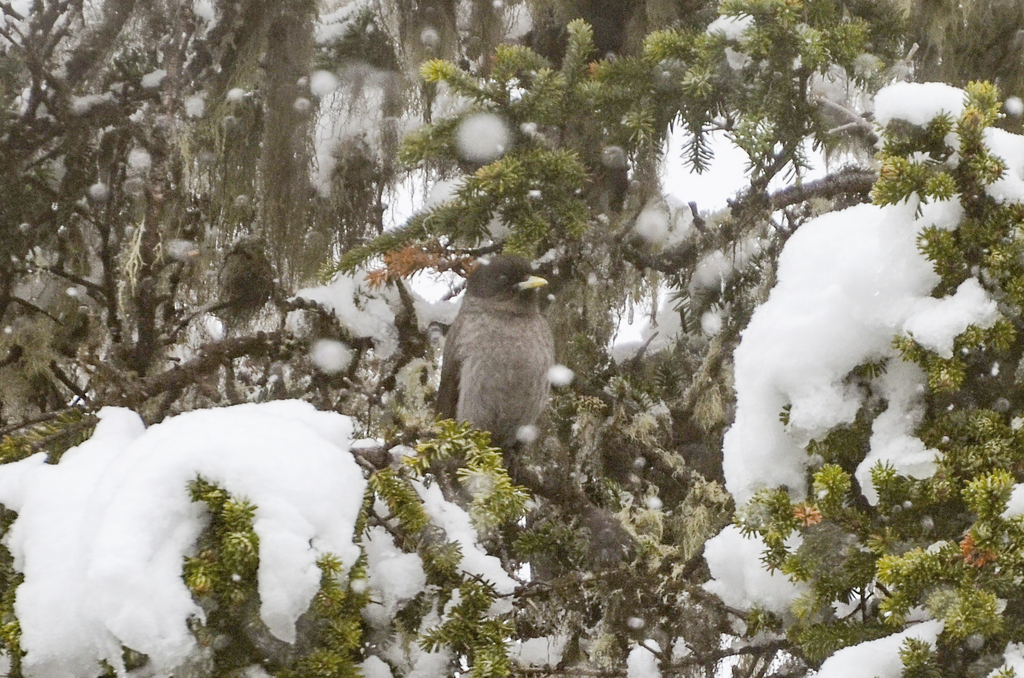
Sichuan Jay
Photo © Jay Pruett
Photo © Jay Pruett — CC BY 4.0 — Source: iNaturalist #197291348The Sichuan jay (Perisoreus internigrans) is a species of bird in the family Corvidae. It is endemic to China. == Taxonomy == It is one of three members of the genus Perisoreus, the others being the Siberian jay, P. infaustus, found from Norway to eastern Russia, and the Canada jay, P. canadensis, restricted to the boreal forest and western montane regions of North America. All three species store food and live year-round on permanent territories in coniferous forests. == Distribution and habitat == Its natural habitat is subtropical or tropical moist montane forests. It is threatened by habitat loss. == Conservation == They are mostly situated in isolated fragments of highly elevated coniferous forests on the Qinghai-Tibet plateau of west-central China. These locations are generally isolated, because of the mountainous terrain of the region. However, it is predicted that both of the extent of suitable habitat and the suitability of that habitat will decrease substantially under climate change. Climate change might force these birds to migrate northward and upward, where areas remaining for such compensatory extension are quite restricted. In addition, acceptable habitat will become much more disconnected, which may increase the negative effects of climate change indirectly by slowing…
Jiuzhai Valley
Jiuzhaigou County, China
+226 birds+7 mammals
Where crystalline alpine streams cascade through limestone gorges and karst terrain rises in dramatic vertical walls, Jiuzhai Valley unfolds across nearly 1,300 square kilometers of southwestern…
VIEW NATURAL MONUMENTHuanglong Scenic and Historic Interest Area
Ngawa Tibetan and Qiang Autonomous Prefecture, China
+194 birds+7 mammals
Across the high plateau of northwestern Sichuan, a geological wonder unfolds where limestone terraces and mineral-rich springs have sculpted one of China's most distinctive natural monuments.…
VIEW NATURAL MONUMENTNo community photos yet. Log in to add the first one.
No community observations of this species yet.