Identification
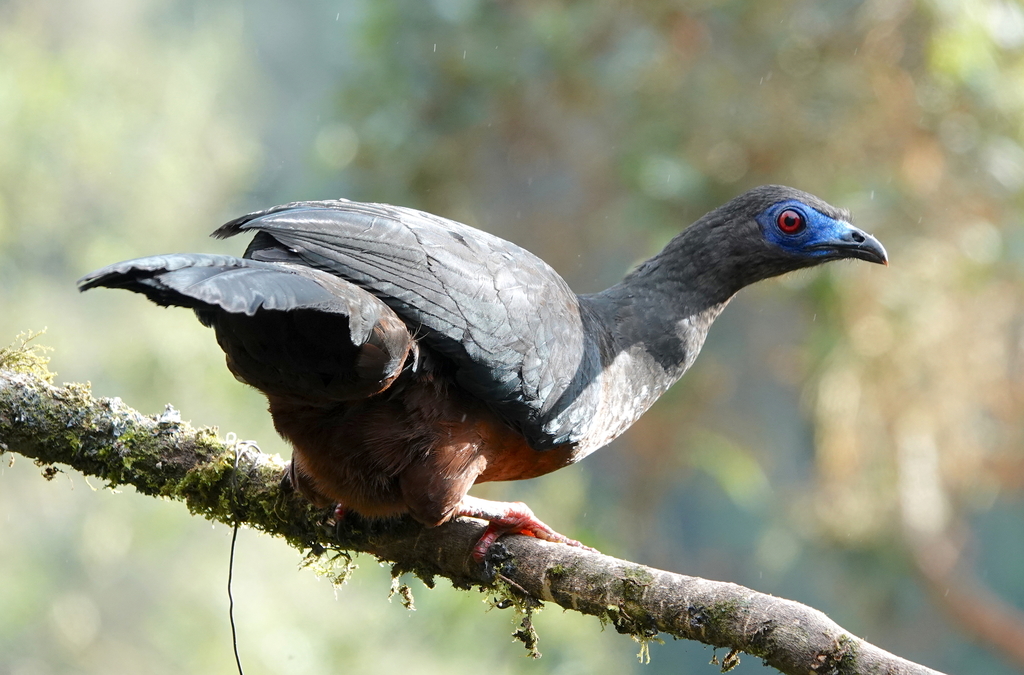
The sickle-winged guan is a medium-sized forest bird measuring 50 to 65 cm in length and weighing 550 to 800 grams. Adults display distinctive plumage with a brown head and neck, dark upperparts, and a bright chestnut belly, contrasted by pale blue facial skin and striking red eyes. Five subspecies exist across its range, with subtle variations in coloration and tone. Some subspecies, such as C. g. tschudii and C. g. rufiventris, are noticeably larger than others. Juveniles resemble adults but display duller coloration, making them slightly more challenging to identify in the field.
Range & Habitat
The sickle-winged guan is found in the Andes mountains of Colombia, Ecuador, Peru, and Bolivia, with five subspecies distributed across specific geographic regions. The westernmost populations inhabit the western and central Andes of Colombia, while others occupy the slopes from northeastern Colombia's Sierra Nevada south through the highlands of Ecuador and Peru. The highest Bolivian populations occur in isolated mountain areas.
This species favors humid and wet forest, particularly tall forest but also adapting to forest edges and secondary growth. It is typically found at middle elevations, ranging from approximately 1,100 to 2,500 meters in Colombian Andes, 1,450 to 2,500 meters in Peru, and reaching 2,500 to 3,500 meters in Bolivia. In the Sierra Nevada de Santa Marta, it ascends as high as 3,000 meters.
Behaviour & Diet
The sickle-winged guan is primarily frugivorous, foraging in fruiting trees at heights up to 13 meters above ground. Pairs often forage together or in small groups of up to eight birds, with activity concentrated around dawn and dusk. Beyond fruits, the diet includes flowers, leaves, and invertebrates comprising up to 15% of its food intake. In some locations, these birds visit feeding stations for bananas.
Breeding occurs from January to June in Colombian Andes, with potential extensions elsewhere. The female constructs a simple platform nest of thin branches, moss, and green and dead vegetation, typically positioned in a tree fork or atop a bromeliad. Clutches comprise two or three eggs. The species is vocal, with some subspecies producing an extremely thin, high-pitched whistle and a distinctive "keeeeeee-uk!" alarm call. Males perform wing-whirring displays, usually at dawn and dusk, flying back and forth between two trees.
Best Time & Places to See It
The sickle-winged guan is considered fairly common to common throughout most of its range, except in the Sierra Nevada de Santa Marta and small Bolivian enclaves, where it is less frequently encountered. The species shows remarkable tolerance for habitat alteration and limited hunting pressure away from human settlements. The best opportunities to observe this guan occur during dawn and dusk hours when it is most actively foraging. Birders and naturalists exploring humid montane forests within the appropriate elevation bands across Colombia, Ecuador, Peru, and Bolivia should actively listen for its distinctive vocalizations and watch fruiting trees during peak activity periods.
Photography Tips
Photographing the sickle-winged guan presents interesting opportunities, particularly during its active feeding periods at dawn and dusk. The bright chestnut belly, pale blue facial skin, and red eyes provide excellent color contrast for compelling images. Position yourself near fruiting trees at the appropriate elevation for your location, focusing on observation during low-light hours when the bird is most active. The wing-whirring display, performed as the bird flies between trees, offers dynamic photographic possibilities. Patient observation of these gregarious birds in small groups will increase your chances of obtaining quality photographs in their natural montane forest habitat.
Guided Birding Tour
Sangay National Park
Cebadas, Ecuador
+320 birds+10 mammals
High in Ecuador's Andean spine, where the Western Cordillera rises to touch perpetual snow, a landscape of volcanic drama and ecological intensity unfolds across Sangay National…
VIEW NATIONAL PARKPodocarpus National Park
Zamora, Ecuador
+496 birds+6 mammals
Where the Andes descend toward the Amazon basin, Podocarpus National Park sprawls across nearly 2,800 square kilometres of the most biodiverse terrain in Ecuador's southern highlands.…
VIEW NATIONAL PARKSumaco Napo-Galeras National Park
Loreto, Ecuador
+563 birds+4 mammals
Where Ecuador's Amazon transitions into cloud forest, a massive shield volcano rises from the emerald lowlands of Orellana Province, anchoring one of the continent's most biodiverse…
VIEW NATIONAL PARKAntisana National Park
Quijos, Ecuador
+432 birds+21 mammals
Where the eastern Andean slopes descend into the Amazon basin, Antisana National Park sprawls across roughly 2,500 square kilometers of some of South America's most dramatic…
VIEW NATIONAL PARKLlanganates National Park
Tena, Ecuador
+239 birds+8 mammals
Where the eastern slopes of the Andes plunge toward the Amazon basin, Llanganates National Park sprawls across nearly 3,500 square kilometers of montane wilderness, its terrain…
VIEW NATIONAL PARKNatural Munchique National Park
El Tambo, Colombia
+194 birds
Where the Western Cordillera rises steeply from the Pacific plains of southwestern Colombia, Natural Munchique National Park sprawls across 1,078 square kilometers of montane forest that…
VIEW NATIONAL PARKNatural Farallones de Cali National Park
Buenaventura, Colombia
+733 birds+27 mammals
Where the Pacific coastal plain meets the western slopes of the Andes, Farallones de Cali National Park sprawls across nearly 3,500 square kilometers of dramatic topography…
VIEW NATIONAL PARKNatural Chingaza National Park
Junín, Colombia
+285 birds+6 mammals
Where the Andes rise above three thousand metres in the Cundinamarca region, high-altitude grasslands and cloud forests converge in a landscape shaped by both geology and…
VIEW NATIONAL PARKPuracé National Natural Park
Puracé, Colombia
+327 birds+2 mammals
Where the Andes thrust upward across southwestern Colombia, Puracé National Natural Park spans nearly 2,631 square kilometers of some of South America's most dramatic montane terrain.…
VIEW NATIONAL PARKGuácharos Cave National Natural Park
Acevedo, Colombia
+359 birds
High in the Andean foothills of southern Huila, where mist-laden slopes rise above 1,600 metres, lies a landscape carved by underground rivers and crowned by karst…
VIEW NATIONAL PARKNatural Sumapaz National Park
Cubarral, Colombia
+368 birds+1 mammals
Where the Andes descend toward the Amazon basin, the high páramo grasslands of Sumapaz National Park sprawl across more than five thousand square kilometers of Meta…
VIEW NATIONAL PARKYanachaga–chemillén National Park
Palcazu, Peru
+639 birds+6 mammals
Where the eastern slopes of Peru's central cordillera plunge into cloud forest, Yanachaga–Chemillén National Park protects nearly three thousand square kilometres of montane wilderness that few…
VIEW NATIONAL PARKTingo Maria National Park
Mariano Dámaso Beraún, Peru
+423 birds
Where the eastern slopes of the Peruvian Andes descend toward the Amazon basin, the landscape fractures into a maze of limestone ridges, humid gorges, and cloud-wrapped…
VIEW NATIONAL PARKNo community photos yet. Log in to add the first one.
No community observations of this species yet.