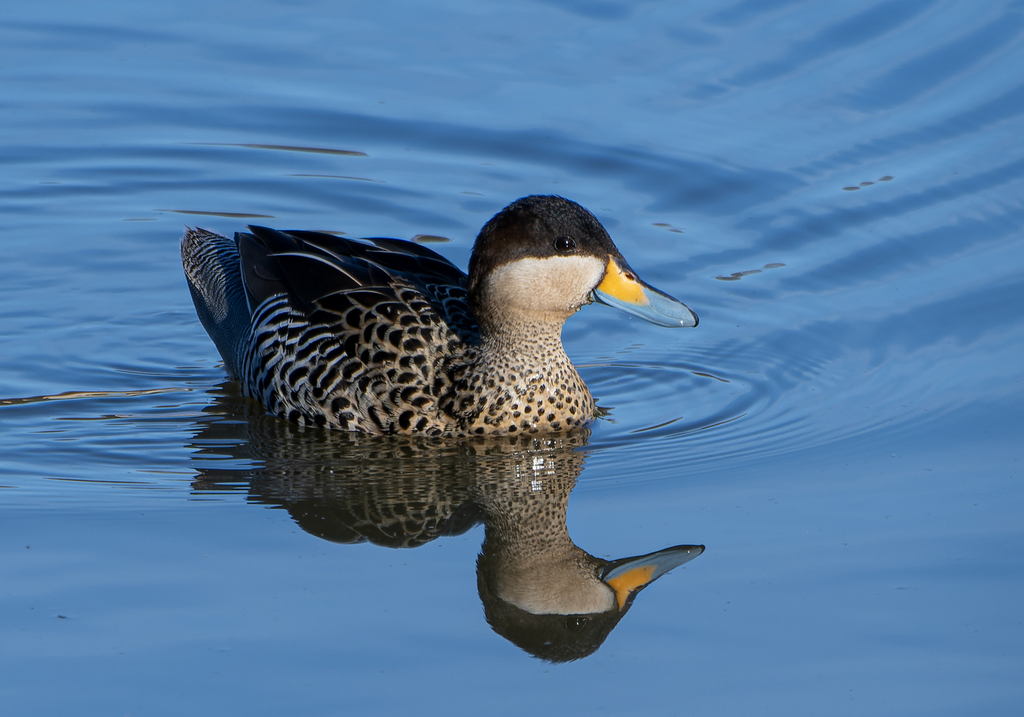
Silver Teal
Photo © David F. Belmonte
Photo © David F. Belmonte — CC BY 4.0 — Source: iNaturalist photo #442618495Identification
The silver teal is a striking dabbling duck with distinctive markings that make it relatively easy to identify in the field. Males display a bold black cap that extends below the eyes, combined with a bluish bill tipped in yellow. Both sexes exhibit a green speculum (the coloured patch on the wing) bordered in white, which is visible in flight. Females are somewhat duller in overall plumage than males and show less yellow at the base of the bill, though they retain the same basic pattern. Two subspecies exist: the northern silver teal found in Paraguay, southern Bolivia, and southern Brazil, and the southern silver teal inhabiting southern Chile, Argentina, and the Falkland Islands.
Range & Habitat
The silver teal's range is confined to South America, spanning a wide latitudinal distribution from southern Bolivia and Paraguay in the north to the Falkland Islands and South Georgia in the far south. Its breeding grounds extend across southern Brazil, Argentina, Chile, and Uruguay. The southernmost populations are migratory, moving northward to southern Brazil during winter months, while other populations may be more sedentary.
This species is a freshwater duck, preferring to live on freshwater bodies in small groups rather than larger congregations. During the breeding season from April to June, silver teals show a particular preference for reed beds, where they establish territories and build nests for egg-laying.
Behaviour & Diet
Silver teals are generally placid ducks with calm temperaments, though this changes when they are defending eggs, young, or females—at which point they become noticeably protective. Pairs may form long-term bonds, and both parents cooperate in rearing the ducklings, a trait they share with swans and geese.
The silver teal's diet consists primarily of vegetable matter, with seeds and aquatic plants forming the bulk of their food intake. They forage by dabbling at the water's surface, typical of their genus. Breeding females lay clutches of 6 to 10 creamy-pink eggs, which incubate for 25 to 27 days before hatching.
Best Time & Places to See It
The optimal time to observe silver teals is during the breeding season from April to June, when they are territorial and more visibly active in reed beds. For northern populations, southern Brazil, Paraguay, and southern Bolivia offer the best viewing opportunities. In the south, Chile, Argentina, and the Falkland Islands are prime locations, particularly for the southern subspecies. The remote and subantarctic regions of South Georgia and the South Sandwich Islands also host populations, though these are less accessible to most travellers.
Photography Tips
Photograph silver teals during early morning or late afternoon light when they are most active and when the sun is lower, bringing out the iridescence of their green speculum and highlighting the contrast of their black caps. The striking facial markings and bill coloration are key features to capture, so position yourself to get clear side-on shots of the head. In flight, focus on capturing the white-bordered green speculum, which is most visible during takeoff or landing. Since they often live in small groups on freshwater bodies, approach slowly and use reeds as natural cover to avoid flushing the birds before you have obtained your shots.
Peixe National Park Lagoon
Brazil
+293 birds+4 mammals
Where the coastal plains of Rio Grande do Sul meet the Atlantic, Peixe National Park Lagoon sprawls across nearly 2,200 square kilometres of shallow waters, reed…
VIEW NATIONAL PARKSea Lion Island
Sealion Island Settlement, Falkland Islands
+74 birds+3 mammals
Windswept tussock grasslands roll across volcanic terrain where Southern Ocean swells crash against rocky shores, creating one of the Falkland Islands' most dramatic wildlife theatres. This…
VIEW ISLAND & ARCHIPELAGOCape Dolphin
falskland islands, Falkland Islands
+54 birds+1 mammals
Where windswept grasslands meet dramatic coastal cliffs, the Falkland Islands' northern reaches reveal one of the Southern Hemisphere's most compelling seabird sanctuaries. The terrain here is…
VIEW NATURE RESERVEVolunteer Point
Stanley, Falkland Islands
+70 birds+3 mammals
Windswept grasslands meet volcanic black sand beaches where three penguin species converge in the South Atlantic's most theatrical wildlife theatre. This remote peninsula on East Falkland…
VIEW NATURE RESERVEWest Point Island
West Point, Falkland Islands
+67 birds+3 mammals
Windswept cliffs plunge dramatically into the South Atlantic, their rust-coloured rock faces sculpted by millennia of gales and spray. This northwestern outpost of the Falkland Islands…
VIEW ISLAND & ARCHIPELAGOTorres del Paine National Park
Torres del Paine, Chile
+143 birds+10 mammals
Where granite spires pierce the Patagonian sky, Torres del Paine commands one of South America's most dramatic landscapes. Across 4,106 square kilometres of southern Chile, jagged…
VIEW NATIONAL PARKPuyehue National Park
Puyehue, Chile
+110 birds+4 mammals
Across the volcanic spine of the Los Lagos Region, where the Andes descend toward temperate rainforest, Puyehue National Park encompasses nearly 2,600 square kilometers of one…
VIEW NATIONAL PARKCerro Castillo National Park
Coyhaique, Chile
+89 birds+3 mammals
Granite peaks and windswept steppe converge across this vast Patagonian landscape, where the Andes' eastern flank drops into terrain sculpted by ice age glaciers and relentless…
VIEW NATIONAL PARKPatagonia National Park
Cochrane, Chile
+133 birds+8 mammals
Where the Andes meet the Patagonian steppe, vast grasslands and shrublands sweep across rolling terrain carved by ancient glaciation, their contours softened by distance and dramatic…
VIEW NATIONAL PARKParque Provincial Península de Magallanes
Argentina
+125 birds+4 mammals
Granite peaks and windswept steppe converge across this 415-square-kilometre peninsula jutting into the cold Atlantic waters of southern Patagonia, where the Magallanes landscape embodies the raw,…
VIEW NATIONAL PARKMonte León National Park
Argentina
+100 birds+4 mammals
Where the Patagonian steppe meets the Atlantic, Monte León National Park protects a landscape of windswept coastal cliffs, rocky outcrops, and semi-arid grassland spanning over 1,200…
VIEW NATIONAL PARKLos Glaciares National Park
Argentina
+121 birds+3 mammals
Where granite peaks and sprawling ice fields dominate the landscape, Los Glaciares National Park encompasses over ten thousand square kilometres of Patagonian wilderness in southern Argentina.…
VIEW NATIONAL PARKEl Palmar National Park
Distrito Sexto, Argentina
+244 birds+14 mammals
Across the Paraná River floodplain in northeastern Argentina, palms rise from wetland and grassland in a landscape shaped by water and time. El Palmar National Park…
VIEW NATIONAL PARKCampos del Tuyú National Park
Argentina
+169 birds+5 mammals
Subtropical forest graces the borderlands where Misiones Province meets Paraguay, a landscape shaped by the Paraná Plateau's weathered topography and the warm, humid climate of northeastern…
VIEW NATIONAL PARKLos Cardones National Park
Argentina
+193 birds+6 mammals
Where the Andes descend into northwestern Argentina, Los Cardones National Park sprawls across nearly 1,200 square kilometres of one of South America's most distinctive high-altitude desert…
VIEW NATIONAL PARKEl Rey National Park
Municipio de Las Lajitas, Argentina
+317 birds+4 mammals
Where the eastern slopes of the Andes descend into northwestern Argentina's subtropical transition zone, El Rey National Park unfolds across 841 square kilometers of dramatically varied…
VIEW NATIONAL PARKLanín National Park
Argentina
+128 birds+7 mammals
Where the volcanic spine of the Andes plunges into Patagonian steppe, Lanín National Park sprawls across nearly 4,700 square kilometers of one of Argentina's most visually…
VIEW NATIONAL PARKLago Puelo National Park
Argentina
+109 birds+1 mammals
Where temperate forests descend to crystalline waters in the foothills of the Andes, Lago Puelo National Park sprawls across nearly 300 square kilometers of pristine wilderness…
VIEW NATIONAL PARKLos Alerces National Park
Argentina
+84 birds+3 mammals
Where the temperate rainforests of southern Patagonia sweep down towards crystalline lakes, Los Alerces National Park unfolds across nearly 3,000 square kilometres of one of South…
VIEW NATIONAL PARKChaco National Park
Municipio de Presidencia de la Plaza, Argentina
+258 birds+7 mammals
Across the humid subtropical lowlands of northeastern Argentina, where the Paraná River basin feeds vast seasonal wetlands and gallery forests, Chaco National Park protects one of…
VIEW NATIONAL PARKNo community photos yet. Log in to add the first one.
No community observations of this species yet.