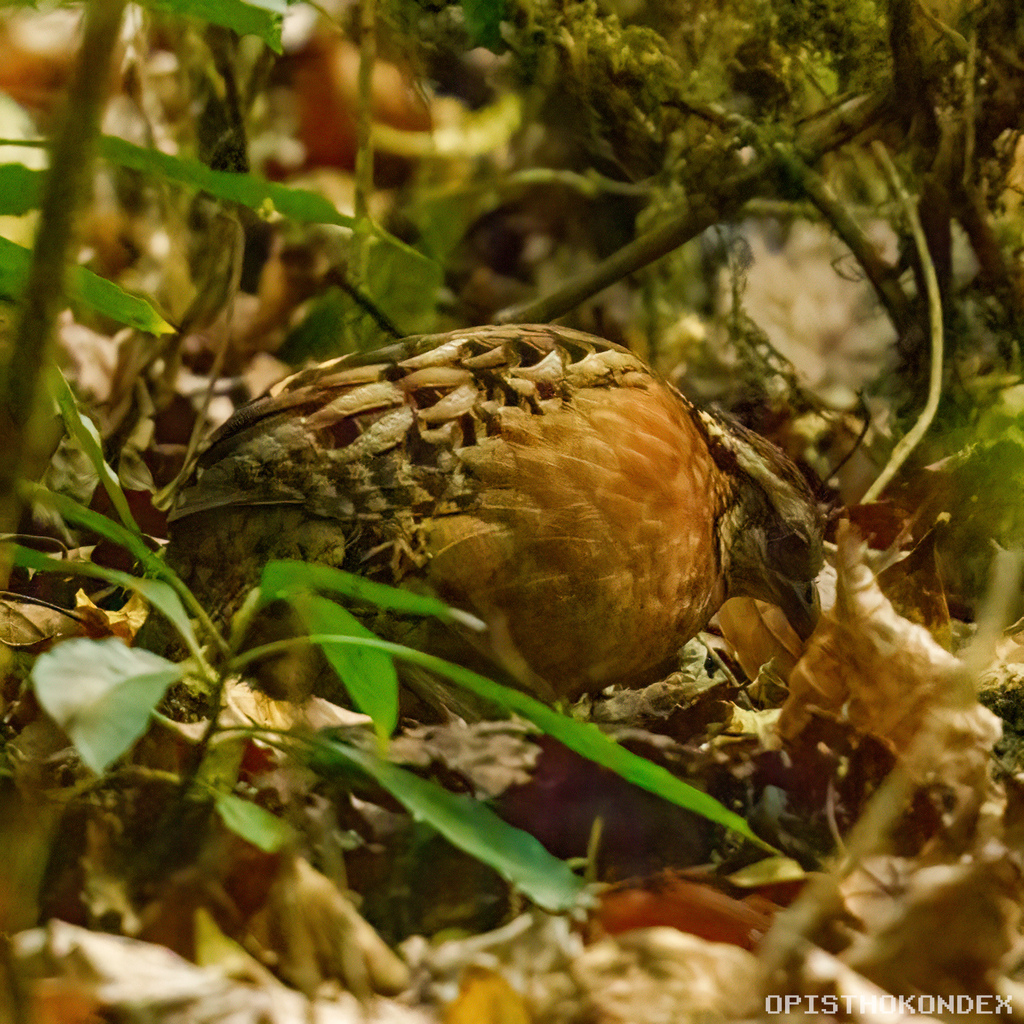
Singing Quail
Photo © Alberto Sánchez
Photo © Alberto Sánchez — CC BY 4.0 — Source: iNaturalist #152777605Identification
The singing quail is a small quail measuring 20 to 23 cm in length, with males weighing considerably more than females (180 to 266 g compared to 115 to 206 g). Males of the nominate subspecies are distinctive, featuring a dark brown crown, buff and black "collar," and a tawny orange face with a characteristic black streak behind the eye. The back and wings are mottled gray and brown with thin white streaks, while the rump is olive brown or gray with black vermiculation. The breast and belly are grayish brown with white streaks, and the lower belly is white.
Females present a notably different appearance, with a gray face, white throat, and paler brown breast and flanks. Juveniles resemble females but show blackish spots on the underparts. The species encompasses 11 recognized subspecies with considerable variation; birds inhabiting mountain forests tend to be darker than those in drier lowlands. Size also varies geographically, with the smallest birds found near sea level and larger individuals in mountainous regions.
Range & Habitat
The singing quail is found across a fragmented range spanning northern, western, and southern Mexico, the Yucatán Peninsula, northern Belize, much of Guatemala, and spottily in El Salvador and Honduras. This species inhabits the forest floor with sparse undergrowth, as well as older secondary forest, forest edges, clear cuts, and coffee plantations. It thrives in subtropical montane forest and cloudforest environments.
The species demonstrates remarkable altitudinal range, occurring from sea level to at least 3,000 meters elevation, showcasing its adaptability to diverse highland and lowland conditions across Central America and Mexico.
Behaviour & Diet
The singing quail typically forages in small coveys of three to five birds, though groups of up to 12 have been recorded. These birds scratch through leaf litter and soil searching for bulbs, seeds, and insects. The species is named for its distinctive vocalization—a loud, far-carrying, rhythmic song that commences with hesitant, plaintive whistles, which increase in frequency and pitch into a rapidly delivered series on varying notes. Multiple covey members may sing together, and they maintain contact with weak twittering calls.
Breeding occurs from February to October, with broods of two to four chicks documented in Yucatán, though detailed breeding ecology remains poorly studied. The species appears capable of withstanding habitat destruction and fragmentation better than other Middle American quails.
Best Time & Places to See It
February through October represents the breeding season when singing quails are most vocal and detectable, making this the optimal period for locating them. The species is locally common across its range, with Guatemala and the Yucatán Peninsula offering reliable opportunities. Coffee plantations and forest edges provide accessible habitat where these ground-dwelling birds can be encountered.
Early morning hours typically offer the best chance of hearing their distinctive loud song, which carries considerable distances through forest and plantation habitats. Patience and careful listening are essential, as these birds remain predominantly on the forest floor.
Photography Tips
Photographing singing quails presents challenges due to their terrestrial habits and preference for dense forest floor vegetation. Dawn hours provide the best lighting for photography while coinciding with peak vocalization periods. Position yourself near forest edges, clear cuts, or coffee plantations where visibility is improved over dense primary forest.
Since these birds forage on the ground and scratch through leaf litter, remain patient and motionless to avoid flushing coveys. The males' striking facial patterns and coloration reward successful encounters, but working slowly and allowing birds to approach naturally will yield the best photographic results. Use of recorded calls or patience during peak dawn vocalization periods increases the likelihood of close approach.
Dzibilchantún National Park
Barcelona, Mexico
+144 birds+2 mammals
Across the limestone plains of Yucatán, where cenotes pierce the bedrock and tropical forest clings to shallow soils, lies Dzibilchantún—a modest yet ecologically vital national park…
VIEW NATIONAL PARKLagunas de Montebello National Park
Laguna de Montebello, Mexico
+360 birds+2 mammals
Where turquoise lagoons pierce the limestone plateau of southeastern Chiapas, the Lagunas de Montebello National Park unfolds across roughly 174 square kilometers of spectral water and…
VIEW NATIONAL PARKSian Ka’an
Chunyaxché, Mexico
+350 birds+16 mammals
Where the Yucatán Peninsula dissolves into wetland and mangrove, a vast mosaic of forest, lagoon, and coastal margin creates one of Mexico's most biodiverse strongholds. Across…
VIEW BIOSPHERE RESERVETikal National Park
Tikal, Guatemala
+399 birds+16 mammals
Dense rainforest canopy rises above the limestone plateau of Petén, where archaeological wonder and ecological richness merge seamlessly across one of Central America's most biodiverse landscapes.…
VIEW NATIONAL PARKNo community photos yet. Log in to add the first one.
No community observations of this species yet.