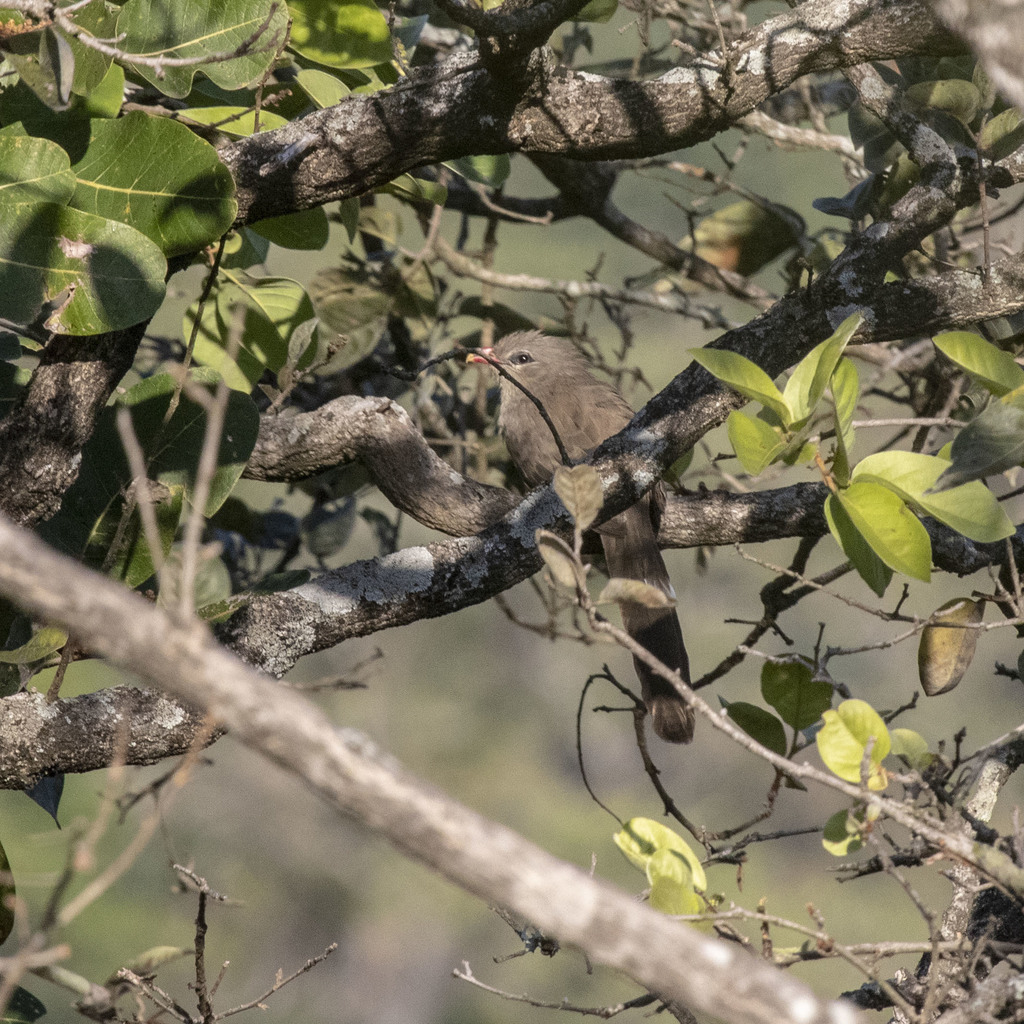
Sirkeer Malkoha
Photo © Paulmathi Vinod
Photo © Paulmathi Vinod — CC BY 4.0 — Source: iNaturalist #92319666Identification
The sirkeer malkoha is a distinctive non-parasitic cuckoo measuring 42–44 centimetres in length, easily recognised by its most striking feature: a curved red bill tipped with yellow. The bird's plumage is predominantly dark olive brown on the back, wings, and central tail feathers, with a rufous underside and a white-tipped, graduated tail. A greenish gloss adorns the wings and darker tail feathers, while dark shafts create prominent streaks on the pale breast. The eyes are particularly notable, rimmed with long, curved bristles that resemble eyelashes—an adaptation protecting the eyes when creeping through dense vegetation. A dark bare patch of skin around the eye, tapering behind it, accentuates the eye's size. The legs are grey, and the iris is reddish brown. Males and females are identical in plumage.
Range & Habitat
The sirkeer malkoha is found throughout the Indian subcontinent, including Bangladesh and Sri Lanka, with patchy distribution in Pakistan and Rajasthan. The species has shown range expansion in recent times, thought to have moved into the Sind region in the 1930s following canal irrigation development. Three subspecies are recognised: the nominate form occupies Peninsular India and extends into Sri Lanka, populations in northwestern India (Rajasthan, Gujarat and Sind) are paler with yellowish throats and breasts, while Eastern Himalayan birds are darker and larger.
These birds favour dry scrub forest and open woodland habitats, typically at elevations below about 1500 metres. They are particularly drawn to rocky, hilly terrain where they can forage on or near the ground amongst grasses and bushes.
Behaviour & Diet
The sirkeer malkoha is remarkably quiet, living up to its reputation as one of the silent members of the cuckoo family. When vocalising, it produces a low buzzing call or sharp, repeated kik or kek sounds reminiscent of rose-ringed parakeets. The bird's behaviour is distinctive: it forages singly or in pairs, creeping through dense vegetation on or close to the ground with a movement remarkably similar to that of a mongoose. When disturbed, it typically creeps through bushes and runs rather than flies, as its flight is weak.
Diet comprises caterpillars, insects and other invertebrates, small vertebrates, and occasionally berries and seeds. Unlike many cuckoos, the sirkeer malkoha is non-parasitic, building its own nest—a broad saucer of twigs placed low in bushes or trees and lined with green leaves. The breeding season spans March to August, with clutches of two to three pale yellowish-brown eggs. Courtship involves elaborate displays of bowing with splayed, upright tails and puffed plumage, followed by raising the head high with the bill pointed upward.
Best Time & Places to See It
The sirkeer malkoha's silent nature and ground-dwelling habits make it challenging to locate, though patient observers in appropriate habitat may spot one creeping through rocky scrub. The breeding season from March to August offers the best opportunity, when birds are more active. The species is distributed widely across dry scrub forests and rocky woodland throughout the Indian subcontinent, with populations varying by region and subspecies.
Photography Tips
Photographing this elusive species requires patience and fieldcraft. Look for movement in rocky scrub and low bushes where the bird forages. The distinctive red and yellow bill is a key identification feature worth capturing clearly. The bird's habit of running along the ground and creeping through vegetation provides opportunities for action shots, though the weak flight means flight photography is unlikely. Early morning may increase your chances of locating active birds before the heat of the day. The long tail and rufous underside provide striking compositional elements when the bird is visible.
Lunugamvehera National Park
Sri Lanka
+204 birds+14 mammals
Dry scrubland and shallow wetlands converge in Sri Lanka's southeastern lowlands, where Lunugamvehera National Park anchors one of the island's most ecologically vital landscapes. The park's…
VIEW NATIONAL PARKRanthambhore National Park
Sawai Madhopur, India
+294 birds+20 mammals
Granite ridges and ravines carved through the Aravalli Range frame this protected landscape in eastern Rajasthan, where deciduous forest mingles with open scrubland and seasonal water…
VIEW NATIONAL PARKKanha Tiger Reserve
Kanha Kisli F.V., India
+321 birds+23 mammals
Where sal forests give way to emerald meadows and crystalline streams carve through ancient valleys, one of India's finest wilderness reserves unfolds across the Maikal Range.…
VIEW NATIONAL PARKTadoba National Park
Palasgaon Singru, India
+270 birds+20 mammals
Where sal forests meet open grasslands and rocky outcrops rise from red laterite soil, central India's landscape unfolds in raw, untamed beauty. Ancient teak woodlands and…
VIEW NATIONAL PARKBandhavgarh National Park
Garhpuri, India
+285 birds+17 mammals
Where granite ridges rise dramatically above sal and bamboo forests, one of India's most pristine tiger reserves unfolds across the Vindhyan plateau. Ancient rock formations tower…
VIEW NATIONAL PARKPanna National Park
Badgadi Kalan, India
+271 birds+17 mammals
Where granite gorges slice through central India's Vindhyan plateau, a landscape of stark beauty unfolds across nearly six hundred square kilometers. The Ken River carves through…
VIEW NATIONAL PARKKeoladeo National Park
Shreenagar Rural, India
+326 birds+14 mammals
Where shallow wetlands shimmer beneath vast Rajasthani skies, one of Asia's finest bird sanctuaries pulses with extraordinary life. This former maharaja's hunting reserve, now spanning 29…
VIEW NATIONAL PARKPeriyar National Park
Mlappara, India
+232 birds+4 mammals
Dawn breaks over mist-shrouded ridges where the Western Ghats tumble toward Kerala's spice-scented lowlands. Here, ancient tropical forests envelope a glittering artificial lake, creating a mosaic…
VIEW NATIONAL PARKPampadum Shola National Park
Vattavada, India
+258 birds+14 mammals
Where misty shola forests cling to the high plateaus of the Nilgiri Mountains, ancient evergreen remnants create a world apart. This 2,316-hectare reserve protects one of…
VIEW NATIONAL PARKBandipur National Park
Hirehalli, India
+302 birds+19 mammals
Where the Western Ghats descend into the Deccan plateau, ancient deciduous forests blanket a landscape carved by the Nugu River. Bandipur unfolds across 880 square kilometres…
VIEW NATIONAL PARKNagarahole Tiger Reserve
Nalkeri Forest, India
+323 birds+23 mammals
Where granite escarpments rise above dense deciduous forests and the Kabini River carves through pristine wilderness, one of India's most biodiverse landscapes unfolds across the Western…
VIEW NATIONAL PARKGir National Park
Asundrali, India
+258 birds+13 mammals
Dry deciduous forests cloak the rolling hills of western Gujarat where the Gir landscape rises as a final sanctuary for one of the world's rarest felids:…
VIEW NATIONAL PARKNo community photos yet. Log in to add the first one.
No community observations of this species yet.